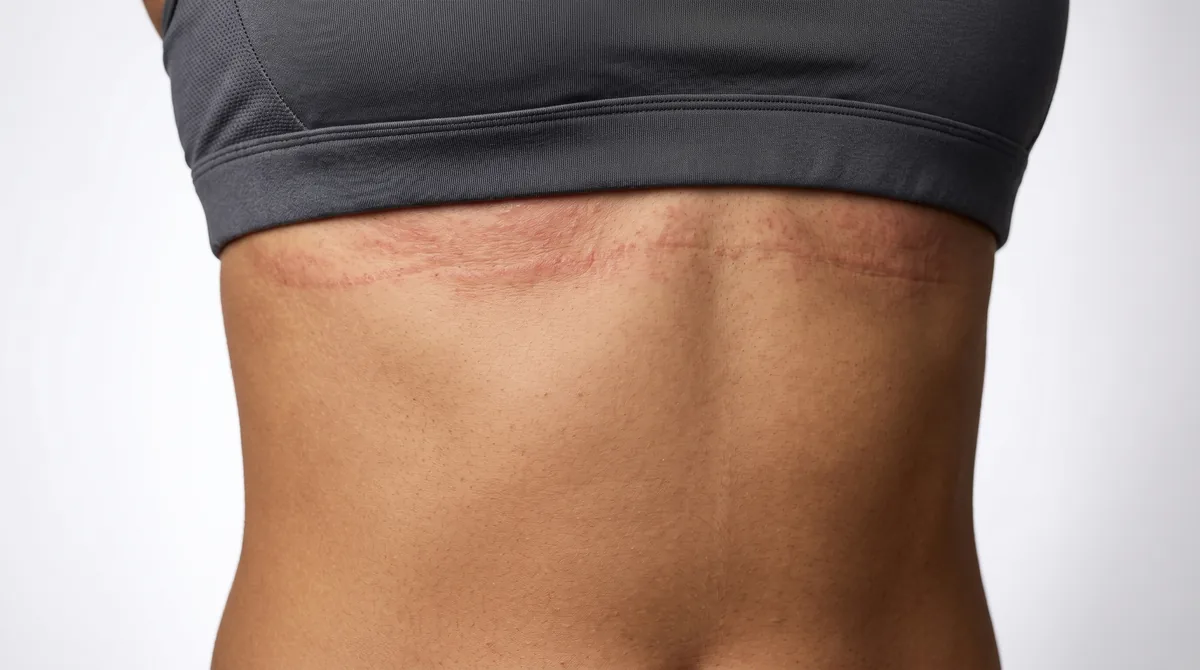
You’ve switched sports bras three times. You’ve tried different fabrics, different brands, different levels of compression. The rash under your bust keeps coming back. Red, itchy, sometimes burning. Worse after outdoor runs. Worse in the summer. You’ve blamed the heat, the sweat, the friction. And you’re partly right. But there’s a third factor most women miss entirely.
The detergent residue trapped in your sports bra fabric. In hard water conditions common across the Gulf region, Arizona, and Southern California, laundry detergent doesn’t rinse clean. It bonds with minerals in the water and creates soap scum that embeds itself in synthetic moisture-wicking fabrics. Then you put that fabric against damp skin, add friction from movement, and create the perfect environment for contact dermatitis. This article contains affiliate links. See our affiliate disclosure for details.
Sports bra dermatitis isn’t one problem. It’s three problems happening at once: mechanical friction from the elastic and seams, occlusive moisture from sweat that can’t evaporate, and chemical irritation from detergent residue your washing machine never fully removed. Understanding this triangle changes how you prevent it.
The Hard Water Laundry Problem Nobody Mentions
Here’s what happens when you wash synthetic athletic wear in hard water. The calcium and magnesium ions in the water bind with the surfactants in your detergent. Instead of rinsing away, they form insoluble complexes that deposit onto fabric fibers. Synthetic fabrics like polyester, nylon, and spandex have a slight negative charge that attracts these positively charged mineral-soap deposits.
The deposits don’t feel crusty or visible when the fabric is dry. But the moment you start sweating, those residues reactivate. They become slightly alkaline and abrasive against damp skin. Add friction from movement and compression from the elastic band, and you’ve created a mechanical-chemical irritation that breaks down your skin barrier within 30 minutes of starting your workout.
This is why the rash often appears in a perfect line along the band. It’s not just friction. It’s friction plus chemical irritation from reactivated detergent residue. The American Academy of Dermatology notes that hard water can leave residues on skin and fabrics that contribute to irritation, though they don’t specifically address athletic wear.
If you’re using a chelating shampoo like Regrowth+ for your hair to remove mineral buildup, the same principle applies to your laundry. You need a product that breaks the mineral-detergent bond, not just more detergent.
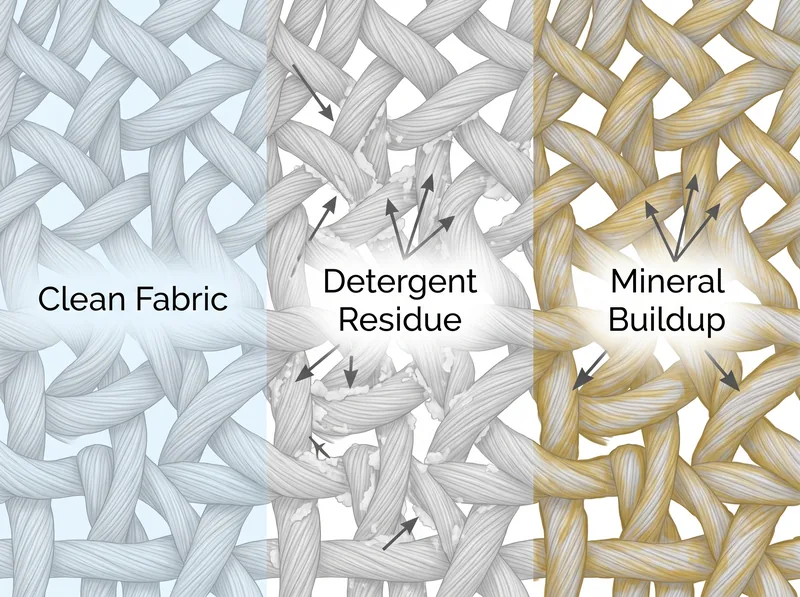 Hard water prevents complete detergent rinsing, leaving mineral-soap complexes trapped in synthetic fabric weave
Why Moisture-Wicking Fabric Makes It Worse
Moisture-wicking fabrics are designed to pull sweat away from your skin and spread it across the fabric surface for faster evaporation. That’s the theory. In practice, when you’re exercising in 40-degree heat with 60% humidity, evaporation doesn’t happen fast enough. The fabric stays damp against your skin for the entire workout.
Damp skin is more vulnerable to friction damage. The outer layer of your skin (stratum corneum) softens when wet, making it easier for mechanical forces to cause micro-tears and inflammation. This is called friction blister formation in sports medicine, but it happens at a microscopic level long before you see an actual blister.
The under-bust fold is particularly vulnerable because it’s an occlusive environment. The skin-to-skin contact plus the tight sports bra band creates a sealed pocket where moisture can’t escape. Bacteria and yeast thrive in warm, moist, occluded areas. What starts as friction dermatitis can quickly develop a secondary fungal or bacterial component if the area stays damp for hours.
This is why the rash often smells slightly sour or yeasty. It’s not just sweat. It’s microbial overgrowth in a compromised skin barrier. Research on textile dermatitis shows that occlusive synthetic fabrics can alter skin pH and microbiome composition, creating conditions for opportunistic infections.
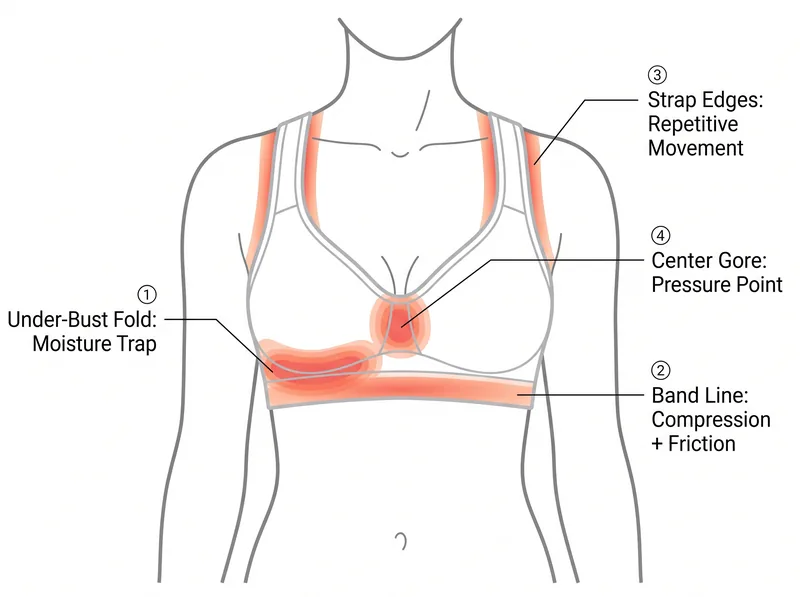 High-risk zones: under-bust fold, band line, strap edges, and center gore where moisture and friction combine
The Friction Zones: Where Dermatitis Develops
Not all parts of your sports bra cause equal irritation. There are four high-risk zones where friction, compression, and moisture combine to break down skin. The under-bust fold is the most common site because it experiences all three factors simultaneously. The skin is naturally folded, creating a moisture trap. The elastic band compresses and moves with every breath and step. And if you’re larger-chested, there’s additional weight creating downward pressure.
The horizontal band line around your ribcage is the second most common site. This is where you see the perfect linear rash that mirrors the elastic band. The repetitive friction from the band moving slightly with each movement creates a wearing-down effect on the skin. If there’s detergent residue in that elastic, you’re adding chemical irritation to mechanical irritation.
The shoulder straps cause a different pattern of irritation. Instead of a linear rash, you’ll see redness and sometimes small bumps along the strap path, especially where the strap curves over the shoulder. This is from repetitive movement friction, worsened if the straps are too tight or if you’re carrying a heavy bag that presses the strap into your skin.
The center gore (the piece of fabric between the cups) can cause a pressure-point irritation, especially if the sports bra doesn’t fit properly. This area doesn’t get much airflow and can trap sweat. If you’re noticing irritation here, it’s often a sign the bra is too small or the wrong style for your breast shape.
The Detergent Residue Solution
Switching to a sports-specific detergent won’t solve this if you’re washing in hard water. You need to address the mineral content first. Add a half-cup of white vinegar to the rinse cycle. The acetic acid in vinegar helps break down mineral deposits and soap scum, allowing them to rinse away instead of embedding in fabric.
Alternatively, use a laundry additive designed for hard water, like Calgon or borax. These products contain water softeners that bind to calcium and magnesium ions, preventing them from forming complexes with your detergent. Add them to the wash cycle before adding detergent.
Cut your detergent amount in half. In hard water, more detergent doesn’t mean cleaner clothes. It means more residue. Use the minimum amount needed, and if your athletic wear doesn’t smell fresh after washing, the problem is mineral buildup preventing the detergent from working, not insufficient detergent.
Run an extra rinse cycle. Most washing machines have this option. It adds 10 minutes to your wash time but ensures more complete removal of detergent and mineral deposits. For sports bras and other close-contact athletic wear, this extra rinse is worth it.
Consider hand-washing your sports bras in distilled water once a month. Fill a basin with warm distilled water (not tap water), add a tiny amount of gentle detergent, wash, and rinse thoroughly in clean distilled water. This gives you a true clean without any mineral interference. You’ll notice the fabric feels softer and less stiff.
Fabric Choice and Fit Adjustments
Not all moisture-wicking fabrics are created equal. Look for sports bras with mesh panels in high-sweat zones like the under-bust band and between the shoulder blades. Mesh allows actual airflow, not just moisture spreading. Brands like Lululemon, Athleta, and Sweaty Betty design sports bras with strategic ventilation.
Avoid sports bras with thick elastic bands. The wider and thicker the band, the more surface area for friction and the less airflow. A band that’s 2-3 inches wide is usually sufficient for support without creating an occlusive seal. If you need more support, look for styles with internal structure (like underwire or molded cups) rather than relying solely on band compression.
Seams matter more than you think. Flat-lock seams lie flush against skin and cause less friction than traditional raised seams. Check the inside of the sports bra before buying. If you can feel rough seam edges with your finger, you’ll definitely feel them during a 5K run.
Size up if you’re between sizes. A too-tight sports bra creates more compression and friction than necessary. Yes, you want support, but you don’t want a tourniquet. The band should be snug but not leave deep red marks that last more than a few minutes after removal. If you’re seeing lasting indentations or skin texture changes, the bra is too tight.
Natural fiber blends can help, but they’re not magic. Cotton blends absorb moisture instead of wicking it, which means they stay wet longer. Bamboo and modal fabrics are softer and less irritating than pure synthetics, but they also retain moisture. There’s no perfect fabric. You’re choosing between different trade-offs.
Skin Barrier Protection Before and After
Apply a barrier cream before your workout. Products like Aquaphor, CeraVe Healing Ointment, or even plain petroleum jelly create a protective layer between your skin and the fabric. Focus on the under-bust fold and along the band line. This won’t stop all friction, but it reduces the mechanical damage and prevents moisture from softening your skin as quickly.
Anti-chafing balms designed for runners work well. Brands like Body Glide or Squirrel’s Nut Butter create a dry, slippery barrier that reduces friction without feeling greasy. Apply them anywhere the sports bra touches skin, especially in areas where you’ve had rashes before.
Shower immediately after your workout. Don’t sit in sweaty workout clothes. The longer damp fabric sits against compromised skin, the higher the risk of bacterial or fungal overgrowth. If you can’t shower right away, at least remove the sports bra and dry the under-bust area thoroughly with a clean towel.
Use a gentle, fragrance-free cleanser in the shower. Avoid harsh soaps or body washes with sulfates, which can further strip your already-compromised skin barrier. Ceramide-based cleansers help maintain skin barrier integrity even when you’re washing frequently.
Apply a barrier-repair moisturizer after showering. Look for products containing ceramides, niacinamide, or colloidal oatmeal. These ingredients help rebuild the lipid barrier and reduce inflammation. CeraVe, La Roche-Posay Cicaplast, and Aveeno Eczema Therapy are all good options. Apply while your skin is still slightly damp to lock in moisture.
When It’s More Than Just Irritation
If the rash doesn’t improve with these changes within two weeks, see a dermatologist. What looks like simple friction dermatitis can sometimes be contact allergic dermatitis (an allergy to a specific fabric dye or chemical treatment), seborrheic dermatitis (especially in the under-bust fold), or even inverse psoriasis.
Signs you need medical evaluation: the rash is oozing or crusting, it’s spreading beyond the sports bra contact areas, it’s extremely itchy (worse than you’d expect from friction alone), or you’re developing small fluid-filled bumps. These suggest infection or an allergic reaction that needs prescription treatment.
Fungal infections are common in the under-bust fold, especially in humid climates. If the rash has a defined border, is slightly scaly, and smells yeasty, it’s probably candida or another fungal infection. Over-the-counter antifungal creams like clotrimazole or miconazole can help, but if it doesn’t clear in a week, you need a prescription-strength treatment.
Some women develop a true contact allergy to formaldehyde resins used in wrinkle-resistant or moisture-wicking fabric treatments. The AAD notes that textile contact dermatitis can develop even to fabrics you’ve worn before without problems. Patch testing by a dermatologist can identify the specific allergen.
References
- Hard Water Effects on Skin and Hair - American Academy of Dermatology
- Textile Dermatitis: An Update - PubMed Central
- Contact Dermatitis: Diagnosis and Treatment - American Academy of Dermatology
- Friction Blisters: Pathophysiology, Prevention and Treatment - Sports Medicine Journal