
You step into your office building and within an hour, your face feels tight. By lunch, you’re reaching for moisturizer again. By 3 PM, the skin around your nose is flaking and your lips are cracked despite the lip balm you applied twice already.
It’s not just you. And it’s not your skincare routine failing. The problem is the air itself.
Air conditioning doesn’t just cool the air. It strips moisture from it, creating an indoor environment drier than many deserts. The US EPA notes that indoor humidity in air-conditioned spaces often drops to 20-30%, well below the 40-60% range where skin maintains healthy barrier function. In the Gulf, where outdoor humidity sits at 60-80% and indoor AC runs year-round at aggressive settings, the contrast creates a skin crisis most women don’t connect to their environment.
This article is medically reviewed by Dr. Layla Hassan, Trichologist.
Here’s what’s actually happening to your skin, why the damage compounds over time, and what you can do about it without quitting your job or moving to a humid climate.
Key Takeaways
• Air-conditioned offices typically maintain 20-30% humidity, far below the 40-60% your skin needs to function properly
• Low indoor humidity accelerates transepidermal water loss (TEWL), causing barrier damage that worsens throughout the workday
• The humidity swing between outdoor Gulf conditions (60-80%) and indoor AC creates repeated barrier stress that traditional moisturizers can’t fully address
• Protecting skin in AC environments requires layered hydration: humectants to attract moisture, occlusives to seal it in, and environmental humidity support
• Small changes like desk humidifiers, strategic product layering, and hydration timing can significantly reduce AC-related skin damage
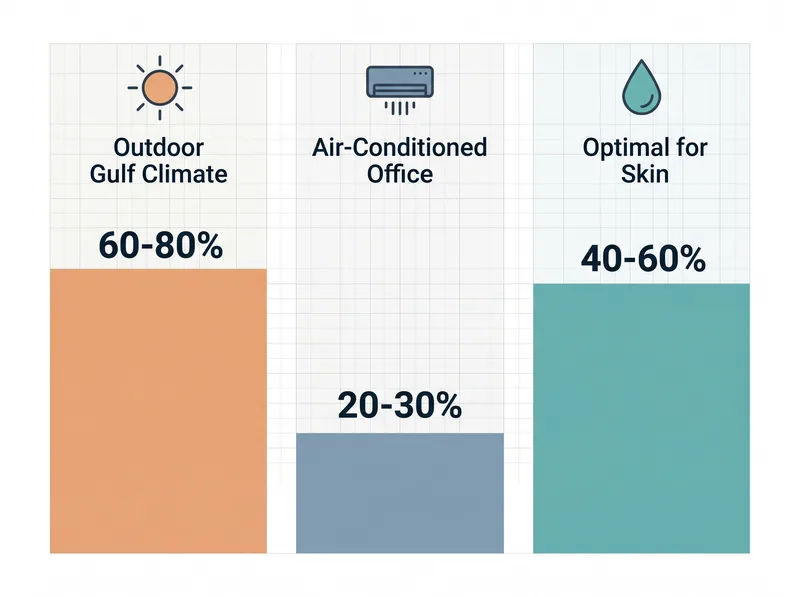 How AC humidity levels compare to what your skin actually needs
The Science of What AC Actually Does to Air
Air conditioning works by removing heat and moisture from indoor air. The process is simple: warm air passes over cold evaporator coils, water vapor condenses out, and drier, cooler air circulates back into the room.
In moderate climates, this moisture removal is manageable. In the Gulf, where AC units run continuously at maximum capacity to combat 45-degree outdoor heat, the moisture extraction is relentless.
Research published in the International Journal of Environmental Research and Public Health found that indoor humidity levels in heavily air-conditioned buildings can drop as low as 15-25%, comparable to arid desert conditions. Your office isn’t just cool. It’s climatically hostile to skin barrier function.
The problem intensifies in open-plan offices with central AC systems. These systems prioritize temperature control over humidity balance, and individual comfort adjustments aren’t possible. You’re stuck in an environment improved for cooling efficiency, not human skin health.
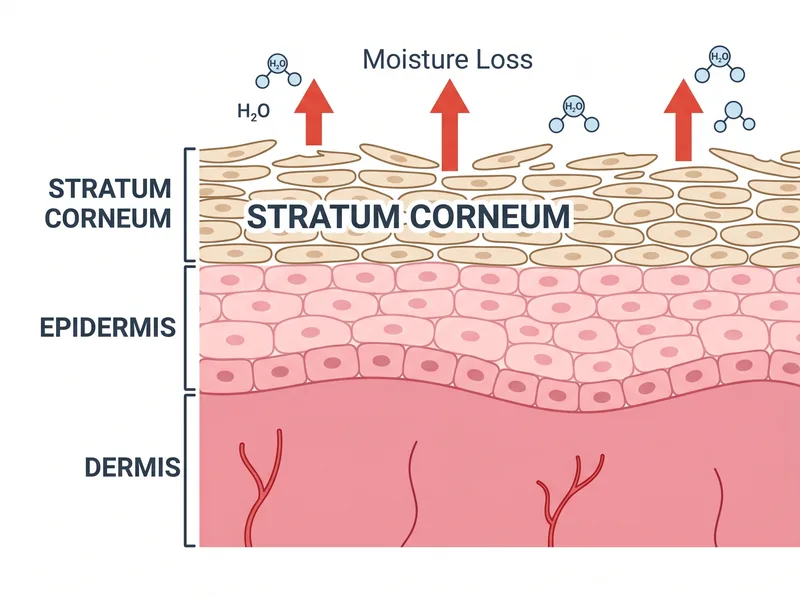 What happens to your skin barrier when indoor humidity drops below 30%
How Low Humidity Damages Your Skin Barrier
Your skin’s outermost layer, the stratum corneum, functions like a brick wall. Skin cells are the bricks, lipids (ceramides, cholesterol, fatty acids) are the mortar. This structure keeps moisture in and irritants out.
When humidity drops below 40%, the lipid mortar begins to crack. Water evaporates from skin cells faster than your body can replace it, a process called transepidermal water loss (TEWL). A study in the British Journal of Dermatology showed that TEWL increases by 25-30% when indoor humidity drops from 50% to 30%.
The damage isn’t just surface-level dryness. Compromised barrier function triggers inflammation, increases sensitivity, and makes skin more vulnerable to irritants. Over weeks and months, chronic low humidity exposure leads to persistent barrier dysfunction that regular moisturizer can’t fully repair.
In the Gulf, you’re dealing with a double assault. Outdoor humidity is high, so your skin barrier adapts to retain less moisture naturally. Then you step into 20% humidity AC for eight hours. Your barrier can’t adjust fast enough, and the moisture loss accelerates.
Why Your Current Moisturizer Isn’t Enough
Most moisturizers are formulated for moderate climates with relatively stable humidity. They’re designed to supplement your skin’s natural moisture retention, not to compensate for an environment actively stripping moisture away.
In low-humidity AC environments, lightweight lotions evaporate almost as fast as you apply them. Even heavier creams struggle because they’re fighting constant moisture extraction. It’s like trying to fill a bucket with a hole in the bottom.
The solution isn’t just more moisturizer. It’s a different approach to hydration that accounts for environmental moisture loss. You need products that attract moisture from deeper skin layers (humectants like hyaluronic acid and glycerin), products that prevent evaporation (occlusives like squalane and ceramides), and ideally, environmental humidity support.
This is where ceramides for barrier repair become critical. They don’t just hydrate; they rebuild the lipid structure that low humidity damages.
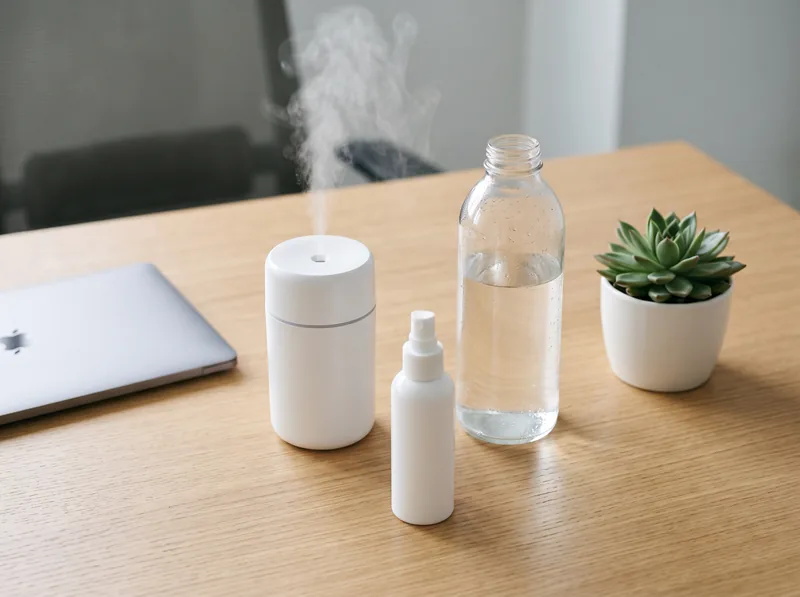 A practical desk setup for maintaining skin hydration in air-conditioned environments
The Cumulative Effect: Why It Gets Worse Over Time
Skin barrier damage from low humidity isn’t immediately obvious. Day one, you notice tightness. Day three, you see flaking. Week two, you’re dealing with sensitivity and redness. Month three, your skin texture has changed and nothing seems to work anymore.
This progression happens because barrier damage is cumulative. Each day of moisture loss weakens the lipid structure a bit more. Each night of attempted repair (when your skin naturally regenerates) can’t fully compensate for eight hours of environmental assault.
Research in the Journal of Clinical and Aesthetic Dermatology shows that chronic low humidity exposure leads to decreased ceramide production, reduced natural moisturizing factor (NMF), and impaired barrier recovery capacity. Your skin literally becomes less able to protect itself over time.
Women who work in air-conditioned offices year-round often report that their skin “changed” after moving to the Gulf, but they can’t pinpoint when. It’s not a sudden shift. It’s gradual barrier degradation from relentless environmental stress.
Practical Protection Strategies That Actually Work
Start with environmental modification where possible. A small desk humidifier (ultrasonic, 200-300ml capacity) can create a microclimate of higher humidity around your workspace. Mayo Clinic research suggests that maintaining 40-50% humidity in personal spaces significantly reduces skin moisture loss.
Layer your skincare strategically. Morning routine: hydrating serum with hyaluronic acid (applied to damp skin), followed by a moisturizer with ceramides and niacinamide, sealed with a thin layer of facial oil or occlusive. Midday: facial mist (not just water; look for formulas with glycerin or hyaluronic acid) followed by a light moisturizer reapplication.
Hydration from within matters more in low-humidity environments. You’re losing moisture through skin faster, so your water intake needs to increase. Aim for 3-4 liters daily in air-conditioned environments, more if you’re also dealing with outdoor heat exposure during commutes.
Protect your hands and lips aggressively. These areas have thinner skin and fewer sebaceous glands, making them more vulnerable to AC damage. Keep hand cream at your desk and reapply every time you wash your hands. Use a lip balm with occlusive ingredients (lanolin, shea butter, petrolatum) and reapply every 1-2 hours.
When to Suspect Your Skin Needs More Than Hydration
Sometimes what looks like AC-related dryness is actually a sign of deeper barrier dysfunction or an underlying condition. If you’re experiencing persistent redness, burning sensations, sudden sensitivity to products you’ve used for years, or skin that feels worse despite increased moisturizer use, you’re dealing with more than simple dryness.
Conditions like stress-related skin inflammation or rosacea can be triggered or worsened by low humidity environments. Eczema and seborrheic dermatitis also flare in dry conditions. If your skin doesn’t improve with hydration strategies within 2-3 weeks, see a dermatologist.
Pay attention to where the dryness appears. AC-related dryness typically affects the entire face, especially the cheeks, around the nose, and forehead. If you’re seeing isolated patches, asymmetric dryness, or areas that crack and weep, that’s not just environmental dryness.
The Gulf’s combination of hard water and aggressive AC creates a perfect storm for barrier damage. If you’re also dealing with scalp issues, hair texture changes, or body skin dryness, you’re likely experiencing systemic environmental stress that needs a more targeted approach.
References
- Indoor Air Quality and Environmental Health - US Environmental Protection Agency
- Effects of Indoor Humidity on Skin Barrier Function - International Journal of Environmental Research and Public Health
- Transepidermal Water Loss in Low Humidity Environments - British Journal of Dermatology
- Chronic Low Humidity and Skin Barrier Function - Journal of Clinical and Aesthetic Dermatology
- Humidifiers and Skin Health - Mayo Clinic