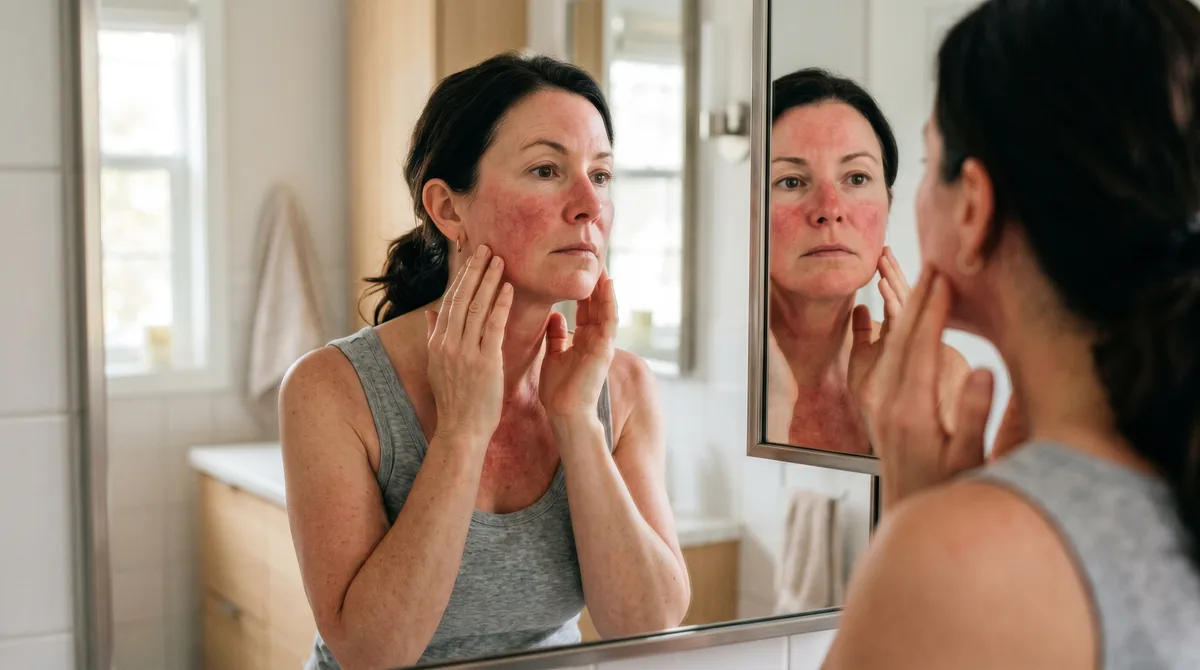
If you’ve started noticing that your face flushes deep red without warning, stays hot long after the room cools down, or develops a persistent ruddy tone that wasn’t there before, you’re not imagining it. Hot flashes don’t just make you feel overheated. They trigger visible, measurable changes in your skin that can last well beyond the initial flush.
This article contains affiliate links. See our affiliate disclosure for details.
Vasomotor symptoms, the clinical term for hot flashes and night sweats, cause rapid dilation of blood vessels near the skin’s surface. That’s the redness you see. But the cascade doesn’t stop there. The repeated thermal stress, combined with declining estrogen’s effect on collagen and barrier lipids, makes your skin more reactive to everything: heat, sun, products, even stress. And if you’re living in a climate where outdoor temperatures regularly hit 45 degrees, the environmental heat compounds the internal heat in ways that make management more urgent.
Medically reviewed by Dr. Layla Hassan, Trichologist and Dermatology Consultant.
Here’s what’s happening to your skin during vasomotor episodes, why the Gulf climate makes it worse, and what actually helps when hormones and heat collide.
What Hot Flashes Do to Your Skin (The Physiology)
A hot flash isn’t just a feeling. It’s a measurable event. Your core body temperature rises rapidly, sometimes by several degrees. Your heart rate increases. And your blood vessels, particularly the superficial capillaries in your face, neck, and chest, dilate suddenly to dissipate heat.
That dilation is what you see as flushing. The redness is blood flow. Your skin is doing exactly what it’s designed to do: release heat. But when this happens multiple times a day, often triggered unpredictably, your skin doesn’t get a chance to recover between episodes.
Research published in Menopause found that women experiencing frequent vasomotor symptoms show increased transepidermal water loss and reduced skin barrier function compared to women without hot flashes. The repeated thermal cycling, the sudden shifts from normal to overheated and back, changes the lipid structure in your skin’s outer layer.
Add declining estrogen, which directly affects collagen production, skin thickness, and sebum output, and you’ve got a barrier that’s structurally weaker and functionally more permeable. That’s why your skin might suddenly react to products it tolerated for years. The barrier can’t buffer irritants the way it used to.
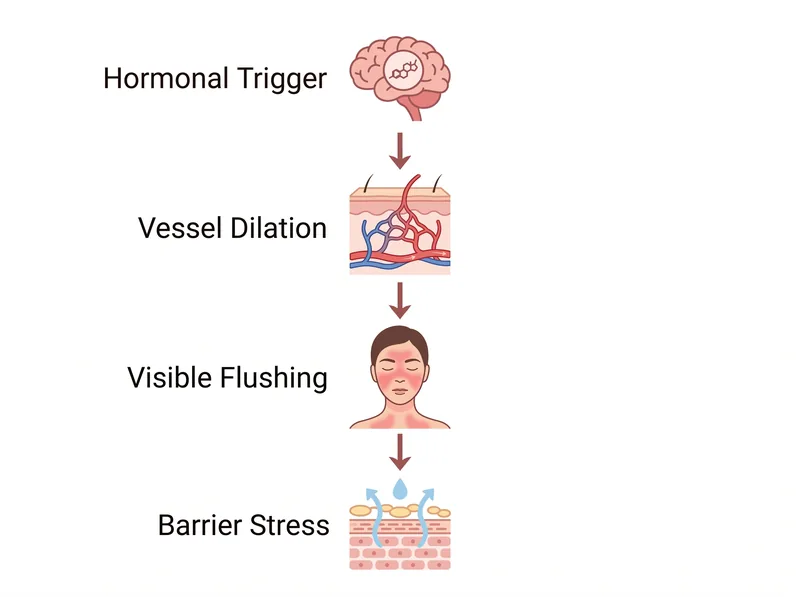 How vasomotor symptoms trigger visible skin reactions: the cascade from hormonal signal to facial flushing and barrier stress.
Why Gulf Heat Makes Vasomotor Symptoms Worse for Skin
If you’re managing hot flashes in a temperate climate, you can step outside to cool down. You can open a window. You can take a walk in cooler air. In the Gulf, that option doesn’t exist for six months of the year.
Outdoor temperatures above 40 degrees mean your skin is already working to dissipate environmental heat before the hot flash even starts. When the internal heat wave hits, your skin has no thermal margin left. You’re overheating from both directions.
The other issue is indoor air conditioning. The temperature differential between outside and inside can be 20 degrees or more. Your skin is cycling between extreme heat and artificial cold multiple times a day. That constant adjustment stresses the barrier, increases inflammation, and makes redness more persistent.
Women in the Gulf report that hot flashes feel more intense and last longer than they did in cooler climates. That’s not psychological. It’s environmental physics. Your body can’t cool efficiently when the ambient temperature is already at the upper limit of what your skin can manage.
The Redness That Doesn’t Go Away (Persistent Flushing)
Some women notice that even between hot flashes, their face stays redder than it used to. The cheeks look ruddy. The nose has a persistent pink tone. This isn’t rosacea, though it can look similar. It’s chronic vasodilation from repeated vasomotor episodes.
When blood vessels dilate frequently, they can lose some of their elasticity. They stay slightly dilated even when you’re not actively flushing. That’s the persistent redness. It’s more common in fair skin, but it happens across all skin tones. In deeper skin, it might appear as a darker, warmer tone rather than red.
A study in the Journal of the American Academy of Dermatology found that perimenopausal women with frequent hot flashes had significantly higher levels of visible facial redness and telangiectasia (visible broken capillaries) compared to age-matched controls without vasomotor symptoms.
This isn’t cosmetic. It’s a sign that your skin’s vascular system is under chronic stress. And it responds to management. When women treat the underlying vasomotor symptoms, either with hormone therapy or other interventions, the persistent redness often improves.
 A practical cooling protocol: products and tools that help stabilize skin temperature during vasomotor episodes.
Skincare That Helps During Vasomotor Episodes
Your skincare routine needs to do three things during this phase: cool the skin quickly, support the barrier, and avoid anything that increases inflammation. That’s a narrower target than general anti-aging skincare.
Start with a gentle, non-foaming cleanser. Foaming agents strip lipids, and your barrier is already compromised. A ceramide-rich cream cleanser or micellar water works better. Cleanse once daily unless you’re sweating heavily, in which case a quick rinse with cool water is enough.
For active flushing episodes, keep a facial mist in the fridge. Spray it on your face, neck, and chest when you feel a hot flash starting. The evaporative cooling helps, and if the mist contains niacinamide or centella asiatica, you’re getting anti-inflammatory benefits too.
Your moisturizer should be a lightweight gel or gel-cream with barrier-repair ingredients: niacinamide, ceramides, hyaluronic acid. Avoid heavy occlusives during the day. They trap heat. Save richer creams for nighttime if your skin tolerates them. A chelating shampoo like Regrowth+ can help if hard water is leaving mineral residue that irritates your already-sensitive scalp and hairline.
Avoid: retinoids during active flushing phases (they increase sensitivity), alcohol-based toners, physical exfoliants, hot water, and any product with fragrance or essential oils. Your skin doesn’t have the capacity to handle additional irritants right now.
The Sun Exposure Problem (And Why SPF Isn’t Enough)
Vasomotor symptoms increase your skin’s sensitivity to UV damage. The inflammation from repeated flushing makes your skin more vulnerable to hyperpigmentation, and the barrier changeion means UV penetrates deeper.
In the Gulf, where UV index regularly hits 11 or 12, this is a compounding problem. You need broad-spectrum SPF 50, applied generously, reapplied every two hours if you’re outdoors. But sunscreen alone isn’t enough.
You also need physical sun avoidance. That means staying indoors during peak UV hours (10 AM to 4 PM), wearing wide-brimmed hats, seeking shade, and using UV-blocking car window film. Think of sun protection as a system, not a single product.
The other issue is that many sunscreens feel heavy or greasy, which makes you feel hotter during a hot flash. Look for lightweight, gel-based mineral sunscreens or chemical sunscreens with a matte finish. Test them before committing to a full-size bottle.
Cooling Tools and Environmental Management
Skincare products help, but environmental management is just as important. Your skin can’t recover if it’s constantly overheated.
Keep a jade or rose quartz facial roller in the fridge or freezer. When you feel a hot flash starting, roll it across your face, neck, and chest. The cold stone provides immediate relief and helps constrict dilated blood vessels. Some women keep a small insulated bag with ice packs and a clean washcloth for quick cooling.
Set your bedroom temperature lower than you think you need. Nighttime hot flashes change sleep, which increases cortisol, which worsens skin inflammation. A cool room (around 18-20 degrees Celsius) helps. Use moisture-wicking bedding and keep a small fan on your nightstand.
During the day, dress in layers you can remove quickly. Natural fibers like cotton and linen breathe better than synthetics. Avoid high necklines and tight clothing around your chest and neck, where flushing is most visible.
If you work in an office, keep a small portable fan at your desk. It’s not vanity. It’s thermal management. Your colleagues might not understand, but your skin does.
When to Consider Medical Treatment
If hot flashes are happening more than a few times a day, changeing your sleep, or causing significant skin changes, talk to your doctor about treatment options. This isn’t something you have to endure.
Hormone replacement therapy (HRT) is the most effective treatment for vasomotor symptoms. It reduces the frequency and severity of hot flashes, which directly improves skin outcomes. The decision to use HRT is individual and depends on your medical history, but it’s worth discussing with a healthcare provider who specializes in menopause care.
Non-hormonal options include SSRIs (like paroxetine), gabapentin, and clonidine. They’re less effective than HRT but can reduce hot flash frequency by 40-60% in some women. There’s also emerging evidence for cognitive behavioral therapy (CBT) specifically designed for vasomotor symptoms.
The key point: if your skin is visibly affected, if you’re developing persistent redness or increased sensitivity, if your quality of life is impacted, treatment is appropriate. This isn’t cosmetic. It’s medical.
What Doesn’t Work (Common Mistakes)
Avoid ice directly on your face. It feels good in the moment, but it can cause capillary damage and rebound dilation. Always wrap ice in a cloth or use a proper cooling tool.
Don’t increase exfoliation to ‘fix’ the redness. Exfoliating acids (AHAs, BHAs) will make inflammation worse. Your skin needs support, not stripping.
Skip the heavy anti-aging serums with multiple actives. Retinoids, vitamin C, peptides, they’re all too much for skin in a vasomotor crisis. Simplify. Focus on barrier repair and cooling. You can reintroduce actives later when your skin stabilizes.
And don’t assume the redness is rosacea and start using rosacea treatments without a diagnosis. Vasomotor flushing and rosacea can coexist, but they’re not the same thing. See a dermatologist if you’re unsure.
References
- Vasomotor symptoms and skin barrier function in perimenopausal women - Menopause: The Journal of The North American Menopause Society
- Facial erythema and telangiectasia in women with menopausal hot flashes - Journal of the American Academy of Dermatology
- Estrogen and skin aging: the effects of estrogen deficiency on dermal structure - American Journal of Clinical Dermatology
- Management of vasomotor symptoms: clinical practice guidelines - The North American Menopause Society