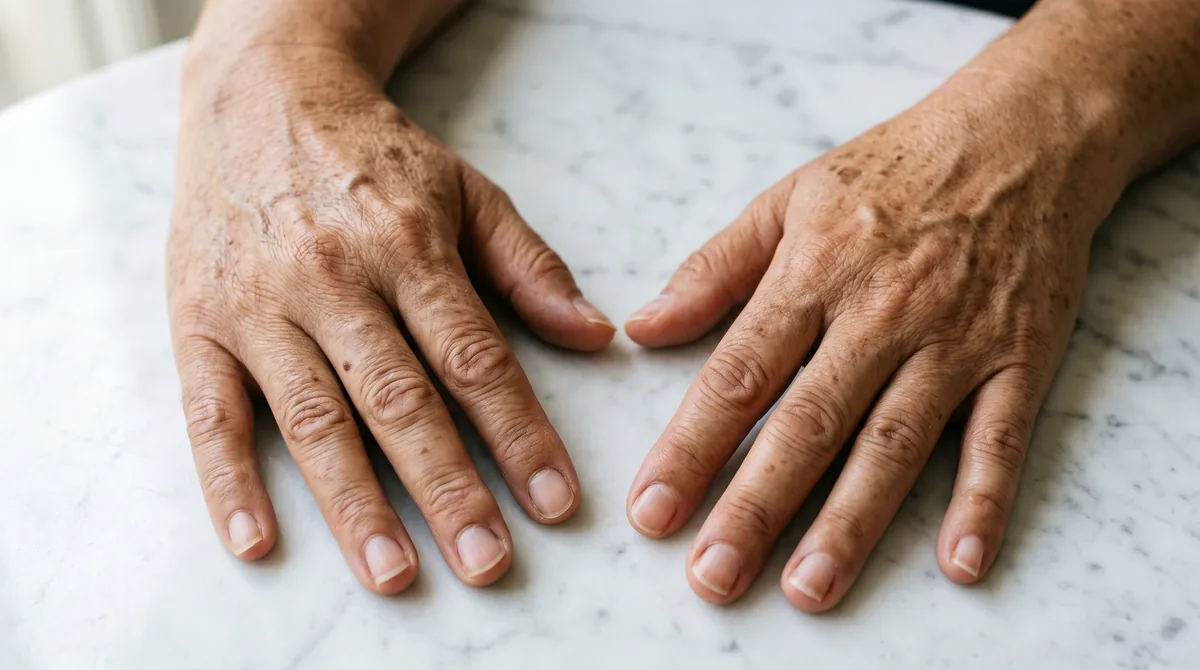
Your hands looked fine six months ago. Now they’re covered in brown spots you don’t remember getting. The skin feels papery when you touch it. Veins you never noticed are suddenly prominent. You’re not imagining it. Hands age faster here, and the combination of factors is specific to this environment.
The Gulf climate creates a perfect storm for accelerated hand aging. Intense UV exposure year-round damages DNA in skin cells. Hard water strips protective oils every time you wash your hands. The mineral residue left behind creates a barrier that prevents moisture absorption. Add chronic dehydration from heat exposure, and you’re looking at visible aging that happens faster than it would anywhere else.
This article contains affiliate links. See our affiliate disclosure for details.
Here’s what’s actually happening to your hands, why the standard advice doesn’t work in this climate, and the evidence-based treatments that reverse visible damage. Medically reviewed by Dr. Layla Hassan, Trichologist.
Why Hands Age Faster Than Facial Skin
Hands have thinner skin than your face. The dermis on the back of your hands is roughly 0.6mm thick compared to 1.2mm on your cheeks. That means less collagen, less elastin, and less natural protection from environmental damage. The same UV exposure that creates fine lines on your face creates deeper, more visible damage on your hands.
Hand skin also has fewer sebaceous glands. Your face produces natural oils that provide some barrier protection. Your hands don’t. Every time you wash them, you’re stripping what little protective barrier exists. In hard water, that washing also deposits calcium and magnesium minerals that create a film on the skin surface.
Research published in the Journal of Cosmetic Dermatology found that hands show photoaging signs an average of 10-15 years earlier than facial skin when sun protection isn’t used consistently. In high-UV environments, that timeline accelerates.
The backs of your hands are also constantly exposed. You might remember to apply sunscreen to your face, but hands touch surfaces, get wet, and are rarely reapplied to throughout the day. That cumulative UV damage adds up faster than most women realize.
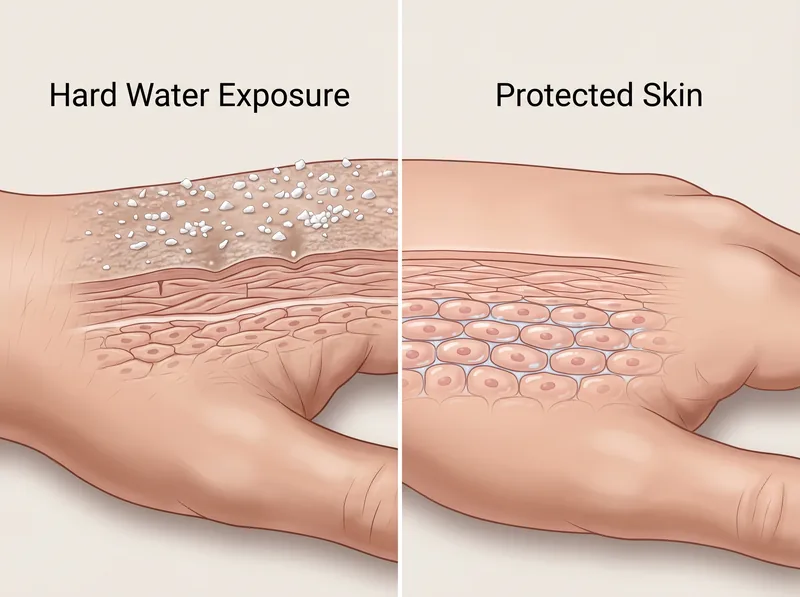 Hard water mineral buildup creates a barrier that prevents moisture absorption and accelerates visible aging
The Hard Water Effect on Hand Skin
Hard water doesn’t just affect your scalp. Every hand wash deposits the same mineral film that builds up on your hair. Calcium carbonate and magnesium sulfate bond to the skin surface, creating a barrier that prevents moisturizers from penetrating. You can apply hand cream five times a day and still have dry, rough skin because the product is sitting on top of mineral residue.
A study in the British Journal of Dermatology demonstrated that hard water exposure increases transepidermal water loss by up to 25% compared to soft water. That means your skin is losing moisture faster than it can retain it, even when you’re applying hydrating products.
The mineral buildup also creates a dull, ashy appearance on the skin surface. That’s not just dryness. It’s a physical layer of deposits that scatters light differently than healthy skin. Regular exfoliation helps, but it doesn’t address the underlying cause.
The same chelating approach that works for mineral buildup on hair applies to hand skin. Using a chelating cleanser like Regrowth+ once or twice a week removes the mineral film and allows your actual skincare products to penetrate properly.
UV Damage and Sunspot Formation
Sunspots aren’t age spots. They’re UV damage. The medical term is solar lentigines, and they’re caused by localized melanin overproduction in response to cumulative sun exposure. The melanocytes in your skin produce excess pigment as a protective response, but that pigment clusters in specific areas instead of distributing evenly.
In the Gulf, year-round UV index averages 8-11, even in winter months. That’s classified as very high to extreme. Your hands are exposed during every outdoor activity, every car ride with the window down, every walk from the parking lot. The damage is cumulative and irreversible without intervention.
Research from the American Academy of Dermatology shows that 90% of visible skin aging is caused by UV exposure. Hands, because they’re rarely protected, show this damage earlier and more severely than other body areas.
The spots you’re seeing now represent damage that occurred months or even years ago. Melanocytes have a delayed response to UV injury. That means the protection you start today prevents spots that would appear next year, but it doesn’t reverse what’s already visible. That requires active treatment.
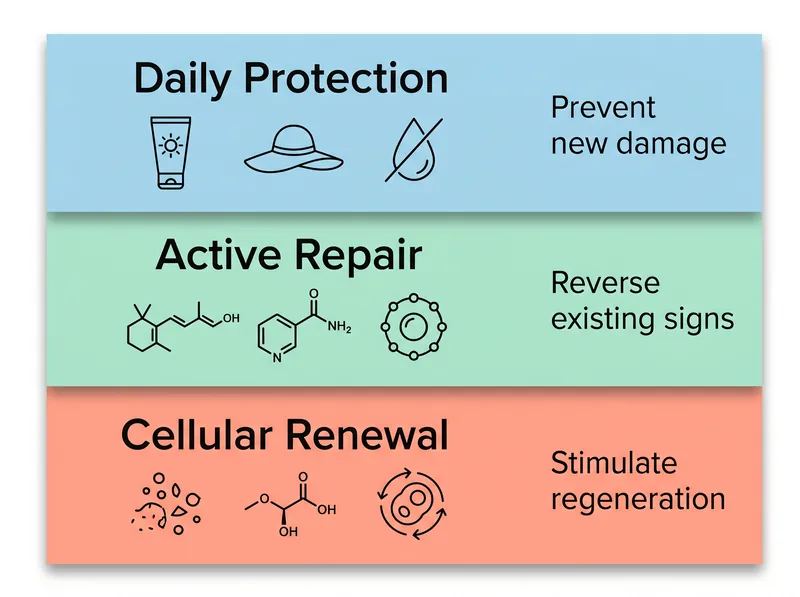 Effective hand rejuvenation requires addressing all three layers: daily protection, active repair, and cellular renewal
What Actually Reverses Visible Hand Aging
Reversal requires three simultaneous approaches: stopping new damage, repairing existing damage, and stimulating cellular renewal. None of them work in isolation. You can’t exfoliate away sunspots without sun protection. You can’t repair collagen without removing the mineral barrier preventing product penetration.
The most effective evidence-based treatments for hand aging are retinoids, vitamin C, niacinamide, alpha hydroxy acids, and broad-spectrum SPF 50+. Each targets a different mechanism of aging. Retinoids stimulate collagen production and accelerate cell turnover. Vitamin C inhibits melanin production and provides antioxidant protection. Niacinamide strengthens the skin barrier and reduces inflammation. AHAs exfoliate dead skin cells and improve product penetration.
A study in Dermatologic Surgery found that a combination of topical retinol and glycolic acid reduced the appearance of hand aging signs by 42% over 12 weeks when used consistently with daily sun protection. The key phrase is ‘with daily sun protection.’ Without it, you’re creating new damage as fast as you’re repairing old damage.
Professional treatments like chemical peels, laser therapy, and intense pulsed light can accelerate results, but they don’t replace daily topical care. They work by creating controlled injury that stimulates healing, but if you’re not protecting and maintaining results with home care, the improvement is temporary.
Building an Effective Hand Care Routine
Morning routine starts with cleansing hands with a gentle, pH-balanced cleanser. If you’re dealing with mineral buildup, use a chelating wash twice a week. Apply a vitamin C serum while skin is still damp. Follow with a niacinamide moisturizer. Finish with broad-spectrum SPF 50+ sunscreen on the backs of hands. Reapply sunscreen every two hours during outdoor exposure or after hand washing.
Evening routine focuses on repair. Cleanse hands thoroughly. Apply a retinol hand cream or serum. If you’re new to retinoids, start with 0.25% retinol three nights a week and gradually increase frequency as your skin adapts. Follow with a rich, occlusive hand cream containing ceramides and peptides. The occlusive layer seals in the active ingredients and prevents transepidermal water loss overnight.
Weekly treatments include a glycolic acid hand mask or peel once a week to accelerate cell turnover and improve product penetration. On the nights you use glycolic acid, skip the retinol. Don’t layer strong actives on the same night. That creates irritation without improving results.
The routine sounds intensive, but each step takes seconds. The consistency matters more than the time investment. You’re not going to see results from sporadic application. You need daily protection and nightly repair for a minimum of 12 weeks before visible improvement appears.
Ingredient Choices for Hot, Dry Climates
Not all formulations survive Gulf heat. Vitamin C serums oxidize faster in high temperatures. Look for stable derivatives like tetrahexyldecyl ascorbate or ascorbyl glucoside instead of L-ascorbic acid. Store vitamin C products in a cool, dark place, not on your bathroom counter.
Retinol stability also matters. Encapsulated retinol formulations protect the active ingredient from heat and light degradation. If your hand cream turns yellow or develops an off smell, the retinol has oxidized and is no longer effective. Replace it.
Niacinamide is one of the most stable actives in hot climates. It doesn’t degrade with heat exposure, it plays well with other ingredients, and it addresses multiple aging mechanisms simultaneously. It’s a workhorse ingredient that should be in every hand care routine here.
Sunscreen formulation matters more than SPF number. Chemical sunscreens can break down in extreme heat and high UV exposure. Mineral sunscreens with zinc oxide or titanium dioxide provide more stable protection, but they can leave a white cast on deeper skin tones. Look for tinted mineral formulas or newer micronized mineral sunscreens that blend more naturally.
When to Consider Professional Treatments
Home care reverses mild to moderate hand aging. If you have deep sunspots, significant volume loss, or prominent veins that bother you, professional treatments accelerate results. But they’re not magic. They work best when combined with consistent home care, not as a replacement for it.
Chemical peels using trichloroacetic acid (TCA) or glycolic acid at professional strength (30-70%) remove damaged surface layers and stimulate collagen production. Results are visible within two weeks, but you’ll need 3-4 treatments spaced a month apart for significant improvement. Expect peeling, redness, and sensitivity for 5-7 days after each treatment.
Laser treatments like fractionated CO2 or erbium lasers target both pigmentation and texture. They’re more aggressive than peels and require longer downtime (7-10 days), but they produce more dramatic results. You’ll need strict sun avoidance for at least a month after treatment. In this climate, that means covering hands completely when outdoors.
Injectable fillers can restore volume loss in hands, but they’re temporary (6-12 months) and expensive. They don’t address pigmentation or texture. They’re purely cosmetic volume restoration. If sunspots and texture are your primary concerns, fillers won’t help.
Protection Strategies That Actually Work
Sun protection for hands requires a different approach than facial sun protection. You can’t rely on once-daily application. Hands get wet constantly. Sunscreen washes off. You need a reapplication strategy that fits your actual life.
Keep a small tube of sunscreen in your car, your bag, and your desk drawer. Apply after every hand wash. Yes, every time. That sounds excessive until you realize how often you wash your hands and how quickly UV damage accumulates. Set a phone reminder if you need to build the habit.
Driving gloves with UPF 50+ protection eliminate the need for constant reapplication during commutes. UV rays penetrate car windows. Your left hand (or right, depending on driving side) gets significantly more sun exposure than your right during daily driving. UPF gloves block 98% of UV rays without the need for sunscreen reapplication.
For outdoor activities, consider long sleeves with built-in UPF protection rather than relying solely on sunscreen. Fabric protection doesn’t wash off, doesn’t need reapplication, and provides more reliable coverage than sunscreen alone. It’s not glamorous, but it works.
References
- Photoaging: mechanisms and repair - Journal of Cosmetic Dermatology
- Hard water exposure and skin barrier function - British Journal of Dermatology
- Sunscreen FAQs - American Academy of Dermatology
- Topical retinol and glycolic acid treatment of photoaged hand skin - Dermatologic Surgery