
You’ve been getting enough sleep. You’re drinking water. You’ve tried every eye cream the internet recommended. And yet, when you look in the mirror, the puffiness under your eyes hasn’t budged. In fact, it might be getting worse.
Here’s what most articles won’t tell you: under-eye bags aren’t always about lifestyle. Sometimes they’re structural. Sometimes they’re genetic. And sometimes, the environmental factors in dry, hot climates with hard, desalinated water make them significantly worse.
This is a medically reviewed guide to what’s actually causing your under-eye bags and what works to treat them, from topical solutions to surgical correction. We’re covering the science, the options, and the realistic expectations for each approach. Medically reviewed by Dr. Layla Hassan, Trichologist and Dermatology Consultant.
What Actually Causes Under-Eye Bags
Under-eye bags are caused by orbital fat herniation. That’s the clinical term for what happens when the fat pads around your eyeball start pushing forward through a weakened orbital septum, the thin membrane that normally holds everything in place.
As we age, the orbital septum weakens and the supportive structures around the eye lose elasticity. The fat that cushions your eyeball (which everyone has) starts to protrude forward, creating the characteristic puffy appearance below the lower eyelid. This is structural, not cosmetic. It’s anatomy, not skincare failure.
But age isn’t the only factor. Research published in the Journal of Cosmetic Dermatology shows that genetics play a significant role in how early and how severely orbital fat herniation occurs. If your parents had prominent under-eye bags, you’re more likely to develop them, often earlier than average.
Then there’s the environmental layer. Chronic dehydration in hot, dry climates causes fluid retention and inflammation. High sodium intake (common in restaurant-heavy expat lifestyles) worsens puffiness. Poor sleep quality changes lymphatic drainage. Hard water exposure can contribute to periorbital inflammation and dark circles, compounding the visual impact of structural bags.
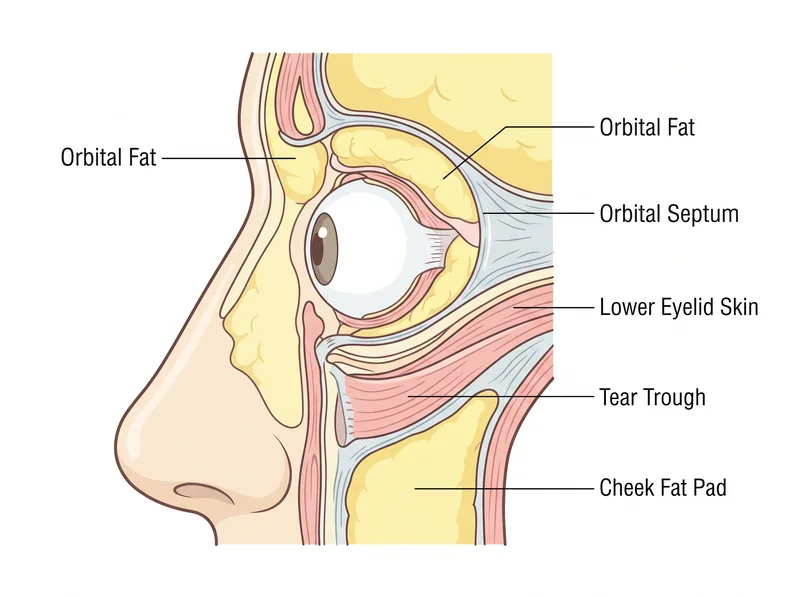 The anatomy of under-eye bags: orbital fat, weakened septum, and skin changes all contribute to visible puffiness.
The Difference Between Bags, Puffiness, and Dark Circles
These terms get used interchangeably, but they’re different problems with different causes and different treatments. Understanding which one you’re dealing with matters because the solutions don’t overlap as much as you’d think.
Under-eye bags are structural. They’re caused by protruding orbital fat and weakened tissue support. They’re present all day, every day, regardless of how much sleep you got or how much water you drank. They cast a shadow and create a physical bulge below the lower lash line.
Puffiness is temporary fluid accumulation in the periorbital tissue. It’s worse in the morning, improves throughout the day, and responds to lifestyle changes like reducing sodium, improving your head while sleeping, and staying hydrated. Puffiness is soft and compressible. Bags are firm.
Dark circles are pigmentation or vascular issues. They can be caused by melanin deposits, thin skin showing underlying blood vessels, or shadowing from structural changes like tear trough hollowing. Dark circles often coexist with bags but require completely different treatment approaches. You can have one without the other, or all three at once.
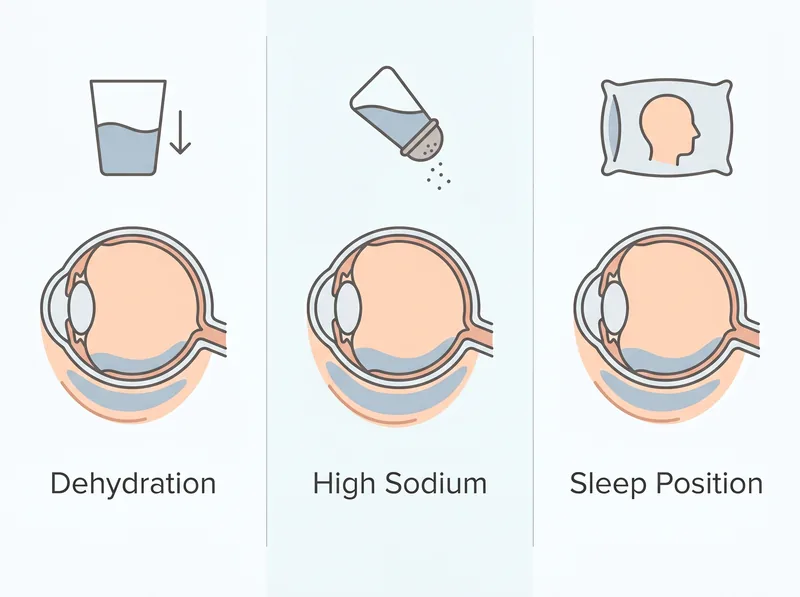 Environmental and lifestyle factors that worsen under-eye bags: dehydration, high sodium, and sleep position all play a role.
Environmental Factors That Make Eye Bags Worse in Dry Climates
Living in a dry, hot climate with hard water creates a perfect storm for worsening under-eye bags. The structural component might be genetic, but the environmental aggravation is very real and often underestimated.
Chronic low-grade dehydration is endemic in desert climates. When your body is consistently under-hydrated, it triggers fluid retention as a compensatory mechanism. That retained fluid pools in areas with loose connective tissue, and the periorbital region is one of the first places it shows up. You end up with both structural bags and inflammatory puffiness layered on top.
High mineral content in hard water changes the skin barrier and causes localized inflammation. The thin, delicate skin around the eyes is particularly vulnerable. Over time, repeated exposure to hard water during face washing can contribute to chronic periorbital edema, making existing bags look more pronounced.
Air conditioning and indoor heating create dramatic humidity fluctuations. You go from 45-degree outdoor heat to 18-degree air-conditioned interiors multiple times a day. This constant environmental whiplash stresses the microcirculation around the eyes and impairs lymphatic drainage. Indoor AC exposure is a significant but overlooked factor in periorbital puffiness for women working in Gulf office environments.
Non-Surgical Treatment Options That Actually Work
Let’s be clear: if your under-eye bags are structural (protruding orbital fat), no topical cream or serum will eliminate them. But non-surgical approaches can improve skin quality, reduce accompanying puffiness, and in some cases, create enough tightening to make the bags less prominent.
Prescription retinoids are the gold standard for improving skin thickness and elasticity around the eyes. Tretinoin 0.025% applied carefully to the lower eyelid area (avoiding the lash line and inner corner) can thicken the dermis over 6-12 months, providing slightly better support for the underlying structures. This won’t fix herniated fat, but it can improve the overall appearance. Start slowly, use a pea-sized amount for the entire face, and expect some initial irritation.
Caffeine-based eye serums reduce temporary puffiness by constricting blood vessels and promoting lymphatic drainage. They work for morning puffiness but won’t touch structural bags. The Ordinary Caffeine Solution 5% + EGCG is an affordable, evidence-backed option. Apply it in the morning on damp skin and give it 10 minutes to work before layering other products.
Hyaluronic acid fillers (tear trough fillers) can create the illusion of smoother contours by filling the hollowed area just below the bag. This doesn’t remove the bag, but it can reduce the shadowing and create a more continuous transition from lower lid to cheek. This is an advanced technique that requires an experienced injector. Poorly placed filler can make bags look worse or create a lumpy, overfilled appearance. Expect to pay $600-1200 per syringe and plan for touch-ups every 12-18 months.
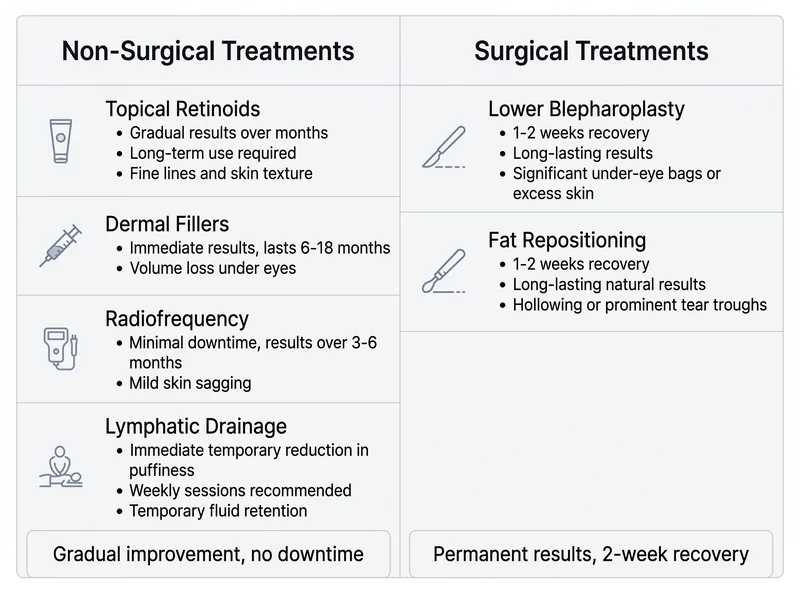 Treatment options at a glance: non-surgical approaches offer gradual improvement with no downtime, while surgical options provide permanent correction.
Radiofrequency and Energy-Based Treatments
Radiofrequency (RF) treatments like Thermage and Profound RF deliver controlled heat to the deeper layers of skin, stimulating collagen production and causing tissue tightening. For under-eye bags, RF can provide modest improvement by tightening the skin and improving support structures, but it won’t reposition or remove orbital fat.
A 2019 study in Aesthetic Surgery Journal found that microneedling radiofrequency around the periorbital area resulted in measurable skin tightening and patient satisfaction scores, but the improvement was classified as mild to moderate, not dramatic. Results develop gradually over 3-6 months as new collagen forms.
Ultrasound-based treatments like Ultherapy work on a similar principle but use focused ultrasound energy instead of radiofrequency. The treatment is uncomfortable (some describe it as painful), expensive ($1500-3000 for periorbital treatment), and results are subtle. If your bags are severe or primarily caused by fat herniation, energy-based treatments won’t deliver the correction you’re hoping for.
These treatments work best for early-stage bags with good skin quality and minimal fat protrusion. They’re also useful as maintenance after surgical correction to prolong results. But if you’re looking at pronounced bags with significant fat herniation, you’re likely going to be disappointed with non-invasive energy treatments.
Surgical Correction: Lower Blepharoplasty Explained
Lower blepharoplasty is the surgical removal or repositioning of orbital fat to correct under-eye bags. It’s the only treatment that provides permanent correction of structural bags caused by fat herniation. There are two main approaches: transconjunctival (incision inside the lower lid) and transcutaneous (incision just below the lash line).
Transconjunctival blepharoplasty is performed from inside the lower eyelid, leaving no visible external scar. The surgeon accesses the orbital fat through the conjunctiva and either removes excess fat or repositions it into the tear trough area to create a smoother contour. This approach works well for younger patients with good skin elasticity and minimal excess skin.
Transcutaneous blepharoplasty involves an external incision just below the lower lash line. This allows the surgeon to remove both excess fat and excess skin, making it the better option for patients with significant skin laxity in addition to fat herniation. The scar typically heals well and becomes nearly invisible within 6-12 months.
Recovery from lower blepharoplasty takes about 2 weeks for most of the visible swelling and bruising to resolve, but subtle swelling can persist for 2-3 months. Expect to take 7-10 days off work. You’ll need to sleep improved, avoid strenuous exercise for 3 weeks, and protect your eyes from sun exposure during healing. Complications are rare but can include dry eyes, temporary vision changes, scarring, and in rare cases, ectropion (lower lid pulling away from the eye).
Realistic Expectations and When Surgery Isn’t the Answer
Surgery fixes structural problems. It removes or repositions fat. It tightens skin. What it doesn’t fix: dark circles caused by pigmentation, hollowing in the midface, or puffiness caused by fluid retention and lifestyle factors. If your primary concern is pigmentation or vascular dark circles, blepharoplasty won’t address that.
The best surgical candidates are people with prominent fat pads, good skin elasticity, and realistic expectations. If you have severe midface volume loss, very thin skin, or significant tear trough hollowing, you might need additional procedures (like midface lifting or fat grafting) to achieve balanced results. A consultation with a board-certified oculoplastic surgeon will clarify what’s achievable.
There’s also a subset of people whose ‘bags’ are actually malar mounds, which are swellings on the cheek just below the lower eyelid caused by fluid retention, not fat herniation. Malar mounds don’t respond to blepharoplasty and can actually look worse after surgery if the fat is removed. This is why proper diagnosis matters.
If you’re considering surgery, choose your surgeon carefully. Oculoplastic surgeons specialize in eyelid surgery and have additional training beyond general plastic surgery. Ask to see before-and-after photos of patients with similar anatomy to yours, not just the surgeon’s best results. Understand the risks, the recovery timeline, and the limitations of what surgery can achieve.
Lifestyle Changes That Reduce Puffiness (Not Bags)
These strategies won’t eliminate structural bags, but they’ll minimize the inflammatory puffiness that makes bags look worse. If you have both fat herniation and fluid retention, addressing the lifestyle factors can make a noticeable difference in how pronounced the bags appear day to day.
Sleep position matters. Sleeping flat on your back allows fluid to pool in the periorbital tissue overnight. Improving your head with an extra pillow or a wedge pillow promotes lymphatic drainage and reduces morning puffiness. Side sleeping and stomach sleeping can worsen asymmetrical puffiness because gravity pulls fluid to the lower side.
Sodium intake has a direct impact on fluid retention. The average restaurant meal in the Gulf contains 2000-3000mg of sodium, sometimes more. If you’re eating out frequently or relying on processed foods, you’re likely consuming 4000-6000mg of sodium daily. The recommended limit is 2300mg. Reducing sodium won’t fix bags, but it will reduce the overlying puffiness that makes them more visible.
Lymphatic drainage massage can temporarily reduce periorbital edema. Using your ring fingers, apply gentle pressure in small circular motions starting at the inner corner of the eye and moving outward toward the temples, then down toward the lymph nodes in front of the ears. This encourages fluid movement out of the tissue. It’s temporary relief, not a cure, but it can help on days when puffiness is particularly bad.
References
- Genetic and Environmental Factors in the Development of Periorbital Aging - Journal of Cosmetic Dermatology
- Efficacy of Microneedling Radiofrequency for Periorbital Rejuvenation - Aesthetic Surgery Journal
- Lower Eyelid Blepharoplasty: Techniques and Outcomes - American Academy of Ophthalmology
- Tear Trough Deformity: Anatomy and Treatment Approaches - American Society of Plastic Surgeons