You’re shedding more than usual, your scalp feels tender, and you’re pretty sure it started around the time work got relentless and sleep became optional. The hair loss forums mention cortisol. The wellness influencers recommend ashwagandha. But what does the actual research say about adaptogens, stress hormones, and hair growth?
This article contains affiliate links. See our affiliate disclosure for details.
Here’s what matters: chronic stress improves cortisol, and sustained high cortisol changes the hair growth cycle in measurable ways. Ashwagandha is one of the most studied adaptogens for lowering cortisol, with multiple clinical trials showing statistically significant reductions. But the connection to hair regrowth is less direct than supplement marketing suggests. Medically reviewed by Dr. Layla Hassan, Trichologist.
If you’re dealing with telogen effluvium triggered by chronic stress, understanding how cortisol affects your hair cycle and whether ashwagandha can help requires looking at what the clinical trials actually measured, not what the product labels promise.
Key Takeaways
• Ashwagandha consistently lowers cortisol by 14-28% in clinical trials, with effects appearing within 8 weeks at 300-600mg daily doses of standardized extract
• Chronic improved cortisol pushes hair follicles into premature shedding phase (telogen effluvium), but cortisol reduction doesn’t guarantee hair regrowth without addressing other factors
• The strongest evidence supports KSM-66 and Sensoril extracts standardized to withanolides; generic ashwagandha powder shows inconsistent results
• Ashwagandha works best as part of a full-system approach alongside sleep improvation, protein intake, and scalp care in hard water climates
• Expect 8-12 weeks before seeing cortisol changes, and another 3-4 months before new hair growth becomes visible if stress was the primary trigger
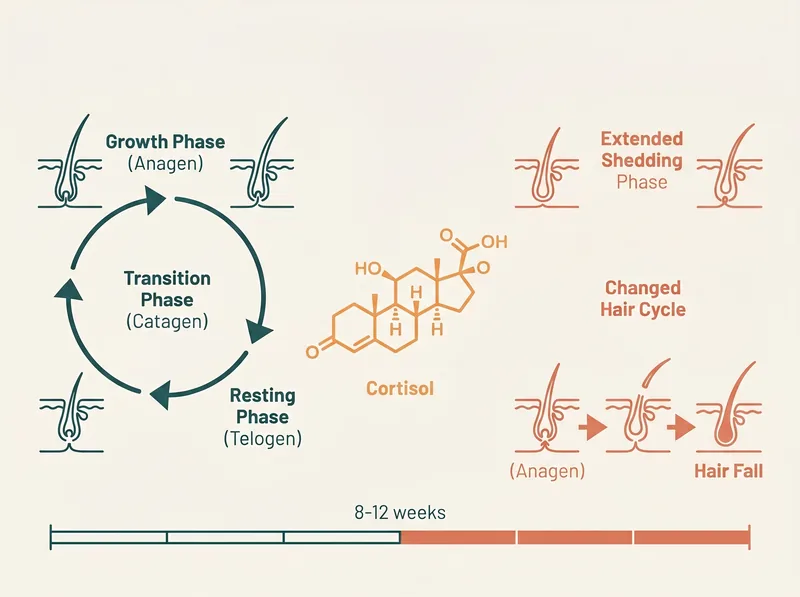 How improved cortisol changes the hair growth cycle, pushing follicles into premature shedding phase
How Cortisol Actually Changes Hair Growth
Cortisol isn’t inherently bad. It’s your body’s primary stress hormone, released in response to physical or psychological threats. Short-term spikes are normal and adaptive.
Chronic improvion is different. When cortisol stays high for weeks or months, it triggers a cascade that affects hair follicles directly. Research published in PLOS ONE found that sustained cortisol exposure inhibits hair follicle stem cell activity and prolongs the resting phase of the hair cycle.
Here’s the mechanism: improved cortisol signals your body to conserve energy for essential functions. Hair growth isn’t essential for survival. So follicles shift prematurely from the active growth phase (anagen) into the resting phase (telogen), where they stay dormant for 2-4 months before shedding.
This is telogen effluvium. You don’t see the shedding immediately. The trigger happens 8-12 weeks before you notice increased hair fall. By the time you’re losing handfuls in the shower, the cortisol spike that caused it may have already resolved, which is why timing matters when evaluating interventions.
What the Ashwagandha Clinical Trials Show
Ashwagandha (Withania somnifera) is classified as an adaptogen, a plant compound that theoretically helps the body resist stressors. The mechanism isn’t fully understood, but research suggests it modulates the hypothalamic-pituitary-adrenal (HPA) axis, the system that regulates cortisol release.
The strongest evidence comes from randomized controlled trials using standardized extracts. A 2012 study in the Indian Journal of Psychological Medicine gave 64 adults with chronic stress either 300mg of high-concentration ashwagandha extract or placebo twice daily. After 60 days, the ashwagandha group showed a 27.9% reduction in serum cortisol compared to baseline.
A larger 2019 trial published in Medicine tested 600mg daily in 58 participants. Cortisol dropped by 14.5% at 8 weeks. Subjective stress scores improved significantly, but the study didn’t measure hair outcomes.
That’s the pattern across trials: ashwagandha reliably lowers cortisol in the 14-28% range within 8-12 weeks. But none of the major studies directly measured hair density, regrowth rate, or telogen effluvium resolution. The hair connection is inferred, not proven.
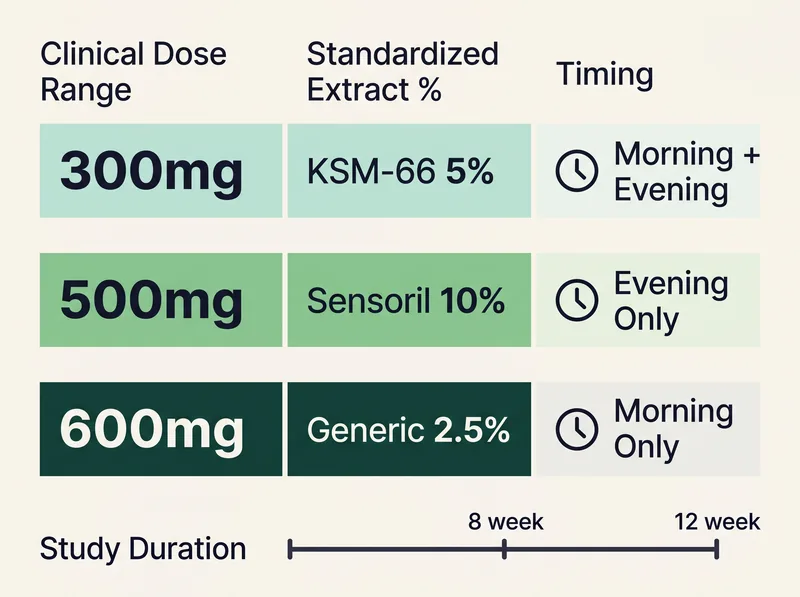 Clinically studied ashwagandha doses for cortisol reduction: what the trials actually used
Standardized Extracts vs Generic Powder
Not all ashwagandha supplements are equivalent. The clinical trials used specific proprietary extracts standardized to withanolide content, the active compounds believed responsible for adaptogenic effects.
KSM-66 is standardized to 5% withanolides and uses only the root. Sensoril uses both root and leaf, standardized to 10% withanolides. These are the extracts with published human trials showing cortisol reduction.
Generic ashwagandha powder or non-standardized capsules may contain 0.5-2% withanolides, or the percentage may not be tested at all. A 2020 analysis of commercial ashwagandha supplements found withanolide content varied by more than 10-fold between products claiming the same dose.
If you’re using ashwagandha specifically for cortisol management, the extract type matters. Look for products listing KSM-66 or Sensoril on the label with third-party testing verification. The dose that worked in trials was 300-600mg of standardized extract, not raw powder.
Dosing, Timing, and What to Expect
The effective dose range from clinical trials is 300-600mg of standardized extract daily, typically split into two doses (morning and evening) or taken once in the evening.
Timing may matter for cortisol’s natural rhythm. Cortisol peaks in the morning and declines through the day. Some practitioners recommend evening dosing to blunt the morning spike, but this hasn’t been directly tested in trials.
Effects aren’t immediate. Most studies measured cortisol changes at 8 weeks minimum. Subjective stress improvements appeared earlier (around 4 weeks), but hormonal shifts take longer.
For hair regrowth, the timeline extends further. Even if ashwagandha lowers your cortisol within 8 weeks, hair follicles that shifted into telogen phase will complete their resting cycle before shedding (2-4 months total). New growth from reactivated follicles takes another 3-4 months to become visible. You’re looking at 6-8 months minimum from starting supplementation to seeing measurable hair changes, assuming cortisol was the primary trigger.
Ashwagandha and Other Hair Loss Causes
Ashwagandha addresses one pathway: stress-induced cortisol improvion. It won’t fix hair loss driven by other mechanisms.
If your hair loss is primarily due to iron deficiency, thyroid dysfunction, androgenic alopecia, or nutritional gaps, lowering cortisol alone won’t restore growth. Many women have multiple overlapping causes.
In Gulf climates, there’s an additional environmental layer. Hard water mineral buildup on the scalp creates a physical barrier that impedes follicle function regardless of your cortisol levels. If you’re using ashwagandha for stress-related shedding but not addressing mineral deposits, you’re only solving part of the problem.
This is where the full-system approach matters. Ashwagandha for cortisol management works best alongside adequate protein intake (1.2-1.6g per kg body weight), targeted supplementation for common deficiencies, and scalp preparation with a chelating shampoo like Regrowth+ to remove mineral buildup before applying any topical treatments.
Side Effects and Contraindications
Ashwagandha is generally well-tolerated in clinical trials, but it’s not risk-free. The most common side effects at 300-600mg daily are mild gastrointestinal upset, drowsiness, and headache, reported in less than 5% of participants.
More concerning: ashwagandha can affect thyroid hormone levels. Some studies show it increases T3 and T4 in people with subclinical hypothyroidism, which sounds beneficial but can be problematic if you’re on thyroid medication or have hyperthyroidism. If you have any thyroid condition, consult your doctor before starting ashwagandha.
It’s also contraindicated during pregnancy and breastfeeding due to insufficient safety data. Some traditional medicine sources classify it as an abortifacient, though modern evidence is limited.
Drug interactions are possible with sedatives, immunosuppressants, and thyroid medications. If you’re on any prescription medications, run it by your healthcare provider first. This isn’t a casual supplement despite its wellness-adjacent marketing.
The Bigger Stress-Hair Picture
Ashwagandha is one tool for managing the cortisol-hair connection, but it’s not a substitute for addressing the underlying stressors or the broader physiological picture.
Chronic stress affects more than cortisol. It changes sleep architecture, which independently affects hair growth. It increases systemic inflammation. It often correlates with poor nutrition (skipped meals, reliance on quick carbs) and reduced physical activity, both of which affect nutrient delivery to hair follicles.
The women who see the best results with adaptogens are typically also improving sleep hygiene, managing workload, incorporating movement, and eating adequate protein. The supplement amplifies the lifestyle changes; it doesn’t replace them.
For expats in high-stress environments, the physiological adaptation to a new climate adds another layer. Your body is already under environmental stress from heat, different water quality, and circadian changeion. Adding ashwagandha may help buffer that load, but it works best when you’re also supporting your system through the basics: hydration, sleep, and nutrient density.
References
- Cortisol inhibits hair growth via regulating the hair cycle and hair follicle stem cells - PLOS ONE
- Adaptogenic and anxiolytic effects of ashwagandha root extract in healthy adults: A double-blind, randomized, placebo-controlled clinical study - Medicine (Baltimore)
- A prospective, randomized double-blind, placebo-controlled study of safety and efficacy of a high-concentration full-spectrum extract of ashwagandha root in reducing stress and anxiety in adults - Indian Journal of Psychological Medicine
- Efficacy and Safety of Ashwagandha Root Extract in Subclinical Hypothyroid Patients: A Double-Blind, Randomized Placebo-Controlled Trial - Journal of Alternative and Complementary Medicine