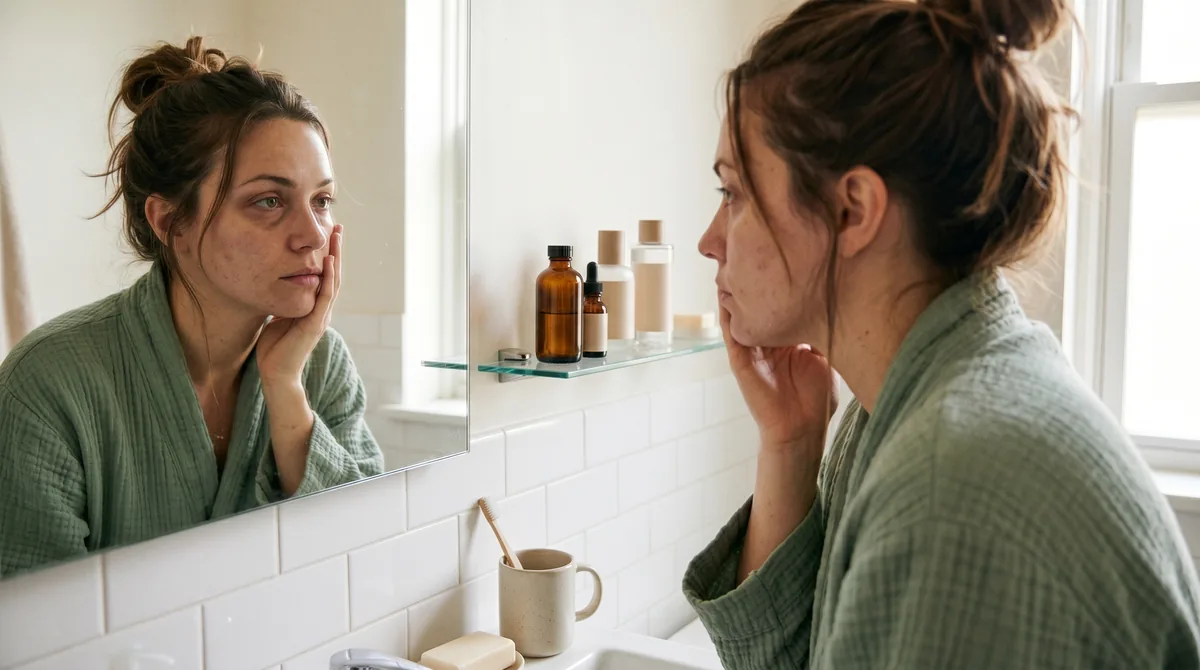
You’re looking in the mirror at 3 a.m. during another night feed, and the face staring back doesn’t quite look like yours. The dark circles have deepened into permanent shadows. Your skin looks grey and flat, like someone turned down the brightness. There’s a breakout on your chin that won’t heal, and your moisturiser seems to sit on top of your skin instead of sinking in. This isn’t just tiredness. This is what chronic sleep deprivation does to your face.
The postpartum period brings a perfect storm of skin stressors: hormonal shifts, environmental factors, and sleep loss that compounds everything else. If you’re living in a region with hard water and extreme heat, you’re managing an even heavier load. This article contains affiliate links. See our affiliate disclosure for details. Medically reviewed by Dr. Layla Hassan, Trichologist.
Sleep deprivation isn’t just about feeling tired. It’s a physiological stressor that triggers measurable changes in your skin’s structure, function, and appearance. Research shows that chronic sleep loss accelerates skin aging markers and compromises barrier function. When you’re getting two-hour sleep blocks for months on end, your skin shows it.
Here’s what’s actually happening to your skin when you can’t sleep, why the Gulf environment makes it worse, and what you can do about it when you barely have time to shower.
What Sleep Deprivation Does to Your Skin
Sleep isn’t passive recovery time. It’s when your skin does most of its repair work. During deep sleep, your body produces growth hormone, which drives cellular regeneration and collagen synthesis. Blood flow to your skin increases by up to 50%, delivering oxygen and nutrients while clearing metabolic waste. When you’re not getting enough sleep, these processes don’t complete.
The most immediate effect is cortisol improvion. Cortisol is your stress hormone, and it spikes when you’re sleep-deprived. Improved cortisol breaks down collagen, increases inflammation, and compromises your skin’s protective barrier. This is why you wake up looking puffy and inflamed after a bad night. It’s not just water retention. It’s your skin under physiological stress.
Your barrier function collapses. The lipid matrix that holds your skin cells together and prevents moisture loss depends on overnight repair. When you’re chronically sleep-deprived, your barrier becomes leaky. Water evaporates faster. Irritants penetrate more easily. Your skin becomes sensitive to products that never bothered you before.
Then there’s the visible aging acceleration. Studies show that women who consistently sleep fewer than five hours per night have twice as many fine lines and wrinkles as those who get seven to nine hours. The mechanism is direct: less sleep means less repair, less collagen production, and more oxidative stress.
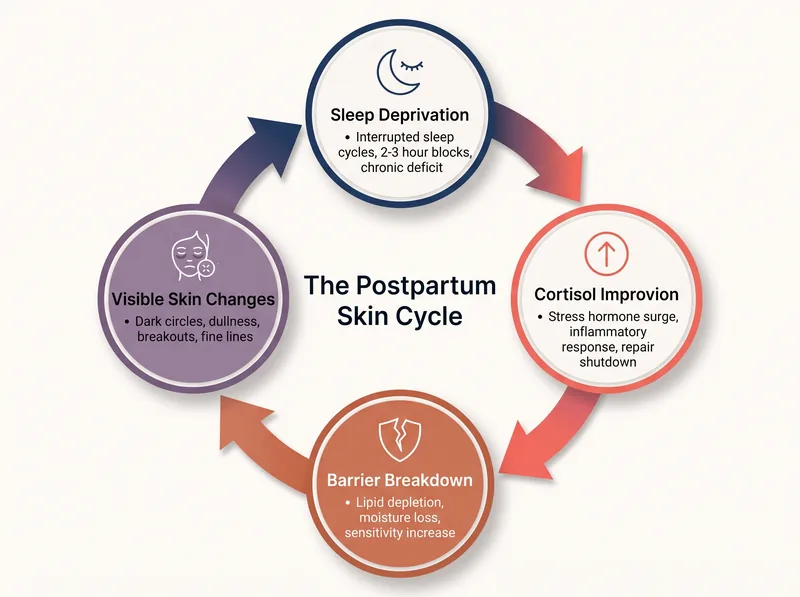 Sleep loss triggers cortisol spikes that directly compromise your skin’s protective barrier and accelerate visible aging.
How Postpartum Sleep Loss Is Different
Postpartum sleep deprivation isn’t like pulling an all-nighter before an exam. It’s chronic, fragmented, and hormonally complicated. You’re not just sleeping less. You’re never reaching deep sleep stages because you’re waking every two to three hours. Your sleep architecture is changeed.
The hormonal context matters. Your estrogen levels have plummeted after delivery, which already affects skin thickness, moisture retention, and collagen density. Progesterone, which has anti-inflammatory effects, has also dropped. You’re managing these hormonal shifts while running on broken sleep, and your skin is caught in the middle.
There’s also the physical recovery load. Your body is healing from pregnancy and delivery while trying to produce milk. These processes require significant resources. When you add sleep deprivation to this equation, something has to give. Often, it’s your skin that shows the strain first.
If you’re in the Gulf region, you’re managing additional environmental stressors: extreme heat, low humidity indoors from constant air conditioning, and hard water that strips your skin barrier every time you wash your face. Sleep deprivation compounds all of these factors.
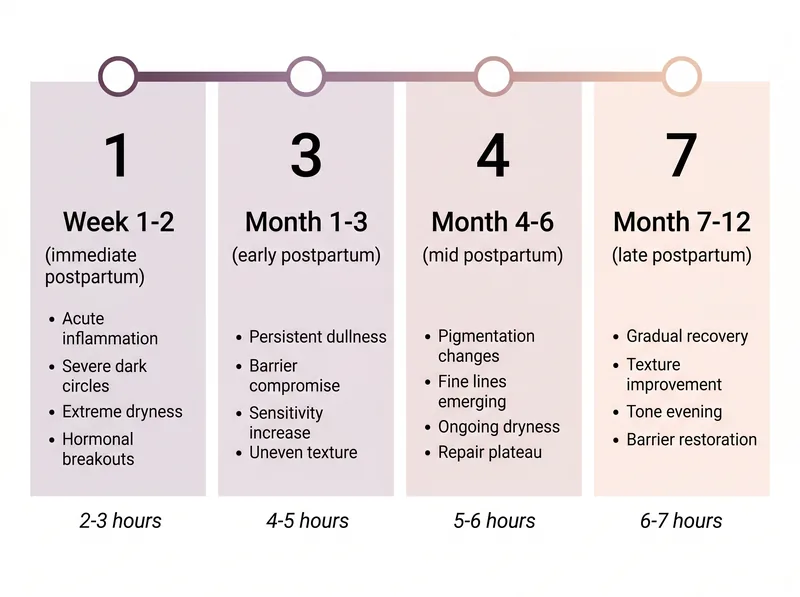 Your skin’s response to sleep loss follows a predictable pattern, but recovery is possible at every stage.
The Visible Signs on Your Face
Dark circles are the most obvious marker. They’re caused by several factors: blood vessel dilation from cortisol, fluid retention from inflammation, and the thinning of skin under your eyes that makes vessels more visible. The purple-blue tint comes from deoxygenated blood pooling in the delicate periorbital area.
Dullness and uneven tone appear next. When you’re sleep-deprived, your skin’s cell turnover slows. Dead cells accumulate on the surface, creating a grey, flat appearance. Blood flow decreases, so your complexion loses its natural flush. The result is skin that looks lifeless and tired because, well, it is.
Breakouts often worsen. Cortisol increases oil production and triggers inflammatory responses. Your pores get congested more easily. If you’re touching your face more often from exhaustion or stress, you’re introducing bacteria. Postpartum hormonal acne is already a challenge. Sleep loss makes it worse.
Fine lines become more pronounced. This isn’t about aging overnight. It’s about dehydration and barrier compromise making existing lines more visible. When your skin is properly hydrated and your barrier is intact, fine lines are less noticeable. When you’re sleep-deprived and your barrier is compromised, every line casts a shadow.
What Actually Helps When You Can’t Sleep More
Let’s be honest: ‘get more sleep’ isn’t helpful advice when you have a newborn. You can’t manufacture sleep that isn’t available. What you can do is support your skin’s repair processes during the limited sleep you do get and protect it during waking hours.
Barrier repair becomes your primary focus. A compromised barrier is at the root of most visible sleep-deprivation symptoms. Look for products with ceramides, cholesterol, and fatty acids. These lipids rebuild your barrier’s structure. Ceramide-based products work particularly well in dry climates because they address both environmental and physiological barrier damage.
Hydration support is critical. Your skin loses more water when your barrier is compromised and when you’re in air-conditioned environments. Use a hydrating serum with hyaluronic acid or glycerin under your moisturiser. Apply it to damp skin. Drink water consistently throughout the day, even when you’re too tired to think about it.
Simplify your routine ruthlessly. You don’t have time or energy for ten-step skincare. Focus on three essentials: gentle cleansing (especially if you’re dealing with hard water buildup), barrier repair, and sun protection. That’s it. Everything else is optional until you’re sleeping more than four hours at a stretch.
The Hard Water Factor
If you’re washing your face with hard water, you’re adding another layer of barrier stress. Hard water leaves mineral deposits on your skin that change lipid organization and increase transepidermal water loss. When your barrier is already compromised from sleep deprivation, hard water accelerates the damage.
The calcium and magnesium in hard water bind to the surfactants in your cleanser, creating a film that’s difficult to rinse off. This residue sits on your skin, preventing your barrier-repair products from penetrating effectively. You’re layering expensive serums over a layer of soap scum and minerals.
A chelating cleanser becomes essential. Look for products with EDTA or citric acid that bind to hard water minerals and allow them to rinse away cleanly. Using a chelating shampoo like Regrowth+ on your scalp can help if you’re noticing postpartum hair changes alongside skin issues. The same mineral buildup affecting your face is affecting your scalp.
Consider using filtered or bottled water for your final rinse, especially in the morning when your skin is most dehydrated. It sounds excessive, but if you’re investing in barrier-repair products, you want them to actually reach your skin.
Realistic Skincare for Survival Mode
You need a routine you can do in three minutes at 2 a.m. when you’re half-asleep. Keep everything within arm’s reach of where you wash your face. Use pump bottles so you don’t have to unscrew caps with one hand while holding a baby.
Morning: Rinse with lukewarm water (skip cleansing if your skin is dry). Apply hydrating serum to damp skin. Follow with a moisturiser that contains SPF. That’s it. Three steps, two minutes.
Night: Use a gentle, low-pH cleanser that won’t strip your already-compromised barrier. Apply the same hydrating serum. Use a heavier barrier-repair cream at night. If you have the energy, add a few drops of a nourishing facial oil over your moisturiser to seal everything in. Four steps, three minutes.
Once a week, if you can manage it, use a gentle chemical exfoliant to address the cell buildup that’s making your skin look dull. AHAs or PHAs work well. Don’t use physical scrubs. Your barrier can’t handle the mechanical stress right now.
When to Expect Recovery
Your skin will start to recover when your sleep starts to improve, but the timeline varies. Most mothers see noticeable improvement around the four to six month mark, when babies often start sleeping in longer stretches. But ‘improvement’ doesn’t mean back to baseline. It means less acute stress.
The dark circles typically improve first, within weeks of getting more consistent sleep. Dullness and texture take longer because they’re related to cell turnover, which operates on a 28-day cycle. Barrier function can take several months to fully restore, especially if you’ve been dealing with chronic compromise.
If you’re still seeing significant skin issues after your baby is sleeping through the night, it’s worth investigating other factors. Nutritional deficiencies are common in postpartum mothers, particularly iron, vitamin D, and omega-3s. These deficiencies affect skin health independently of sleep.
Some changes may be permanent or require intervention. If you develop melasma (dark patches on your face) during pregnancy or postpartum, it may persist even after sleep normalizes. This is hormonally driven and often requires targeted treatment. Similarly, if you’ve developed significant volume loss or deep lines, topical products may not be enough.
What Doesn’t Work
Eye creams marketed for dark circles rarely work because they can’t address the underlying causes: blood vessel dilation, fluid retention, and skin thinning. The most effective interventions for dark circles are actually systemic: better sleep, reduced inflammation, and adequate hydration. Topical caffeine can provide temporary vasoconstriction, but the effect is minimal and short-lived.
Harsh exfoliation makes everything worse. When your barrier is compromised, aggressive exfoliation creates micro-damage that your skin can’t repair quickly enough. You’ll end up with more inflammation, more sensitivity, and potentially more breakouts as bacteria penetrate your damaged barrier.
Expensive serums won’t compensate for missing sleep. The skincare industry wants you to believe that the right product can reverse sleep deprivation. It can’t. Products can support your skin’s limited repair capacity and protect against additional damage, but they can’t manufacture the growth hormone and cellular regeneration that only happen during deep sleep.
Drinking more water alone won’t fix dehydration if your barrier is leaking. You need to address the barrier compromise first. Otherwise, you’re just increasing the water your skin is losing through transepidermal water loss.
References
- Sleep and skin aging: is there a connection? - Clinical and Experimental Dermatology
- The Impact of Psychological Stress on Skin Barrier Function - PubMed Central
- Does poor sleep quality affect skin aging? - Clinical and Experimental Dermatology
- Postpartum skin changes: what to expect - American Academy of Dermatology