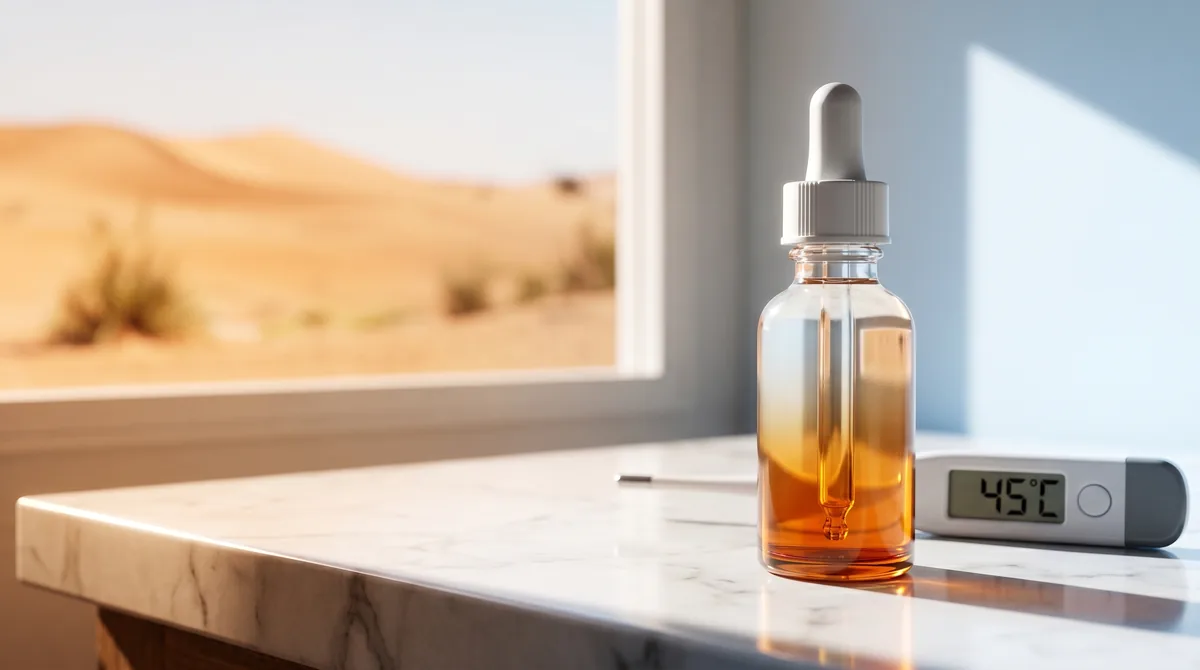
You bought the expensive vitamin C serum. The one with the clinical studies and the elegant packaging and the promise of brighter, firmer skin. You stored it in your bathroom cabinet, used it religiously every morning, and within three weeks it turned the color of iced tea. The texture went sticky. It stopped doing anything at all.
Here’s what happened: ascorbic acid, the most potent form of vitamin C, degrades rapidly in heat. And in a climate where ambient temperatures hit 45 degrees Celsius, where your bathroom stays warm even at night, where the delivery truck that brought your serum sat in the sun for hours, that degradation happens faster than you can finish the bottle. This article contains affiliate links. See our affiliate disclosure for details.
The problem isn’t you. It’s the chemistry. Vitamin C is notoriously unstable, and heat accelerates oxidation exponentially. What works in temperate climates fails here, which is why understanding the science behind stability matters more than brand loyalty or price point. Some formulations survive Gulf conditions. Most don’t.
Why Heat Destroys Vitamin C Faster Than You Think
L-ascorbic acid, the active form of vitamin C used in most serums, is a water-soluble antioxidant that oxidizes when exposed to heat, light, or air. Oxidation converts ascorbic acid into dehydroascorbic acid, which has minimal antioxidant activity and eventually degrades further into inactive compounds. This isn’t a slow process.
Research published in the Journal of Pharmaceutical Sciences shows that ascorbic acid stability drops by approximately 50% when stored at 40 degrees Celsius compared to 20 degrees. In Gulf conditions, where bathroom temperatures regularly exceed 30 degrees and can spike to 40+ during summer, you’re working against exponential degradation curves.
The visible sign is color change. Fresh vitamin C serum is clear to pale yellow. As it oxidizes, it turns amber, then orange, then brown. By the time it’s noticeably dark, most of the active ingredient is gone. But here’s the problem: degradation starts before you see it. A serum that looks fine might already be half-oxidized.
Heat also affects pH stability. L-ascorbic acid works at a pH below 3.5, which is acidic enough to cause irritation in some people. When heat destabilizes the formulation, the pH can shift, making the product either ineffective or more irritating. You can’t tell by looking at it.
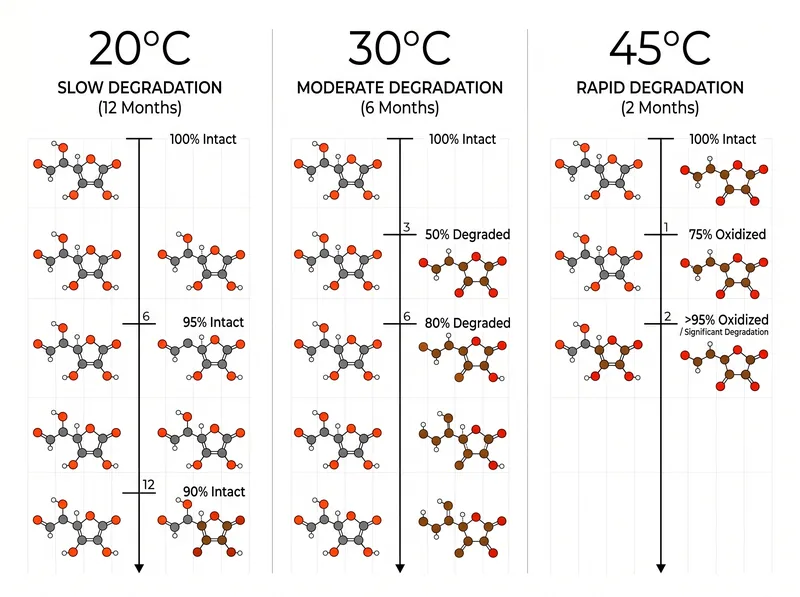 Ascorbic acid degradation accelerates exponentially above 30°C, with stability dropping by 50% at 45°C ambient temperature.
The Derivative Question: What Actually Survives
Vitamin C derivatives exist because pure ascorbic acid is so unstable. These are modified forms of vitamin C designed to be more heat-stable, less pH-dependent, and easier to formulate. The tradeoff is efficacy. Derivatives must convert to ascorbic acid in the skin to work, and that conversion isn’t always efficient.
Sodium Ascorbyl Phosphate (SAP) is one of the most heat-stable derivatives. It remains stable at neutral pH and doesn’t oxidize quickly in heat. Studies show SAP has anti-acne properties and can brighten skin, though it’s less potent than pure ascorbic acid. For Gulf conditions, this stability matters more than maximum theoretical potency.
Magnesium Ascorbyl Phosphate (MAP) is similarly stable but penetrates skin poorly. It works, but slowly. Ascorbyl Glucoside is moderately stable and converts to ascorbic acid in skin, but the conversion rate varies. Tetrahexyldecyl Ascorbate is oil-soluble, highly stable, and doesn’t require conversion, but it’s expensive and less researched.
Here’s the practical reality: if you’re using a serum with pure L-ascorbic acid in the Gulf, it needs to be stored in the fridge, used within 30 days of opening, and kept away from light. If you can’t commit to that, a derivative-based formula will give you better results than oxidized ascorbic acid.
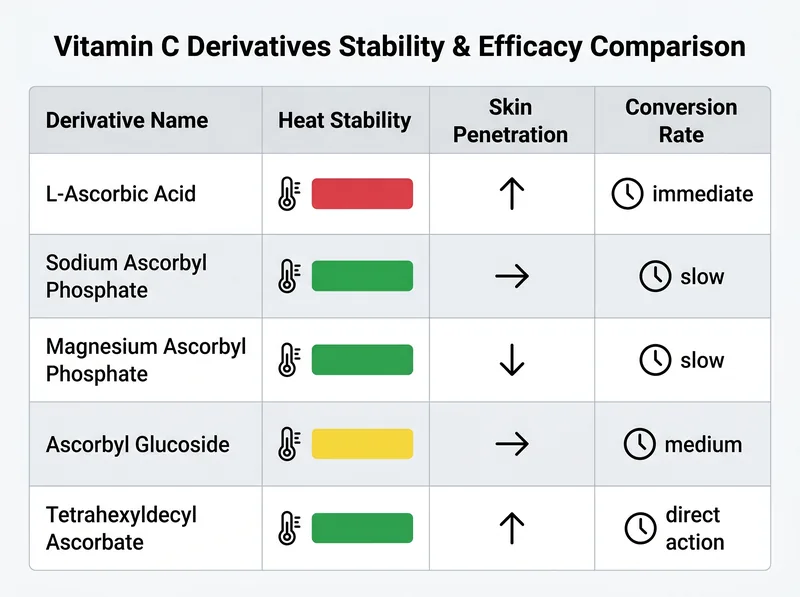 Vitamin C derivatives offer varying stability profiles, with some maintaining efficacy in extreme heat while others degrade as rapidly as pure ascorbic acid.
Storage Realities: Where Your Serum Actually Lives
The standard advice is to store vitamin C serum in a cool, dark place. In most climates, that means a bathroom cabinet. In the Gulf, your bathroom cabinet is neither cool nor consistently dark. Bathroom temperatures fluctuate with shower steam and ambient heat. Light enters when you open the cabinet. The environment is hostile to stability.
Refrigeration solves the heat problem but creates a usage problem. You have to remember to take the serum out of the fridge, wait for it to warm slightly (cold serum on warm skin can cause irritation), apply it, and put it back. Most people don’t maintain that routine. The serum ends up at room temperature, where degradation resumes.
Airless pump bottles help more than droppers. Every time you open a dropper bottle, you expose the entire contents to oxygen. Airless pumps dispense product without air contact, slowing oxidation. Dark glass bottles block light better than clear ones. These aren’t minor details in hot climates; they’re the difference between a serum that lasts two months and one that oxidizes in three weeks.
If you’re ordering online, consider shipping conditions. Your serum might sit in a delivery truck at 50+ degrees for hours before reaching you. By the time you open it, degradation has already started. Some brands ship with ice packs during summer months. Most don’t.
Formulation Chemistry: What Stabilizes and What Doesn’t
Ferulic acid is the most researched stabilizing ingredient for vitamin C. A study in the Journal of Investigative Dermatology found that combining L-ascorbic acid with ferulic acid and vitamin E increases stability eightfold and doubles photoprotection. The combination works synergistically, with ferulic acid preventing oxidation and vitamin E regenerating ascorbic acid.
But ferulic acid formulations still require proper storage. They’re more stable than ascorbic acid alone, but they’re not immune to heat. You gain time, not invincibility. A ferulic acid serum might last six weeks instead of three, but it will still oxidize if stored poorly.
Anhydrous (water-free) formulations sidestep some stability issues. Since water accelerates ascorbic acid degradation, removing it from the formula extends shelf life. These serums use silicone or oil bases instead. They feel different on skin, more silky than watery, and they don’t penetrate as quickly, but they survive heat better.
pH matters more than most people realize. L-ascorbic acid is only effective below pH 3.5, which is why vitamin C serums sting. Derivatives like SAP work at neutral pH, which makes them gentler but requires different formulation chemistry. You can’t just swap ascorbic acid for a derivative in the same formula and expect it to work the same way.
The Concentration Myth: More Isn’t Better in Heat
Vitamin C serums range from 10% to 20% concentration, with some going higher. The assumption is that higher concentration means better results. In stable conditions, that’s partially true. In heat, it’s backwards. Higher concentrations oxidize faster because there’s more ascorbic acid available to react with oxygen and heat.
A 20% L-ascorbic acid serum in Gulf conditions might oxidize before you use half the bottle. A 10% serum with stabilizers might maintain efficacy longer, delivering more total vitamin C to your skin over time. This is counterintuitive, but it’s chemistry. Concentration only matters if the ingredient remains stable.
Research suggests that 10-15% L-ascorbic acid is sufficient for collagen synthesis and antioxidant benefits. Going higher increases irritation risk without proportional benefit, especially if the product degrades quickly. For hot climates, a stable 10% formula outperforms an unstable 20% formula.
Derivative-based serums often use lower concentrations because derivatives are less potent. A 3% SAP serum won’t match a fresh 15% ascorbic acid serum in potency, but it will outperform an oxidized 15% ascorbic acid serum. Context matters more than numbers on the label.
What Actually Works: Practical Formulation Choices
If you’re committed to L-ascorbic acid, buy small bottles (15-20ml), store them in the fridge, and replace them every 4-6 weeks. Use airless pump packaging if possible. Look for formulations with ferulic acid and vitamin E. Accept that you’re fighting chemistry and plan accordingly.
If refrigeration isn’t realistic, switch to a derivative. Sodium Ascorbyl Phosphate is the most reliable for heat stability. It won’t give you the same rapid results as fresh ascorbic acid, but it will give you consistent results, which matters more over months of use. Understanding ingredient labels helps you identify which derivative a product uses.
Anhydrous vitamin C formulations are worth trying if you dislike the texture of water-based serums. They’re more stable in heat, though they can feel heavy on skin in humid conditions. Test them during cooler months first. Some people find them too occlusive for Gulf humidity.
Consider alternating. Use a stable derivative serum daily, and reserve a high-potency ascorbic acid serum (stored in the fridge) for twice-weekly intensive treatment. This gives you stability for maintenance and potency for targeted results without wasting expensive product to oxidation.
The environmental reality here extends beyond skincare. Just as hard water requires chelating shampoos like Regrowth+ to prevent mineral buildup on hair, extreme heat requires rethinking which active ingredients can survive your actual storage conditions. It’s not about buying better products; it’s about buying products that match your environment.
When to Throw It Out: Signs of Degradation
Color change is the obvious sign. If your serum has turned darker than pale yellow, it’s oxidized. Don’t use it. Oxidized vitamin C can cause irritation without providing benefits, and in some cases, it may generate free radicals instead of neutralizing them. This is the opposite of what you want from an antioxidant.
Texture changes matter too. If the serum becomes sticky, gritty, or separates into layers, the formulation has destabilized. This happens when heat breaks down emulsifiers or when pH shifts cause ingredients to precipitate. The product is no longer safe or effective.
Smell is a less reliable indicator because many vitamin C serums have a slight metallic or acidic scent from the start. But if the smell intensifies or becomes rancid, that’s degradation. Trust your nose. If something smells off, it probably is.
Here’s the hard truth: most vitamin C serums in Gulf conditions should be replaced every 6-8 weeks after opening, regardless of how they look. If you’re not willing to do that, you’re better off using a more stable alternative. Skincare isn’t effective if the active ingredients are gone.
References
- Stability of Ascorbic Acid in Various Vehicles - Journal of Pharmaceutical Sciences
- Sodium Ascorbyl Phosphate in Topical Microemulsions - International Journal of Pharmaceutics
- Ferulic Acid Stabilizes a Solution of Vitamins C and E and Doubles Photoprotection of Skin - Journal of Investigative Dermatology
- Vitamin C in Dermatology - Indian Dermatology Online Journal