If you’ve noticed your skin acting unpredictable since moving to a humid climate, you’re not imagining it. The combination of high humidity, hard water, and indoor air conditioning creates a barrier nightmare that most skincare advice doesn’t address. Your moisturiser stops working. Your serums pill. Your skin feels simultaneously oily and dehydrated.
Niacinamide is one of the few ingredients that actually performs better under these conditions, but only if you understand how humidity changes the way it works. This isn’t about adding another serum to your routine. It’s about understanding why your skin barrier is compromised in the first place and how niacinamide addresses the specific damage pattern caused by mineral-heavy water and environmental stress. This article contains affiliate links. See our affiliate disclosure for details.
Medically reviewed by Dr. Layla Hassan, Trichologist
Key Takeaways
• Niacinamide strengthens skin barrier function by increasing ceramide production, which is particularly important when hard water and humidity compromise barrier integrity
• In humid climates, niacinamide helps regulate sebum production without over-drying, addressing the oily-yet-dehydrated paradox many women experience
• The ingredient works synergistically with barrier repair when mineral buildup is removed first, similar to how scalp barrier function improves after chelating mineral deposits
• Concentration matters: 5-10% niacinamide is optimal for barrier repair in compromised skin, while higher percentages may irritate already-stressed barriers
• Niacinamide’s anti-inflammatory properties help calm the chronic low-grade inflammation caused by environmental stressors common in Gulf climates
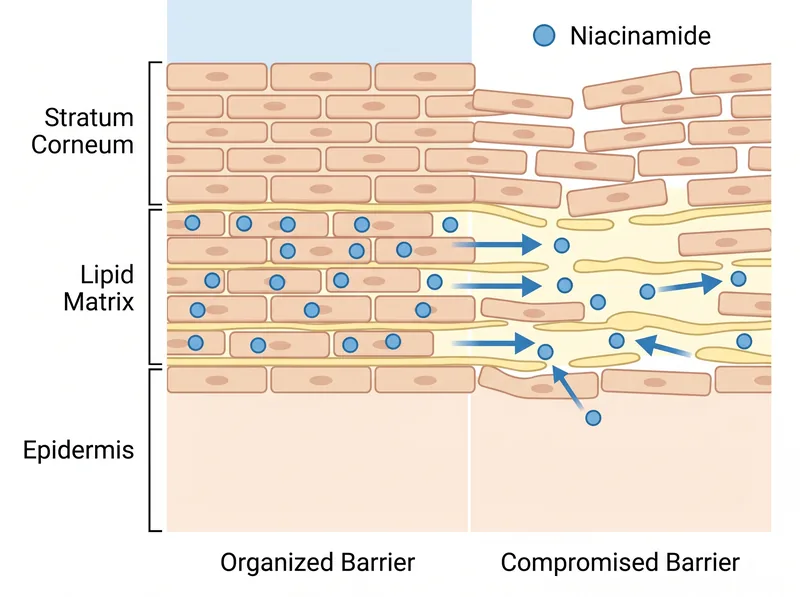 How niacinamide reinforces the skin barrier’s lipid matrix, particularly important when humidity and hard water compromise barrier integrity.
Why Niacinamide Works Differently in Humid Climates
Niacinamide (vitamin B3) is a water-soluble vitamin that your skin can actually use topically. Unlike many trendy ingredients, it has decades of peer-reviewed research showing real barrier repair, sebum regulation, and anti-inflammatory effects. But here’s what the standard skincare advice misses: humidity changes how niacinamide penetrates and performs.
In dry climates, niacinamide works primarily as a barrier strengthener, helping your skin hold onto moisture it’s struggling to retain. In humid climates, it does something more complex. It regulates the barrier’s response to constant moisture fluctuation while simultaneously controlling the sebum overproduction that happens when your skin can’t tell the difference between external humidity and internal hydration.
Research published in the British Journal of Dermatology found that niacinamide increases ceramide synthesis by up to 34% in compromised barriers. Ceramides are the lipid molecules that literally hold your skin cells together. When hard water strips these lipids (the same way it strips natural oils from your scalp), your barrier develops microscopic gaps. Humidity makes this worse because moisture moves in and out of these gaps constantly, preventing them from healing.
Niacinamide addresses this by signaling your skin to produce more ceramides, essentially giving your barrier the raw materials it needs to repair itself. But this only works if you’re not actively damaging the barrier faster than niacinamide can repair it. That’s where understanding hard water’s effect on your skin barrier becomes critical.
The Sebum Regulation Effect Nobody Explains Properly
If your skin feels oily by noon despite using mattifying products, you’re experiencing the humidity-sebum feedback loop. Your skin produces oil in response to barrier damage, not just because it’s hot. When hard water compromises your barrier, your sebaceous glands go into overdrive trying to compensate. Humidity makes this visible immediately because the moisture in the air prevents the sebum from evaporating or absorbing.
Niacinamide regulates sebum at the source by reducing the size and activity of sebaceous glands. A study in the Journal of Cosmetic and Laser Therapy showed that 2% niacinamide reduced sebum production by 30% after four weeks of twice-daily use. But here’s the part that matters for humid climates: this regulation happens without compromising barrier function. Your skin produces less oil because it needs less oil, not because you’ve stripped it.
This is fundamentally different from how most oil-control products work. Salicylic acid, clay masks, and alcohol-based toners reduce oil by drying or exfoliating. They might work short-term, but they damage your barrier further, which triggers more sebum production in a vicious cycle. Niacinamide breaks that cycle by addressing barrier integrity first.
The timeline matters. You won’t see sebum regulation in three days. Most women notice a difference around week three, with optimal results by week eight. If you’re using niacinamide and still seeing excessive oil after two months, the issue isn’t the ingredient. It’s likely ongoing barrier damage from your water, your cleanser, or environmental factors you haven’t addressed yet.
 Applying niacinamide on damp skin in humid climates can enhance absorption, but only if your barrier isn’t already compromised.
Concentration, Formulation, and What Actually Penetrates
The skincare industry loves high percentages because they sound impressive. You’ll see 20% niacinamide serums marketed as more effective. They’re not. Research shows that concentrations above 10% don’t increase efficacy and may increase irritation, particularly in already-compromised barriers.
The optimal range for barrier repair is 5-10% niacinamide. At this concentration, you get maximum ceramide synthesis, sebum regulation, and anti-inflammatory effects without overwhelming a stressed barrier. If your skin is currently irritated, start at 5%. If your barrier is relatively healthy but you’re dealing with sebum or pigmentation issues, 10% is appropriate.
Formulation matters as much as concentration. Niacinamide is water-soluble, so it works best in lightweight, water-based serums that can penetrate before you apply heavier moisturisers. In humid climates, this is particularly important because heavy formulations sit on the skin surface rather than absorbing. Look for serums with niacinamide listed in the first three ingredients, formulated with humectants like hyaluronic acid or glycerin that help it penetrate.
One formulation rule that’s critical in Gulf climates: avoid niacinamide products with high percentages of silicones. Silicones create an occlusive barrier that traps moisture, which sounds good until you realize they also trap the environmental humidity, sebum, and any mineral residue from your water. You end up with a sealed layer of problems. Water-based niacinamide serums absorb cleanly and don’t create this occlusive trap.
How to Layer Niacinamide in a Humid Climate Routine
The standard skincare layering advice (thinnest to thickest) doesn’t account for humidity. In Gulf climates, you need to think about what actually absorbs versus what sits on your skin attracting moisture and dust. Niacinamide should go on clean, slightly damp skin immediately after cleansing, before anything else.
Here’s why: when your skin is slightly damp, the water channels in your stratum corneum are open. Niacinamide penetrates more effectively in this state. But this only works if your skin is clean from mineral buildup. If you’re cleansing with hard water and not using a chelating cleanser periodically, you’re applying niacinamide over a layer of calcium and magnesium deposits. It can’t penetrate properly, and you won’t see results.
After niacinamide absorbs (give it 60 seconds), you can layer other actives if needed. Niacinamide plays well with most ingredients, including retinoids, vitamin C, and AHAs, despite outdated advice suggesting otherwise. The one exception: don’t mix it with very low pH products (below pH 3) in the same step, as this can convert niacinamide to niacin and cause flushing. Layer them separately with time in between.
In the morning, niacinamide goes under sunscreen. At night, it goes under your moisturiser. If you’re using a retinoid, niacinamide first actually buffers some of retinoid’s irritation while maintaining efficacy. This is particularly valuable in climates where your barrier is already stressed. The anti-inflammatory effects of niacinamide help your skin tolerate stronger actives without the typical irritation response.
The Hard Water Connection: Why Mineral Removal Matters First
This is where skincare advice from temperate climates fails women in the Gulf. Niacinamide can’t repair a barrier that’s being actively damaged faster than it can heal. Hard water creates a continuous cycle of lipid stripping and mineral deposition that compromises barrier function daily. Adding niacinamide without addressing this is like trying to fill a bucket with holes.
The calcium and magnesium in hard water bind to the lipids in your skin barrier, literally pulling them away from the surface. This creates the tight, dry feeling after washing that many women mistake for ‘clean.’ It’s not clean. It’s stripped. Niacinamide can increase ceramide production, but if you’re stripping lipids every time you wash your face, you’re in a losing battle.
The solution isn’t complicated, but it does require acknowledging that your water is part of your skincare routine. Using a chelating cleanser once or twice a week removes the mineral buildup that prevents your other products from working. Think of it like the chelating approach for scalp health. Your face and scalp are both skin. The same mineral buildup logic applies.
For daily cleansing, choose a gentle, pH-balanced cleanser that doesn’t further compromise your barrier. Save your chelating cleanser for periodic deep cleans. On those days, follow immediately with niacinamide while your skin is still damp and mineral-free. This is when you’ll see the most dramatic absorption and results. Some women describe it as their skin ‘drinking’ the serum. That’s penetration, not marketing.
What to Expect: Realistic Timeline and Results
Niacinamide isn’t an instant gratification ingredient. If you’re used to acids that show visible exfoliation in days, you’ll need to adjust your expectations. Barrier repair happens at the cellular level over weeks, not days. Here’s what a realistic timeline looks like.
Week one: Most women notice nothing dramatic. Some experience slight flushing if their barrier is very compromised. This usually resolves as the barrier strengthens. If flushing persists beyond week two, you’re either using too high a concentration or your barrier needs more basic repair before introducing actives.
Weeks two to four: This is when sebum regulation becomes visible. Your skin produces less oil throughout the day. You might notice your makeup lasting longer or your blotting papers lasting an extra hour or two. Barrier repair is happening but not yet visible. Your skin might feel slightly more resilient, less reactive to temperature changes or air conditioning.
Weeks six to eight: Barrier repair becomes visible. Your skin looks more even-toned because niacinamide inhibits melanosome transfer, reducing the appearance of hyperpigmentation. Fine lines may appear less pronounced because a stronger barrier holds moisture more effectively. This is also when the anti-inflammatory effects become obvious. Redness, irritation, and sensitivity decrease noticeably. Many women report that products that previously stung or irritated now absorb comfortably.
Beyond three months: This is maintenance territory. Your barrier is stronger, your sebum production is regulated, and your skin tolerates environmental stress better. You might find you need less product overall because your barrier is functioning properly. This is the goal: a self-regulating system that doesn’t require constant intervention.
When Niacinamide Doesn’t Work: What’s Actually Wrong
If you’ve used niacinamide for three months and seen no improvement, the ingredient isn’t the problem. Something else in your routine or environment is preventing it from working. Here are the most common barriers to niacinamide efficacy in Gulf climates.
First: ongoing mineral damage. If you’re still cleansing with hard water daily without periodic chelation, you’re stripping your barrier faster than niacinamide can repair it. The solution is a chelating shampoo used on your scalp and a chelating cleanser for your face. Products like Regrowth+ chelating shampoo work on both scalp and face because the chemistry is the same. Mineral buildup is mineral buildup regardless of where it occurs.
Second: formulation incompatibility. If you’re layering niacinamide under heavy silicone-based products, it’s not penetrating. Switch to water-based formulations across your routine, particularly in humid climates where occlusive products trap problems rather than solving them.
Third: percentage mismatch. If your barrier is severely compromised and you’re using 10-20% niacinamide, you’re overwhelming it. Drop to 5% and focus on basic barrier repair first. Add stronger actives once your barrier can handle them. There’s no award for using the highest percentage. There’s only results or irritation.
Fourth: unrealistic expectations. Niacinamide won’t erase deep wrinkles, eliminate severe acne, or reverse significant sun damage. It’s a barrier-repair and regulation ingredient, not a miracle worker. If you’re expecting dramatic transformation, you’re setting yourself up for disappointment. What niacinamide does do is create the foundation for other treatments to work more effectively by giving you a healthy, functional barrier.
References
- Nicotinamide improves the epidermal permeability barrier in vivo - British Journal of Dermatology
- The effect of niacinamide on reducing cutaneous pigmentation and suppression of melanosome transfer - Journal of Cosmetic and Laser Therapy
- Niacinamide: A B vitamin that improves aging facial skin appearance - PubMed Central
- Topical nicotinamide modulates cellular energy metabolism and provides broad-spectrum protection against ultraviolet radiation damage - PubMed