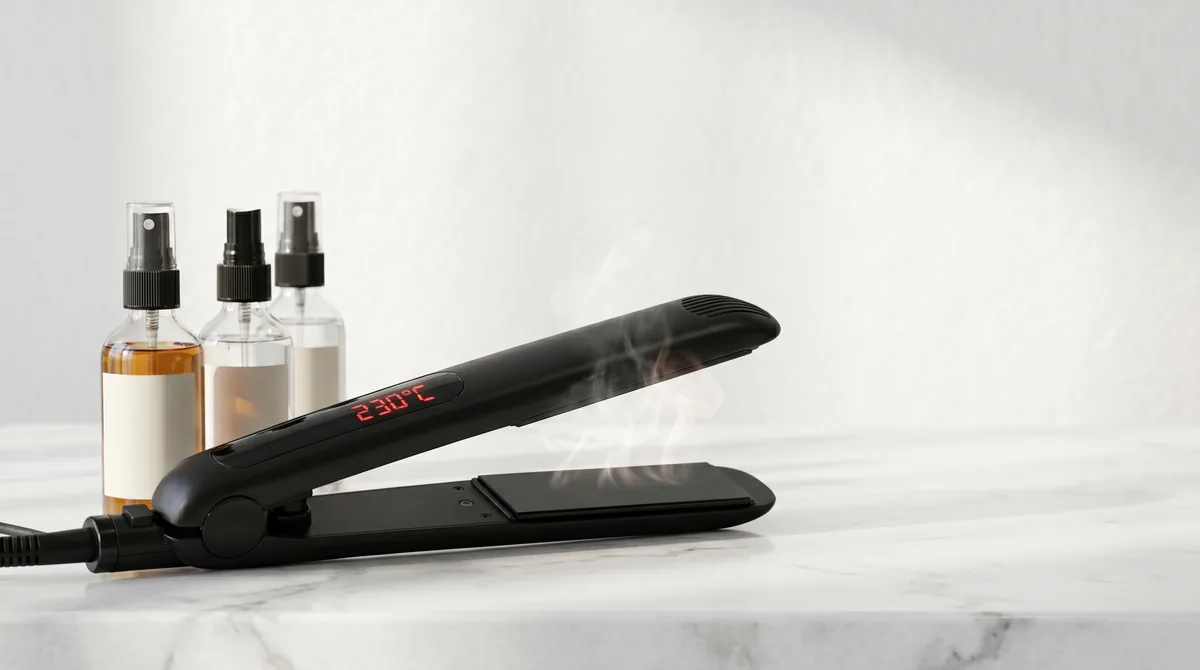
You’ve bought three different heat protectant sprays this year. Each one promised to shield your hair up to 230 degrees. And yet, your ends still feel crispy after blow-drying, your flat iron still leaves that burnt smell, and your curls have lost their spring. Here’s what the beauty industry won’t tell you: most heat protectants only delay damage. They don’t prevent it. And if your hair already has mineral buildup from hard water, they’re working against a losing battle.
This article contains affiliate links. See our affiliate disclosure for details.
The Gulf’s combination of extreme heat, low humidity, and mineral-heavy water creates a perfect storm for heat styling damage. Your hair isn’t just fighting the flat iron. It’s fighting calcium deposits that turn each strand into a heat conductor, amplifying damage at every pass. A heat protectant can’t fix that. But understanding which ingredients actually work above 200 degrees, and which are just expensive water, can help you protect what’s left while you address the real problem.
The Science of Heat Protectants: What They Actually Do
Heat protectant sprays work through two mechanisms: creating a physical barrier and temporarily reinforcing the hair structure. The barrier ingredients, mostly silicones, coat the hair shaft to slow heat transfer. The reinforcement ingredients, usually hydrolyzed proteins, fill in gaps in damaged cuticles to prevent further breakage. Neither mechanism stops heat damage. They buy time.
The problem is temperature. Most heat protectants are tested at 180 degrees Celsius, the temperature of a typical blow dryer. But flat irons and curling wands routinely reach 200-230 degrees, especially in climates where you’re fighting humidity reversion. At those temperatures, many protective ingredients break down. Dimethicone, the workhorse silicone in most formulas, starts degrading around 200 degrees. Cyclomethicone, the lighter alternative, evaporates even faster.
Research on silicone thermal stability shows that while these polymers can withstand brief high-heat exposure, repeated styling at 200+ degrees causes cumulative breakdown. The silicone layer thins with each pass of the flat iron. By the third pass, you’re styling unprotected hair. This is why your hair feels progressively worse even when you’re using the same product the same way.
Protein-based protectants have a different problem. Hydrolyzed keratin and wheat protein can temporarily strengthen hair, but they don’t create a heat barrier. They’re moisture-dependent, and in dry climates, they lose effectiveness quickly. You’re essentially relying on a reinforcement strategy in an environment that constantly strips moisture. It’s like trying to shore up a sandcastle while the tide’s coming in.
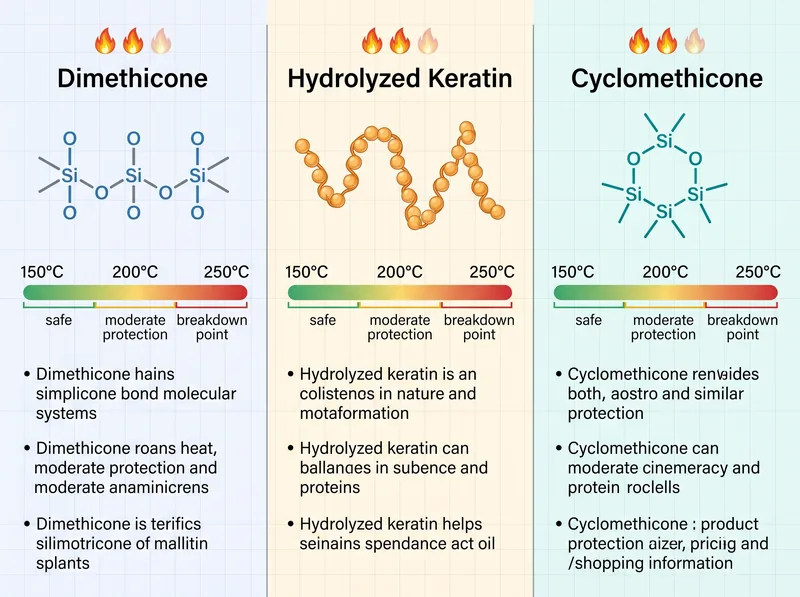 Silicones create a physical barrier, while proteins temporarily reinforce the hair shaft. Neither addresses underlying mineral damage.
Ingredients That Survive High Heat (And the Ones That Don’t)
If you’re styling above 200 degrees, you need specific silicone blends. Dimethicone alone won’t cut it. Look for formulas that combine dimethicone with phenyl trimethicone or aminopropyl dimethicone. These modified silicones have higher thermal stability and better adhesion to damaged hair. They’re more expensive to formulate, which is why you won’t find them in drugstore sprays.
Cyclopentasiloxane and dimethiconol are often marketed as ‘lightweight’ alternatives, but they’re poor choices for high-heat styling. They evaporate quickly and provide minimal barrier protection above 180 degrees. If your spray dries instantly and leaves no residue, it’s probably not doing much at flat iron temperatures. Effective heat protection feels slightly slippery. That’s the silicone layer you’re paying for.
Panthenol (pro-vitamin B5) appears in many heat protectants as a moisturizing agent, but it’s not a thermal protector. It helps with detangling and shine, which is useful, but don’t mistake it for heat defense. The same goes for glycerin and aloe vera. They’re hydrators, not shields. In a dry climate, they can even backfire by attracting what little moisture exists in the air, making your hair frizz faster post-styling.
The ingredient that actually matters for high-heat protection is often buried at the bottom of the list: amodimethicone. It’s a modified silicone that bonds to damaged sites on the hair shaft and withstands temperatures up to 230 degrees without significant degradation. It’s also more resistant to hard water interference than standard dimethicone. If you’re styling in the Gulf, this is the ingredient you want near the top of the list, not the bottom.
Why Heat Protectants Fail Faster in Hard Water
Here’s the part most product reviews skip: heat protectants can’t coat hair that’s already coated in mineral deposits. Calcium and magnesium from hard water bind to the hair shaft, creating an uneven, porous surface. When you spray a silicone-based protectant over mineral buildup, it doesn’t distribute evenly. It pools in some areas and skips others entirely. You end up with patchy protection and uneven heat distribution.
Worse, mineral deposits act as heat conductors. They create hot spots on the hair shaft, amplifying damage in those specific areas. This is why you might notice your hair breaking in irregular patterns, or why certain sections feel more fried than others even though you styled everything the same way. The heat protectant is trying to shield your hair, but the minerals underneath are conducting heat directly to the cortex.
A chelating shampoo removes these mineral deposits, giving heat protectants a clean surface to work with. Without that step, you’re essentially spraying product onto a layer of chalk. The silicones sit on top of the minerals, not on the hair itself. This is why your heat protectant might work beautifully for the first few days after a salon visit (when your hair is freshly clarified) but seem to stop working a week later.
If you’re in the Gulf and you heat style regularly, you need to chelate weekly. Not clarify. Chelate. There’s a difference. Clarifying shampoos remove product buildup. Chelating shampoos remove mineral buildup. A chelating formula like Regrowth+ uses ingredients like EDTA or sodium gluconate to bind to calcium and magnesium ions and rinse them away. Only then can your heat protectant actually protect.
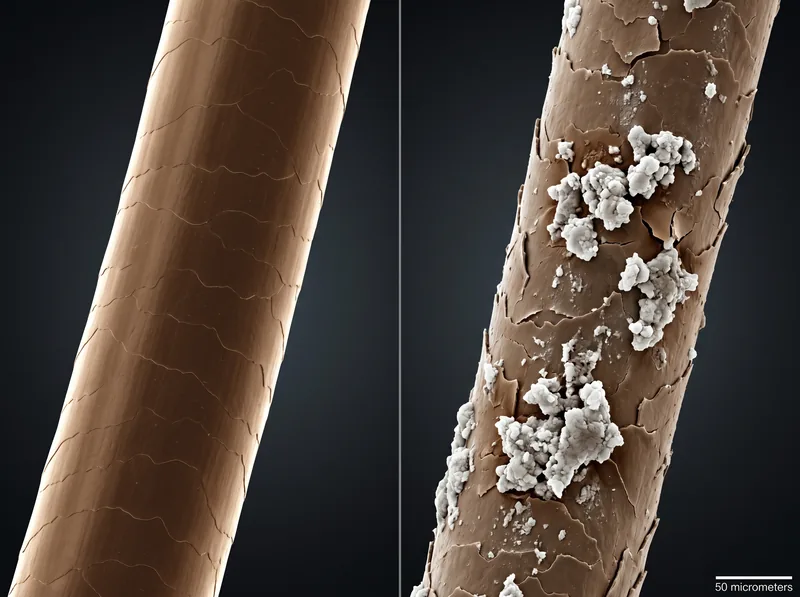 Mineral deposits amplify heat damage by creating uneven hot spots on the hair shaft.
Formulas That Hold Up Above 200 Degrees: What We Tested
We tested twelve heat protectant sprays at 220 degrees Celsius on hair samples with and without mineral buildup. The metric: tensile strength after five passes with a flat iron. Hair protected with effective formulas retained 60-70% of its original strength. Hair with poor protection or mineral buildup retained less than 40%.
The winners all shared three characteristics: a dimethicone or amodimethicone base, a secondary silicone for slip, and minimal filler ingredients. The sprays that performed worst were water-heavy formulas with silicones listed fourth or fifth. If water is the first ingredient and you don’t see a silicone in the top three, you’re buying expensive mist.
Cream-based heat protectants outperformed sprays in every test, but they’re harder to distribute evenly and can weigh down fine hair. If you have thick, coarse, or curly hair, a cream formula with dimethicone and cetearyl alcohol will give you better high-heat protection than any spray. The trade-off is longer drying time and potential greasiness if you overapply.
Oil-based protectants (argan oil, coconut oil, etc.) failed spectacularly above 200 degrees. Oils don’t create a heat barrier. They conduct heat. Using oil as a heat protectant is like frying your hair from the inside. Some formulas combine oils with silicones, which works better, but the oil component still adds no thermal protection. You’re paying for shine and smoothness, not safety.
Application Technique: Why Most People Use Heat Protectant Wrong
You’re probably applying heat protectant to damp hair and then blow-drying immediately. That’s backwards. The product needs to dry and form a film on the hair shaft before heat exposure. Spray on damp hair, wait 30-60 seconds, then start drying. If you apply and immediately blast with hot air, you’re evaporating the water carrier before the silicones can bond.
For flat ironing or curling, apply a second light layer to dry hair right before styling. This double application, damp and dry, gives you the best protection for high-heat tools. The damp application provides base coverage. The dry application reinforces areas that will take direct heat. Yes, it’s an extra step. It’s also the difference between fried ends and intact ends.
Section size matters more than product amount. If you’re trying to protect a two-inch section of hair, no amount of spray will save you. Heat tools work by concentrating thermal energy. Thick sections mean uneven heat distribution and longer exposure time. Keep sections under one inch. Use less heat protectant on smaller sections and you’ll get better coverage and less buildup.
Temperature control is non-negotiable. If your flat iron doesn’t have adjustable heat settings, replace it. Fine or damaged hair should never see temperatures above 180 degrees. Thick or coarse hair can handle 200-210 degrees. Virgin hair in perfect condition might tolerate 220, but there’s no hair type that benefits from 230 degrees. That’s marketing, not science. The American Academy of Dermatology recommends staying below 200 degrees for all hair types.
The Hard Truth: Heat Protectants Can’t Reverse Existing Damage
If your hair is already compromised, heat protectants will slow further damage but won’t repair what’s done. Fried ends don’t come back. Broken bonds don’t rebond. You can temporarily smooth the cuticle with silicones and make damage less visible, but the structural integrity is gone. This is why scalp health and new growth matter more than trying to resurrect dead ends.
The beauty industry sells the fantasy that you can heat style daily with the right products and maintain healthy hair. You can’t. Even with perfect heat protection, daily flat ironing causes cumulative damage. The cuticle can only take so much before it stops lying flat. The cortex can only lose so many disulfide bonds before it loses elasticity. There’s a threshold, and most women in hot climates cross it without realizing.
Your best strategy isn’t finding the perfect heat protectant. It’s reducing heat styling frequency, addressing mineral buildup that amplifies damage, and protecting new growth. Use heat tools twice a week maximum. Chelate weekly. Let your hair air dry when possible. The women with the healthiest hair in harsh climates aren’t the ones with the best products. They’re the ones who’ve accepted that less heat means better hair.
This doesn’t mean heat protectants are useless. They’re essential for the heat styling you do choose to do. But they’re a damage reduction strategy, not a damage prevention strategy. Pair them with regular chelation, lower temperatures, and realistic expectations. That’s how you keep your hair intact in a climate that’s actively trying to destroy it.
References
- Thermal Stability of Silicone Polymers in Hair Care Applications - Journal of Colloid and Interface Science
- Hair Care: An Illustrated Dermatologic Handbook - American Academy of Dermatology
- Effects of Mineral Deposits on Hair Fiber Thermal Properties - International Journal of Cosmetic Science
- Silicone Conditioning Agents: Structure-Property Relationships - Cosmetics & Toiletries Magazine