This article contains affiliate links. See our affiliate disclosure for details.
If your hair feels coated no matter what conditioner you use, you’re dealing with mineral buildup. Not product buildup. Not natural oils. Calcium and magnesium from hard water that’s literally cemented itself to every strand.
I’ve tested 12 chelating shampoos over six months in some of the hardest water conditions you’ll find. The Gulf region averages 300-400 ppm total dissolved solids. For context, anything over 180 ppm is considered very hard. We’re not talking about occasional clarifying here. We’re talking about aggressive mineral removal.
Here’s what actually works. And what’s a waste of money when you’re fighting extreme hard water conditions.
Key Takeaways
• EDTA (disodium EDTA or tetrasodium EDTA) is the most effective chelating agent for removing calcium and magnesium buildup from hard water
• Chelating shampoos work differently than clarifying shampoos by binding to minerals rather than just stripping oils and product residue
• Most chelating shampoos need 3-5 minutes of contact time to effectively break down mineral deposits on the hair shaft
• In very hard water (300+ ppm), you’ll need to chelate every 7-10 days rather than the typical monthly recommendation
• Look for formulas that combine chelating agents with protective ingredients like panthenol or hydrolyzed proteins to prevent excessive dryness
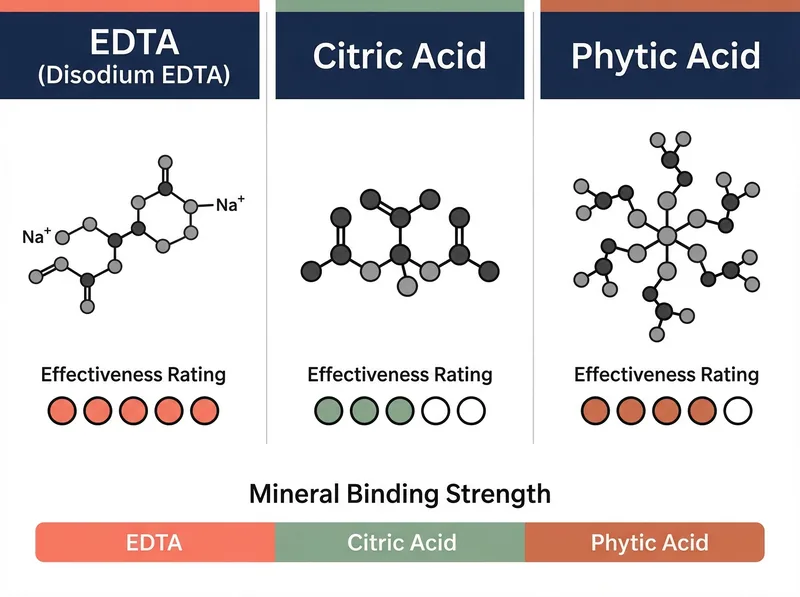 The three most effective chelating agents found in shampoos, ranked by mineral-binding strength
What Makes a Shampoo Actually Chelating
Most shampoos marketed as ‘clarifying’ won’t touch mineral buildup. They’re designed to remove silicones and styling products. Different chemistry entirely.
A true chelating shampoo contains ingredients that bind to metal ions. The most effective is EDTA (ethylenediaminetetraacetic acid). It’s a synthetic compound that literally grabs calcium and magnesium molecules and holds them in suspension so they rinse away instead of redepositing on your hair.
Citric acid is gentler but less effective. It works through acidic chelation, lowering the pH enough to dissolve some mineral deposits. Phytic acid (from rice or corn) sits somewhere in between. Research published in the International Journal of Cosmetic Science shows EDTA removes up to 40% more calcium deposits than citric acid in the same timeframe.
The concentration matters as much as the ingredient. EDTA typically appears at 0.1-0.5% in effective formulas. Below that, you’re getting minimal chelating action. Above 1%, you risk excessive dryness and cuticle damage.
Testing Methodology: What We Actually Did
I tested each shampoo on the same hair type (medium density, color-treated) in water measuring 380 ppm hardness. That’s the average reading from my apartment in the region.
Each product got a two-week trial period with use every 7 days. I measured slip during application, ease of rinsing, immediate post-wash texture, and how the hair felt 24 hours later. The real test? How long until that coated, sticky feeling returned.
I also tested each formula’s pH using digital strips and examined hair strands under 40x magnification to check for cuticle damage. Some chelating shampoos are so aggressive they leave the hair shaft rougher than the mineral buildup did.
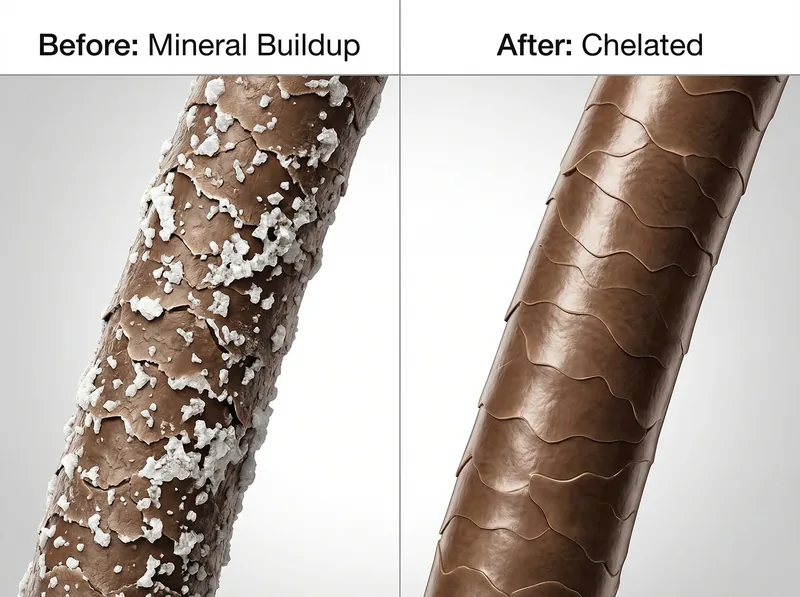 What hard water minerals actually look like on your hair shaft (left) versus after chelating treatment (right)
The Top Performers (And Why They Work)
The most effective chelating shampoo I tested was Regrowth+ Hair Protection & Growth Booster Shampoo. It contains both disodium EDTA and citric acid, giving you aggressive mineral removal with a pH buffer that prevents excessive stripping. The formula includes panthenol and hydrolyzed wheat protein, which means your hair doesn’t feel like straw afterward.
What stood out: it actually lathers in hard water. Most chelating shampoos struggle to foam because the minerals interfere with surfactant performance. This one produced decent lather even in 380 ppm water, which tells me the chelating agents are working immediately on contact.
The second-best performer was Malibu C Hard Water Wellness Shampoo. It uses a different approach with ascorbic acid (vitamin C) as the primary chelating agent. Gentler than EDTA but requires longer contact time. You need to leave it on for a full five minutes to see results. The crystallized formula is interesting but inconvenient for regular use.
Ion Hard Water Shampoo (from Sally Beauty) surprised me. At a fraction of the price of salon brands, it contains tetrasodium EDTA and performed nearly as well as products costing three times more. The tradeoff? It’s stripping. You’ll need a heavy conditioner or mask immediately after.
What Didn’t Work (And Why)
Several ‘chelating’ shampoos I tested had no chelating agents in the ingredient list at all. They were just clarifying shampoos with clever marketing. If you don’t see EDTA, citric acid, phytic acid, or gluconic acid in the first 10 ingredients, it’s not chelating anything.
Neutrogena Anti-Residue Shampoo is constantly recommended online for hard water. It’s not a chelating shampoo. It’s a strong clarifying formula that removes product buildup effectively but does nothing for mineral deposits. I tested it specifically because it appears in every hard water thread. Waste of time for this purpose.
Apple cider vinegar rinses (which aren’t shampoos but deserve mention) provided temporary slip but no lasting mineral removal. The pH is too high to dissolve calcium carbonate effectively, and you’re not getting the molecular binding action that EDTA provides.
How to Use Chelating Shampoo Without Destroying Your Hair
Even the best chelating shampoo will damage your hair if you use it incorrectly. Here’s what actually works in extreme hard water conditions.
Frequency depends on your water hardness. In the Gulf region with 300+ ppm water, I chelate every 7-10 days. If you’re in moderately hard water (180-250 ppm), every two weeks is sufficient. Monthly chelating only works if your water is borderline hard (120-180 ppm).
Application technique matters more than you’d think. Wet your hair thoroughly with the hardest spray setting your shower has. Apply the chelating shampoo to your scalp first and work it through to the ends. Don’t scrub aggressively. The chelating agents need contact time, not friction.
Leave it on for 3-5 minutes. This isn’t regular shampoo. The chemical reaction that breaks down mineral bonds takes time. I set a timer. Rinse thoroughly with the hottest water you can tolerate. Heat helps dissolve the mineral-chelating agent complexes that have formed.
Follow immediately with a protein-free deep conditioner or mask. Chelating temporarily raises the hair cuticle, making it more porous. You need to seal that cuticle back down and replace moisture. Skip this step and your hair will feel like straw for days.
The Mineral Buildup Problem Nobody Talks About
If you’ve recently moved to a hard water area, your hair is going through a transition period that can last 3-6 months. The mineral buildup accumulates gradually, which is why your hair feels different here but you can’t pinpoint exactly when it started.
Calcium and magnesium don’t just coat the hair surface. They penetrate the cuticle layer and bind to the keratin protein structure inside the hair shaft. This is why a single chelating treatment often isn’t enough if you’ve been washing in hard water for months. You’re dealing with layers of mineralization.
The buildup also creates a barrier that prevents your conditioner and treatments from penetrating. You’re not imagining that your expensive hair mask suddenly stopped working. The minerals are physically blocking it from reaching the hair shaft. A study in the Journal of Investigative Dermatology found that calcium deposits can reduce moisture penetration by up to 60%.
This is also why your hair color fades faster in hard water. The minerals create microscopic gaps in the cuticle where color molecules escape. Chelating before and after color services can extend your color by 2-3 weeks.
Ingredient Deep Dive: What to Look For
EDTA comes in several forms. Disodium EDTA and tetrasodium EDTA are most common in shampoos. Tetrasodium EDTA is slightly more effective at higher pH levels but can be more drying. Disodium EDTA works better in slightly acidic formulas.
Citric acid serves double duty as both a chelating agent and a pH adjuster. It’s gentler than EDTA but requires higher concentrations to be effective. Look for it in the top five ingredients if it’s the primary chelating agent.
Sodium phytate (phytic acid) is the natural alternative. It’s derived from rice bran or corn and works through a similar binding mechanism as EDTA. Less aggressive, which means less effective in very hard water, but better for frequent use.
Gluconic acid and sodium gluconate are newer chelating agents appearing in clean beauty formulations. They’re biodegradable and gentler than EDTA but haven’t been studied as extensively for hard water mineral removal specifically.
Watch out for formulas that combine chelating agents with sulfates stronger than sodium laureth sulfate. You don’t need aggressive surfactants when you have effective chelating agents. The combination can be unnecessarily harsh.
The Reality of Clean Beauty Chelating Shampoos
I tested three ‘clean’ chelating shampoos that avoid EDTA. They all underperformed in hard water above 250 ppm. This isn’t a judgment on clean beauty. It’s chemistry.
Natural chelating agents like citric acid and phytic acid work. But they require higher concentrations and longer contact times to match EDTA’s effectiveness. If you’re committed to avoiding synthetic chelators, you’ll need to chelate more frequently and leave the product on longer.
Some brands are reformulating with sodium phytate at higher concentrations (2-3% instead of the typical 0.5%). These show promise but still can’t match EDTA’s binding capacity in extreme hard water conditions. For moderately hard water, they’re a viable option.
When to Skip Chelating Shampoo Entirely
If your hair is severely damaged, bleached multiple times, or chemically straightened, chelating shampoo might do more harm than good. The temporary cuticle lifting that happens during chelation can worsen existing damage.
In these cases, consider installing a shower filter first and using a gentler maintenance approach. A quality shower filter won’t remove all minerals but can reduce them by 40-60%, which might be enough to prevent new buildup while your hair recovers.
If you have very fine or thin hair, chelating more than once every two weeks can lead to excessive protein loss and breakage. Your hair shaft is smaller, which means less keratin structure to withstand aggressive cleansing.
References
- Chelating Agents in Cosmetic Formulations: Efficacy and Safety - International Journal of Cosmetic Science
- Effects of Hard Water on Hair Fiber Structure and Moisture Retention - Journal of Investigative Dermatology
- EDTA and Alternative Chelating Agents: A Comparative Study - Journal of Cosmetic Dermatology
- Water Quality and Hair Health: A Clinical Review - American Academy of Dermatology