
You moved six months ago. The job is good. The apartment is fine. But your hair is coming out in handfuls every time you shower, and you can see your scalp in photos when you never could before. You’re not imagining it. This is telogen effluvium, a specific type of temporary hair loss that sends a disproportionate number of follicles into the shedding phase simultaneously. And if you’re an expat, you’re at significantly higher risk than you were before you relocated.
This article contains affiliate links. See our affiliate disclosure for details.
Telogen effluvium (TE) is the second most common form of hair loss after androgenetic alopecia, but it’s the most common cause of sudden, diffuse shedding in women. It’s triggered by physiological or psychological stress that changes the normal hair growth cycle. What makes it particularly relevant for expats is that international relocation combines multiple TE triggers simultaneously: emotional stress, climate adaptation, dietary changes, sleep changeion, and in many cases, exposure to mineral-heavy water that compounds the problem during an already vulnerable recovery period.
Here’s what you need to know about telogen effluvium, why expat life makes you susceptible, and what actually helps when your hair is in this acute shedding phase. Medically reviewed by Dr. Layla Hassan, Trichologist.
Understanding the Hair Growth Cycle and What Goes Wrong
Your hair doesn’t grow continuously. Each follicle cycles through three distinct phases: anagen (active growth, lasting 2-7 years), catagen (transition, lasting 2-3 weeks), and telogen (rest, lasting 3-4 months). At any given time, about 85-90% of your follicles are in anagen, 1-2% are in catagen, and 8-14% are in telogen. This is why you naturally shed 50-100 hairs daily without noticing thinning.
Telogen effluvium changes this balance. A triggering event causes a disproportionate number of follicles to prematurely shift from anagen into telogen. Instead of the normal 8-14%, suddenly 30-50% of your follicles enter the resting phase. Because telogen lasts 3-4 months before the hair actually sheds, you don’t notice the problem until months after the trigger occurred. This delayed timeline is why many expats don’t connect their hair loss to their relocation, the connection isn’t immediately obvious.
The shedding itself can last 3-6 months once it starts. You’re not losing the follicles, just the hair shafts. The follicles remain intact and capable of producing new hair. But during the acute phase, you can shed 300-400 hairs daily, which is terrifying when you’re watching it happen. Research published in the International Journal of Trichology confirms that TE is fully reversible in most cases, but recovery requires addressing the underlying trigger and giving follicles time to reset their growth cycle.
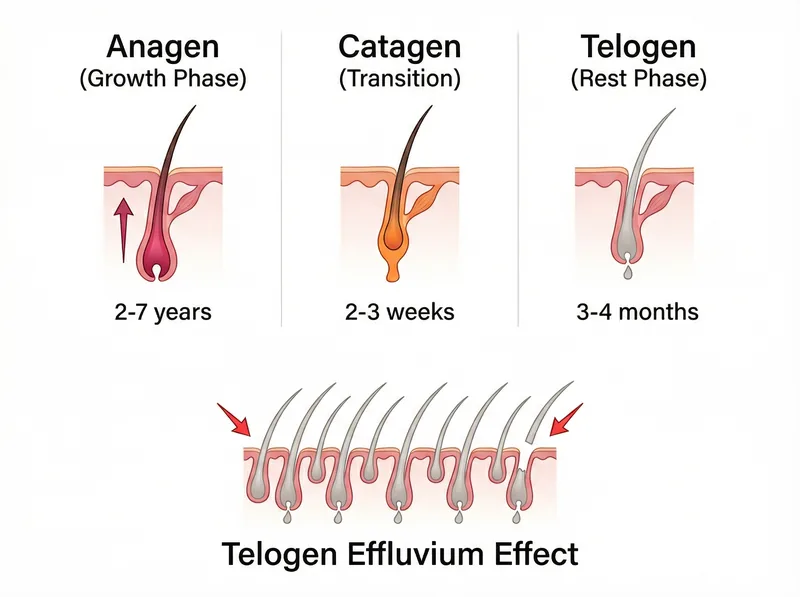 Normal hair cycles through growth, transition, and rest phases. Telogen effluvium forces a disproportionate number of follicles into the resting phase simultaneously.
Why Relocation Is a Perfect Storm for Telogen Effluvium
International moves aren’t just stressful, they’re physiologically significant in ways that directly trigger TE. You’re not dealing with one stressor. You’re dealing with five or six simultaneously, and your body responds by shutting down non-essential functions like hair growth to conserve resources for survival.
The stress response is the most obvious trigger. Relocation involves chronic cortisol improvion: leaving your support network, adapting to a new culture, navigating unfamiliar systems, managing visa uncertainty, and often dealing with professional pressure in a new role. Studies on stress-induced hair loss show that sustained cortisol improvion changes the hair cycle by shortening anagen and pushing follicles prematurely into telogen. This isn’t about being weak or poorly adjusted. It’s a biological response to significant life change.
Climate adaptation compounds the problem. Moving from a temperate climate to extreme heat triggers physiological stress as your body works to maintain homeostasis. The first-year adaptation period is metabolically expensive. Your body is burning through nutrients faster than usual while simultaneously dealing with increased water loss through perspiration. This creates a resource deficit that affects hair growth.
Then there’s the circadian changeion. Crossing multiple time zones scrambles your sleep-wake cycle, and irregular sleep directly impacts hair growth. Follicles are highly sensitive to circadian rhythm changeion because cell division in the hair bulb happens on a tightly regulated schedule. Poor sleep during the adjustment period can independently trigger TE, even without other stressors present.
The Hard Water Factor: Why Recovery Takes Longer Here
What makes telogen effluvium particularly frustrating for expats in the Gulf region isn’t just the triggering, it’s the prolonged recovery. Hair that should start regrowing within 6-9 months often takes 12-18 months to show visible improvement. The environmental factor that extends this timeline is mineral-heavy water.
During telogen effluvium, your scalp is in a vulnerable state. Follicles are trying to transition back into anagen and produce new hair shafts. But hard water creates a mineral film on the scalp that interferes with this process. Calcium and magnesium deposits accumulate around follicle openings, creating a physical barrier that impedes new hair emergence. The new growth is there, it’s just struggling to break through the surface.
The mineral buildup also creates chronic low-grade scalp inflammation. Your scalp becomes reactive, itchy, and prone to flaking. This inflammatory environment isn’t conducive to healthy regrowth. Research on scalp health and hair growth shows that follicles in inflamed tissue produce thinner, weaker hair shafts, even after the TE trigger has resolved. You end up with regrowth that’s noticeably different in texture and diameter from your pre-TE hair.
This is where a chelating shampoo becomes relevant. Products like Regrowth+ are specifically formulated to remove mineral deposits without stripping the scalp. Used once or twice weekly during the recovery phase, chelating shampoos clear the buildup that’s impeding regrowth. It doesn’t speed up the hair cycle, nothing can, but it removes one environmental obstacle that’s making recovery harder than it needs to be.
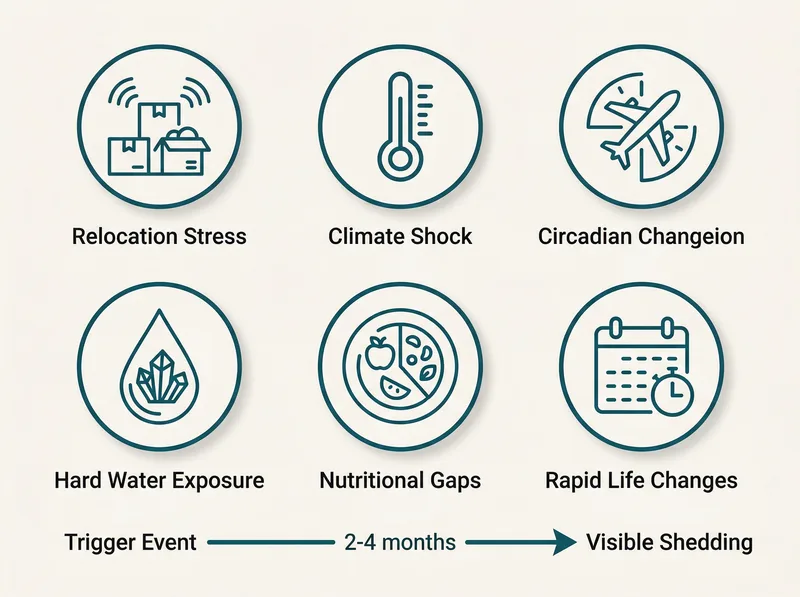 Relocation combines multiple TE triggers simultaneously, which is why expats experience higher rates of diffuse shedding.
Common Triggers Expats Experience (Beyond the Obvious Stress)
Relocation stress is the headline trigger, but several other factors contribute to TE in expat populations. Recognising these helps you understand why your hair loss might be more severe or prolonged than expected.
Nutritional gaps are common during the adjustment period. You’re eating different foods, shopping in unfamiliar stores, and often relying on restaurants more than you did at home. Iron deficiency is particularly prevalent among women who relocate to regions where red meat consumption patterns differ from their home country. Vitamin D deficiency is counterintuitively common in sun-heavy climates because indoor lifestyles and sun avoidance reduce natural synthesis. Both deficiencies independently trigger TE.
Rapid weight changes also play a role. Some expats lose weight due to stress, heat-induced appetite suppression, or increased physical activity. Others gain weight due to lifestyle changes, social eating, or stress eating. Either direction, if the change is rapid (more than 10% of body weight in 3-4 months), it can trigger TE. Your body interprets rapid weight change as a sign of resource scarcity or instability and responds by shedding hair.
Illness or infection during the transition period is another trigger. A bout of food poisoning, a respiratory infection, or even a severe cold can push follicles into telogen. If you got sick during your first few months after relocating, that could be the trigger, not the move itself. The timing makes it hard to distinguish, but the mechanism is the same: physiological stress that changes the hair cycle.
How to Confirm It’s Telogen Effluvium (and Not Something Else)
Telogen effluvium has a specific presentation that distinguishes it from other types of hair loss. The shedding is diffuse, meaning it happens all over the scalp rather than in a specific pattern. You don’t see a receding hairline or a widening part, you see overall thinning that’s most noticeable at the crown and temples because the hair is shorter there and the scalp shows through more easily.
The timeline is diagnostic. If your shedding started 2-4 months after a significant life event (relocation, illness, surgery, childbirth, medication change), that delayed onset points to TE. The shedding itself is dramatic, you’re losing far more hair than normal, but it’s consistent across the entire scalp. You’re not seeing bald patches or areas of complete loss.
The pull test is a simple at-home assessment. Gently grasp a small section of hair (about 40-60 strands) between your thumb and forefinger. Pull slowly but firmly from root to tip. If more than 6-8 hairs come out, that suggests active TE. The hairs that come out should have a small white bulb at the root (the telogen club hair), not a dark, elongated root (which would indicate anagen hair being pulled out prematurely).
If you’re uncertain, see a dermatologist or trichologist. They can perform a more thorough pull test, examine your scalp under magnification, and potentially do a scalp biopsy if the diagnosis is unclear. But in most cases, the history and presentation are enough to confirm TE without invasive testing.
What Actually Helps During the Acute Shedding Phase
The most important thing to understand about telogen effluvium is that there’s no way to stop the shedding once it’s started. Those hairs are already in telogen, already detached from the follicle, already on their way out. Anything claiming to stop TE shedding immediately is lying. What you can do is address the underlying trigger and support your scalp’s transition back into healthy growth.
First, identify and remove the trigger if possible. If it’s stress-related, you can’t eliminate the stress of relocation, but you can manage it better. If it’s nutritional, get bloodwork done and address deficiencies. If it’s sleep-related, prioritise circadian rhythm restoration. The shedding won’t stop immediately even after you address the trigger, but you’re preventing additional follicles from entering telogen.
Second, optimise your scalp environment. This means removing mineral buildup, reducing inflammation, and ensuring follicles have the resources they need for regrowth. A healthy scalp environment doesn’t speed up the hair cycle, but it ensures that when follicles are ready to transition back into anagen, they can do so without obstruction. This is where chelating shampoos, gentle scalp exfoliation, and anti-inflammatory ingredients become relevant.
Third, address nutritional gaps systematically. A targeted supplement approach should include iron (if deficient), vitamin D (if deficient), B-complex vitamins, and omega-3 fatty acids. These don’t treat TE directly, but they ensure your body has the raw materials it needs for hair production once follicles transition back into anagen. Don’t waste money on biotin unless you have a confirmed biotin deficiency, which is rare.
The Recovery Timeline: What to Expect and When
Telogen effluvium recovery follows a predictable but slow timeline. Understanding this helps manage expectations and reduces the anxiety that can perpetuate the problem.
The acute shedding phase lasts 3-6 months from onset. During this time, you’re losing 200-400 hairs daily. It’s distressing, but it’s finite. The shedding will taper off on its own as the follicles that entered telogen complete their rest phase and transition back into anagen. You can’t speed this up. You can only wait it out while supporting your scalp and addressing the underlying trigger.
New growth becomes visible 3-4 months after the shedding stops. You’ll see short, fine hairs emerging all over your scalp, often called ‘baby hairs’ or ‘regrowth hairs’. These are new anagen hairs beginning their growth cycle. They’re fragile and easily broken, so handle your hair gently during this phase. Avoid tight hairstyles, excessive heat styling, and harsh chemical treatments.
Full recovery, meaning your hair returns to its pre-TE density and length, takes 12-18 months from the initial trigger. This is longer than most people expect, and it’s why so many expats feel like their hair ‘never recovered’. It did recover, it just took longer than the 6-month timeline often cited in general information. In hard water environments, the timeline skews toward the longer end because mineral buildup slows visible regrowth even though the follicles are active.
If you’re not seeing improvement after 12 months, or if the shedding restarts after a period of stability, see a specialist. Chronic telogen effluvium is a recognised variant that requires more targeted intervention. But in most cases, acute TE resolves on its own once the trigger is removed and enough time has passed.
When to Worry: Signs It’s Not Just Telogen Effluvium
Most cases of diffuse hair shedding in expats are telogen effluvium, but not all. There are red flags that suggest something else is going on, and these warrant professional evaluation.
If the shedding continues at high intensity beyond 6 months without any tapering, that suggests chronic TE or a different diagnosis entirely. Acute TE should show some improvement in shedding rate by the 6-month mark, even if regrowth isn’t visible yet. Persistent high-volume shedding suggests an ongoing trigger that hasn’t been identified or addressed.
If you’re seeing pattern hair loss (thinning concentrated at the hairline, crown, or part) rather than diffuse shedding, that’s more consistent with androgenetic alopecia than TE. The two can coexist, TE can unmask underlying androgenetic alopecia, but the treatment approach is different. Pattern loss requires targeted intervention beyond just addressing the TE trigger.
If you have other symptoms alongside the hair loss, particularly fatigue, cold intolerance, unexplained weight changes, or skin changes, get your thyroid checked. Thyroid dysfunction causes hair loss that mimics TE but won’t resolve until the thyroid issue is treated. Hypothyroidism is common in women and often goes undiagnosed because the symptoms are vague and develop gradually.
References
- Telogen Effluvium: A Review of the Literature - International Journal of Trichology
- The Impact of Psychological Stress on Hair Growth - PubMed Central
- Scalp Inflammation and Hair Loss: A Review - PubMed
- Hypothyroidism: Symptoms and Causes - Mayo Clinic