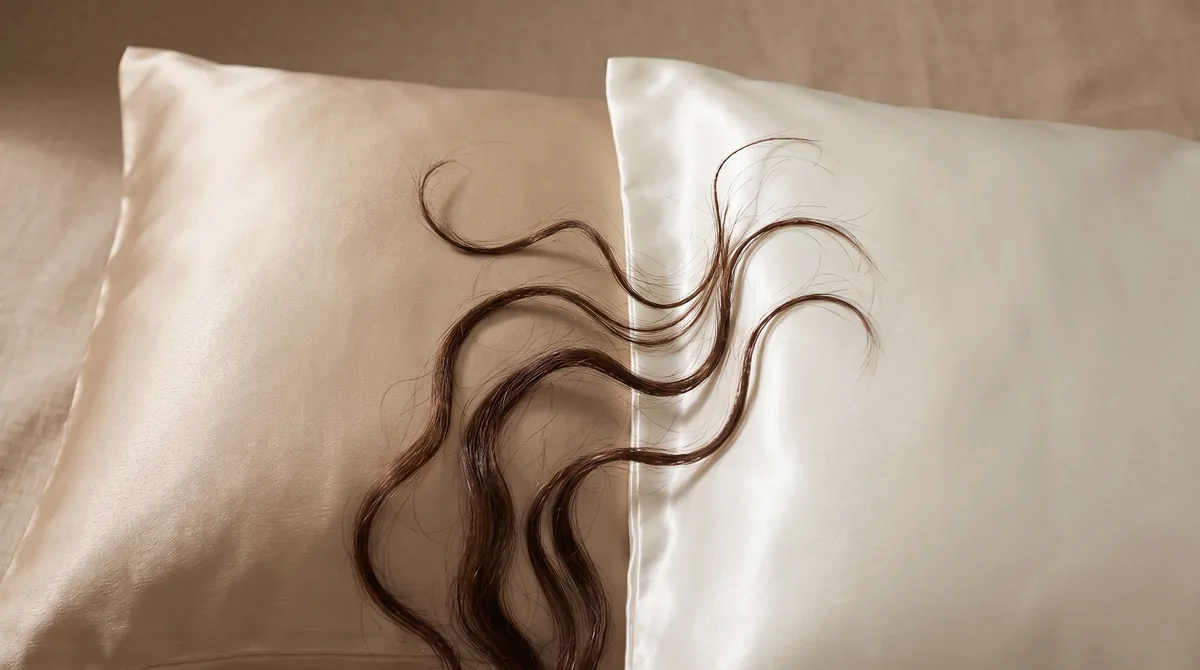
You bought the pillowcase. You’ve seen the before-and-after photos, read the testimonials, heard that silk or satin would save your hair from breakage. And maybe it has helped. But if you’re living in the Gulf region, you’ve probably noticed that the pillowcase alone isn’t solving everything. Your hair still feels rough by mid-week. The ends still split. The texture still changes.
Here’s what’s happening. Friction is one source of hair damage. Mineral buildup is another. The pillowcase reduces friction while you sleep. But if your hair is coated in calcium and magnesium from hard water, the roughness is structural. The cuticle is compromised. And no amount of smooth fabric will fix that.
This article breaks down the actual science behind silk and satin pillowcases, what they do for hair health, and how they fit into a complete hair protection system that also addresses the mineral damage most women in dry, hard water climates are dealing with. We’ll also clear up the confusion between silk (a fiber) and satin (a weave), because they’re not interchangeable.
Key Takeaways
• Silk and satin pillowcases reduce friction-related hair breakage by creating a smoother surface than cotton, allowing hair to glide rather than snag during sleep movement.
• Silk is a natural protein fiber (from silkworm cocoons) while satin is a weave structure (usually polyester). Both reduce friction, but silk offers additional benefits like temperature regulation and hypoallergenic properties.
• Pillowcases address mechanical damage from friction, but they don’t remove mineral buildup from hard water. For complete hair protection in the Gulf region, pair low-friction fabrics with regular chelating treatments.
• Research shows that friction causes cuticle lifting and breakage, particularly in already-compromised hair. Reducing overnight friction is most beneficial for chemically treated, heat-styled, or mineral-damaged hair.
• Proper care matters: silk requires gentle washing and air drying to maintain its smooth surface, while satin polyester is more durable and machine-washable. Both lose effectiveness if the fabric surface degrades.
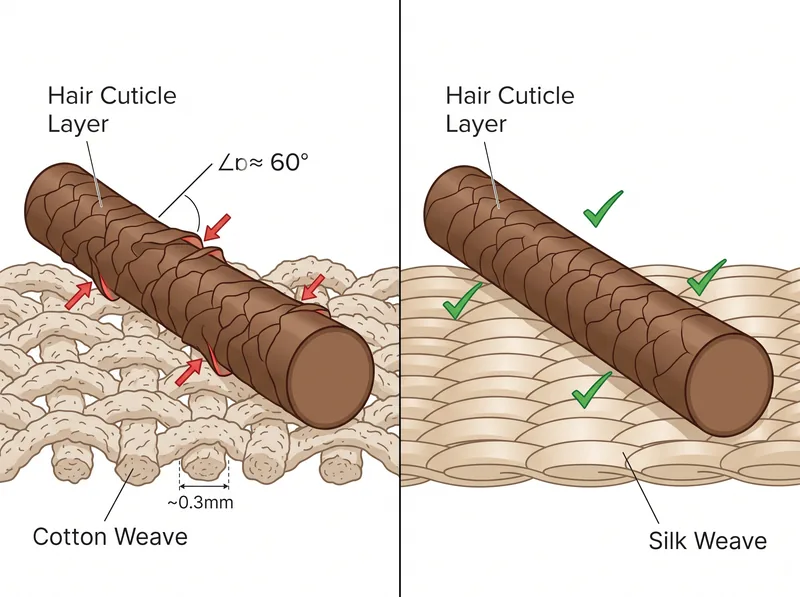 Hair cuticles experience dramatically different friction levels depending on fabric surface smoothness and thread structure.
The Friction Problem: Why Your Hair Breaks While You Sleep
Every time you move your head at night, your hair rubs against your pillowcase. On cotton, that friction is significant. Cotton fibers are absorbent and textured. They create drag. And when hair strands are pulled across that surface repeatedly, the outermost layer (the cuticle) starts to lift.
The hair cuticle is made of overlapping scales, like roof shingles. When those scales lie flat, hair looks shiny and feels smooth. When they lift and separate, hair becomes porous, dull, and prone to tangling. Research published in the International Journal of Cosmetic Science found that mechanical friction is a primary cause of cuticle damage, particularly in hair that’s already structurally weakened.
Here’s where the Gulf environment compounds the issue. If your hair is coated in mineral deposits from hard water, the cuticle is already rough. The calcium and magnesium create a textured surface on each strand. That makes friction even more damaging because there’s more surface area to catch and snag. You’re starting each night with compromised hair, and cotton pillowcases make it worse.
Silk and satin fabrics are smoother. They have less surface texture. Hair glides across them with minimal drag, which means less cuticle lifting, less breakage, and less tangling by morning. It’s not magic. It’s physics.
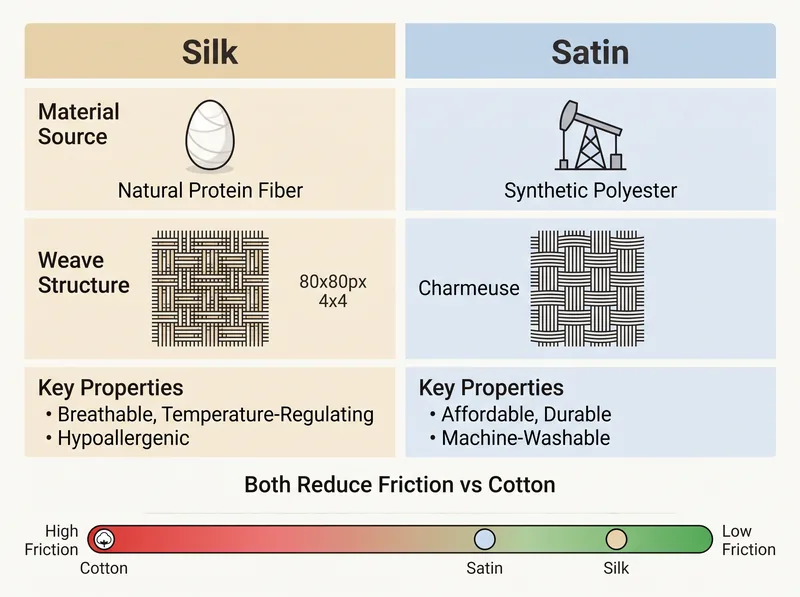 Understanding the difference between silk (a fiber) and satin (a weave) helps you choose the right pillowcase for your hair type and budget.
Silk vs Satin: What You’re Actually Buying
Let’s clear this up. Silk is a fiber. Satin is a weave. They’re not the same thing, and the marketing around pillowcases deliberately conflates them.
Silk is a natural protein fiber produced by silkworms. It’s been used in textiles for thousands of years. Real silk is smooth, breathable, temperature-regulating, and hypoallergenic. It’s also expensive. A genuine mulberry silk pillowcase typically costs between $30 and $80 depending on thread count and quality. The smoothness comes from the fiber itself, not just the weave.
Satin, on the other hand, is a weave structure. Most satin pillowcases are made from polyester, a synthetic fiber derived from petroleum. The satin weave (called charmeuse) creates a smooth, glossy surface by floating threads over multiple cross-threads. It looks shiny. It feels slippery. And it’s much cheaper than silk, usually $10 to $25 per pillowcase.
Both reduce friction compared to cotton. But they’re not identical. Silk breathes better, which matters in hot climates. Polyester satin traps heat and doesn’t wick moisture as effectively. If you wake up with a sweaty scalp or damp hair, satin may be contributing. Silk regulates temperature and absorbs less moisture from your hair, which helps maintain hydration levels overnight.
What the Research Actually Shows About Friction and Hair Damage
The cosmetic science literature on hair friction is consistent. Mechanical stress from combing, brushing, and rubbing causes cuticle damage. A study in the Journal of Cosmetic Science measured friction coefficients of various fabrics against hair and found that silk and satin produced significantly lower friction than cotton or linen.
Another study examined hair breakage patterns in women who slept on different pillowcase materials. The cotton group showed measurably more split ends and mid-shaft breakage after 30 days compared to the silk group. The difference wasn’t dramatic, but it was statistically significant. And it compounded over time.
Here’s what matters for women dealing with environmental hair stress. If your hair is already fragile from mineral buildup, heat styling, or chemical treatments, reducing friction becomes more important. Healthy hair can tolerate more mechanical stress. Compromised hair can’t. Every source of damage adds up.
The pillowcase won’t reverse existing damage. But it will slow down new damage. Think of it as damage prevention, not damage repair. You still need to address the underlying causes of hair fragility, which in the Gulf usually means chelating the minerals and restoring moisture balance.
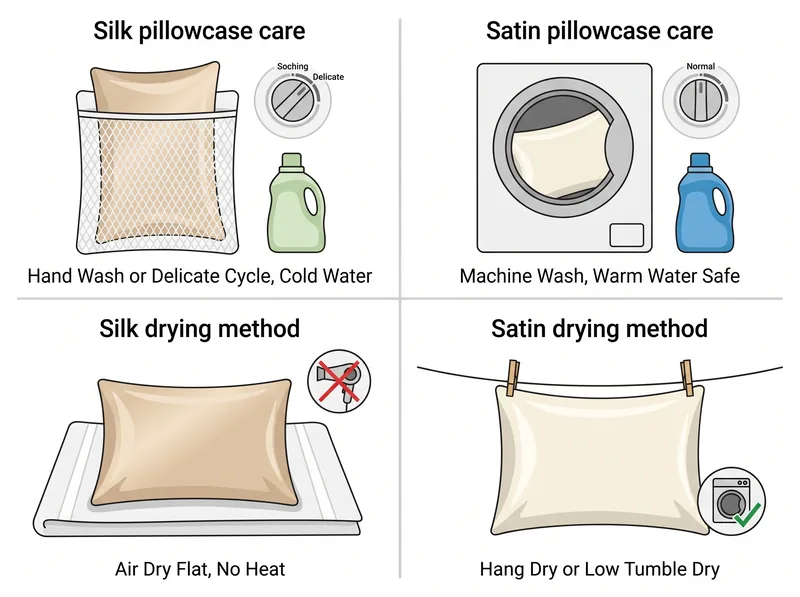 Proper care extends pillowcase lifespan and maintains the low-friction surface that protects your hair.
How Pillowcases Fit Into a Complete Hair Protection System
Reducing friction is one piece of the puzzle. It’s not the whole solution. If you’re dealing with hair that feels different since moving to a dry climate, or hair that’s become progressively rougher despite using the right products, the pillowcase alone won’t fix it.
Here’s the system that works. First, remove the mineral buildup. That means using a chelating shampoo like Regrowth+ once or twice a week to strip calcium and magnesium from the hair shaft. This restores the cuticle to a smoother baseline. Without this step, you’re just reducing friction on top of a rough, mineral-coated surface.
Second, maintain moisture. Hard water and low humidity pull moisture out of hair. Use a deep conditioner or hair mask weekly. Look for ingredients like shea butter, argan oil, or hydrolyzed proteins that actually penetrate the shaft rather than just coating it. Environmental breakdown requires active moisture replacement, not just surface smoothing.
Third, reduce friction during sleep. That’s where the silk or satin pillowcase comes in. Once your hair is clean and moisturized, the low-friction surface prevents the mechanical damage that undoes your other efforts. It’s the last layer of protection, not the first.
Choosing Between Silk and Satin: What Actually Matters
If you can afford silk, buy silk. The natural fiber breathes better, regulates temperature, and lasts longer if you care for it properly. Look for mulberry silk with a momme weight between 19 and 25. Higher momme means denser, more durable fabric. Anything below 19 is too thin and won’t hold up to regular washing.
If silk is outside your budget, polyester satin is a reasonable alternative. You’ll get most of the friction reduction at a fraction of the cost. Just accept that it won’t breathe as well and you may need to replace it more frequently as the surface degrades. Wash it inside out to preserve the smooth finish.
One thing to watch: some satin pillowcases are made from nylon or acetate instead of polyester. Avoid these. Nylon generates static, which creates flyaways and frizz. Acetate degrades quickly and loses its smooth surface after a few washes. Stick with polyester satin if you’re not buying silk.
And ignore the marketing around ‘silk-infused satin’ or ‘satin with silk fibers.’ These are polyester products with trace amounts of silk added for labeling purposes. They don’t perform like real silk. If the price is under $20, it’s not silk.
Care and Maintenance: Making Your Pillowcase Last
Silk requires gentle care. Hand wash in cold water with a pH-neutral detergent, or use the delicate cycle in a mesh laundry bag. Never use bleach or fabric softener. Air dry flat on a towel. Don’t wring it out or hang it while wet because the fibers stretch. Heat destroys silk, so no tumble drying and no ironing.
Polyester satin is more forgiving. Machine wash on normal cycle in warm water. You can tumble dry on low heat, but air drying extends the life of the smooth finish. The satin weave will eventually break down with repeated washing, which increases friction. When the pillowcase starts to feel rougher or less slippery, replace it.
Both fabrics accumulate oils from your hair and skin. Wash your pillowcase weekly, same as you’d wash cotton. A dirty pillowcase loses its friction-reducing properties because the buildup of sebum and product residue creates a sticky surface. Clean fabric glides. Dirty fabric drags.
If you notice your silk pillowcase developing snags or rough patches, it’s compromised. The friction reduction is gone. Don’t keep using it just because it’s expensive. The whole point is the smooth surface. Once that’s lost, it’s no better than cotton.
What Pillowcases Can’t Fix (And What You Need Instead)
Let’s be clear about what a pillowcase doesn’t do. It doesn’t remove buildup. It doesn’t add moisture. It doesn’t repair split ends. It doesn’t reverse chemical damage or heat damage. It reduces one specific type of mechanical stress during the 6-8 hours you’re asleep.
If your hair problems are primarily related to hard water damage, the pillowcase is a secondary intervention. The primary intervention is chelation. You need to physically remove the mineral deposits that are roughening the cuticle and preventing moisture absorption. No amount of friction reduction will compensate for a hair shaft that’s structurally compromised by calcium buildup.
If your hair loss is related to telogen effluvium or hormonal changes, the pillowcase won’t address that either. Friction-related breakage is different from shedding at the root. You need to identify the underlying cause of the hair loss, not just minimize breakage of the hair that’s left.
The pillowcase is part of a system. It works best when combined with proper cleansing, deep conditioning, and environmental protection. On its own, it’s a minor improvement. As part of a complete routine, it’s a meaningful layer of protection.
References
- Mechanical damage to hair: individual fibers - International Journal of Cosmetic Science
- Friction properties of hair and skin: influence of surface properties - Journal of Cosmetic Science
- Hair cosmetics: An overview - International Journal of Trichology
- The structure and properties of silk fibers - Journal of Applied Polymer Science