You know that feeling when you come back from the beach and your hair feels like straw? It’s not just the salt. Ocean water is doing something more complex to your hair than you realize, and if you’re in a region with already-hard tap water, you’re layering one mineral problem on top of another. This article contains affiliate links. See our affiliate disclosure for details.
Most women treat post-beach hair like it’s just dry. They reach for deep conditioner, maybe a hair mask, and wonder why their curls still feel weird three days later. The texture’s off. The definition isn’t coming back. Here’s what’s actually happening: ocean water deposits a complex mix of sodium chloride (table salt), magnesium, calcium, and trace minerals onto your hair shaft. When you rinse with hard tap water, you’re not removing those deposits. You’re adding more minerals on top of them.
Key Takeaways
• Ocean water deposits both salt and dissolved minerals (calcium, magnesium) that bind to the hair cuticle and change curl pattern formation
• Regular conditioner cannot remove mineral deposits; chelating agents are required to break the ionic bonds between minerals and hair protein
• Post-beach hair recovery requires a two-step process: chelation first to remove buildup, then moisture restoration with protein-free products
• Women living in hard water regions face compounded mineral loading when rinsing beach hair with tap water, requiring more aggressive chelation
• Curl pattern recovery typically takes 24-48 hours after proper chelation as the cuticle closes and natural curl memory returns
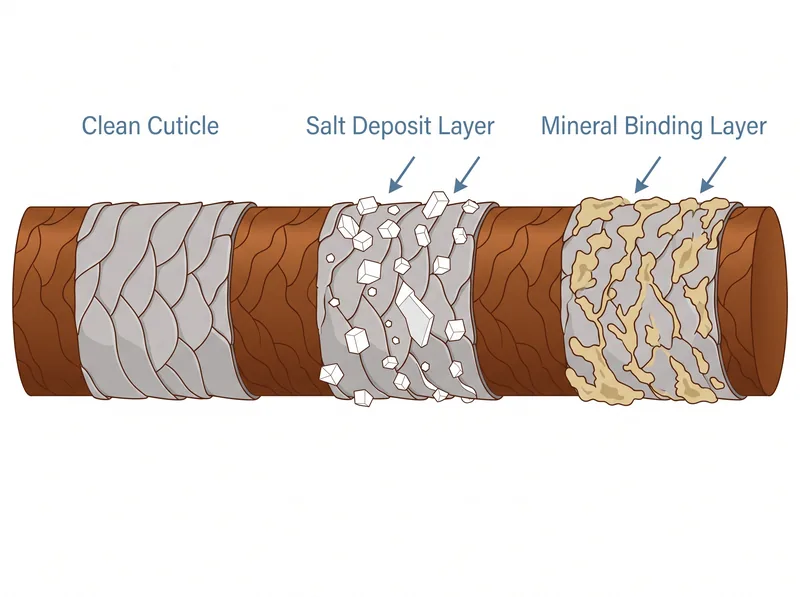 Ocean water deposits both sodium chloride and dissolved minerals that bind to the hair cuticle, creating a double layer of buildup that requires specific removal methods.
What Ocean Water Actually Does to Your Hair
Ocean water isn’t just salty. It contains approximately 35,000 parts per million of dissolved solids. That’s roughly 3.5% mineral content by weight. The primary component is sodium chloride, but seawater also carries significant concentrations of magnesium sulfate, calcium carbonate, and potassium chloride.
When your hair gets wet in the ocean, these minerals don’t just sit on the surface. They bind to the negatively charged sites on your hair’s keratin protein structure. Research published in the International Journal of Trichology shows that salt water exposure causes the hair cuticle to swell and lift, creating more surface area for mineral adhesion. The salt crystals then dehydrate as your hair dries, pulling moisture out of the hair shaft with them.
For curly and wavy hair, this creates a specific problem. Your curl pattern forms because of the way your hair shaft bends and how moisture distributes along its length. When minerals coat the cuticle and change that moisture distribution, your curls lose their ability to clump and form their natural pattern. You get frizz, undefined waves, or curls that look stretched and limp.
If you’re rinsing this mineral-loaded hair with hard tap water, you’re compounding the problem. The calcium and magnesium in your shower water bind to the same protein sites, creating a layered mineral deposit that regular shampoo can’t touch.
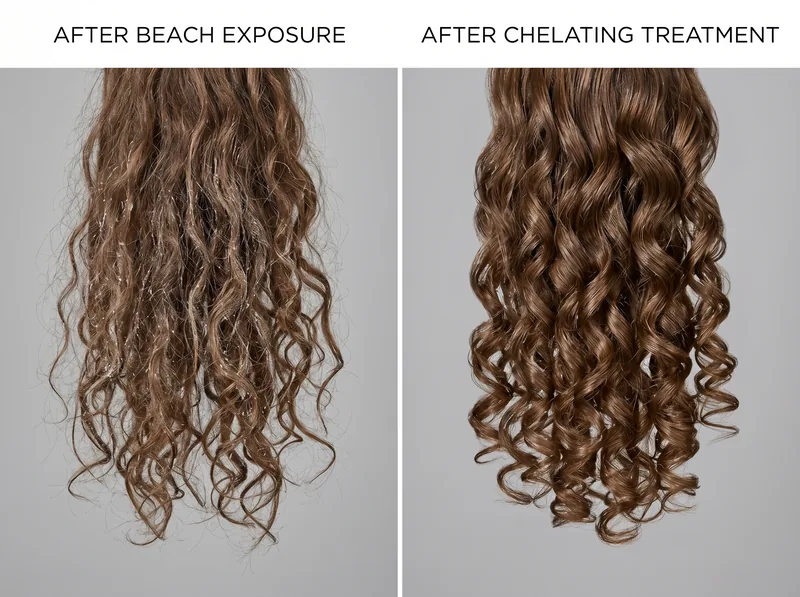 Proper chelation removes both salt and mineral deposits, allowing the hair cuticle to close and curl pattern to reform naturally.
Why Your Normal Hair Routine Isn’t Working
Most post-beach hair advice tells you to use a clarifying shampoo and follow with deep conditioning. That approach treats the symptom (dryness) but not the cause (mineral deposits). Clarifying shampoos are designed to remove product buildup and excess oils. They use surfactants that work on organic compounds, not ionic mineral bonds.
The minerals stuck to your hair after ocean exposure are held there by electrostatic attraction. Your hair shaft has a negative charge. Calcium and magnesium ions have a positive charge. They’re literally magnetically attracted to each other. A regular surfactant can’t break that bond because it’s not designed to.
This is why your hair can feel clean but still look dull and frizzy. You’ve removed the salt crystals and any sand or debris, but the mineral layer remains. Your conditioner is then trying to penetrate through that mineral coating, which is why it doesn’t absorb the way it normally does.
Women with curly hair notice this more acutely because curl definition depends on the cuticle lying flat and moisture distributing evenly. With a mineral barrier, neither of those things can happen. Your curls look undefined not because they’re damaged, but because they’re coated.
The Chelation Step You’re Probably Skipping
Chelation is the chemical process of binding to metal ions and removing them. In hair care, chelating agents are ingredients that specifically target mineral deposits. The most common ones you’ll see on ingredient labels are EDTA (ethylenediaminetetraacetic acid), citric acid, and phytic acid.
These ingredients work by forming a complex with the mineral ions, essentially wrapping around them and neutralizing their charge. Once neutralized, the minerals can be rinsed away with water. A chelating shampoo like Regrowth+ uses this mechanism to remove both the ocean minerals and any hard water deposits from your regular shower.
The difference between chelation and clarification is significant. A study in the Journal of Cosmetic Science found that chelating shampoos reduced mineral content on hair by up to 85% in a single wash, while clarifying shampoos showed minimal effect on mineral deposits despite effectively removing organic buildup.
For post-beach hair recovery, chelation should be your first step. Not conditioning. Not a hair mask. You need to remove the mineral layer before you attempt to restore moisture, or you’re just coating the problem.
The Correct Post-Beach Hair Recovery Sequence
Here’s the actual sequence that works. When you get home from the beach, rinse your hair thoroughly with lukewarm water. Not hot. Hot water opens the cuticle further and allows more minerals to penetrate. Your goal here is just to remove sand, salt crystals, and surface debris.
Next, apply your chelating shampoo. Work it through from roots to ends, and let it sit for 2-3 minutes. This contact time matters. The chelating agents need time to bind to the minerals. Rinse thoroughly. You should notice the water feels different as it runs through your hair. Slicker, less resistant. That’s the mineral coating releasing.
Now you can condition. Use a protein-free conditioner for this step. Your hair doesn’t need protein right now; it needs moisture and slip. Protein treatments are for structural damage. This isn’t structural damage. This is surface coating removal and moisture restoration.
After conditioning, don’t rough-dry with a towel. That creates more frizz on already-changeed cuticles. Use a microfiber towel or old t-shirt to blot excess water, then apply your normal styling products. Your curl pattern won’t fully return immediately. It takes 24-48 hours for the cuticle to close completely and for your hair’s natural curl memory to reassert itself.
Special Considerations for Hard Water Regions
If you live in a hard water area, your post-beach recovery needs to be more aggressive. You’re dealing with mineral deposits from two sources: the ocean and your tap water. Mineral buildup in these conditions accumulates faster and penetrates deeper into the cuticle structure.
Consider doing a double chelation: once immediately after the beach, and again 48 hours later. The first wash removes the bulk of the ocean minerals. The second wash catches any residual deposits that were trapped under the cuticle and have since migrated to the surface as your hair dried and the cuticle closed.
You may also need to adjust your water temperature. In hard water regions, cold water rinses are more effective for final rinses because they close the cuticle faster, preventing additional mineral absorption from your tap water during the rinse phase. It’s uncomfortable, but it makes a measurable difference in how quickly your curl pattern returns.
Some women in extremely hard water areas find that installing a shower filter helps with long-term hair health, but it won’t remove minerals that are already bonded to your hair. The filter is prevention. Chelation is treatment.
When to Use Protein vs. Moisture Treatments
There’s a lot of confusion about whether post-beach hair needs protein or moisture. The answer depends on whether the ocean exposure caused actual structural damage or just mineral coating. If you spent hours in the sun with wet, salty hair, you likely have both.
UV radiation breaks down the disulfide bonds in your hair’s keratin structure. That’s protein damage. Salt dehydration and mineral coating are moisture problems. You can tell the difference by how your hair feels when wet. If it feels mushy, stretchy, or overly elastic, that’s protein damage. If it feels dry and stiff but maintains its normal strength, that’s moisture loss with mineral coating.
For most beach days, you’re dealing primarily with mineral coating and dehydration. Protein treatments in this scenario can actually make things worse by adding more buildup on top of the mineral layer. Start with chelation and moisture. If your hair still feels weak or overly stretchy after 48 hours, then consider a light protein treatment.
Environmental damage to hair is cumulative. One beach day won’t destroy your hair structure. But repeated exposure without proper mineral removal will lead to genuine protein degradation over time.
Preventing Mineral Damage Before It Happens
The best recovery is prevention. Before you go in the ocean, saturate your hair with fresh water. Wet hair absorbs less salt water because the hair shaft is already full. This is the same principle as pre-soaking a sponge. It’s basic displacement chemistry.
Apply a leave-in conditioner or hair oil before ocean exposure. This creates a hydrophobic barrier that reduces how much salt water can penetrate the cuticle. Coconut oil is particularly effective because its molecular structure allows it to penetrate the hair shaft, providing protection from the inside. Research in the Journal of Cosmetic Science showed that coconut oil reduced protein loss from hair during salt water exposure by approximately 40%.
Wear your hair in a protective style. A braid or bun minimizes surface area exposure and keeps your hair from whipping around in the wind, which drives salt water deeper into the cuticle through mechanical friction. It’s not glamorous, but it’s effective.
Rinse immediately after swimming if possible. Most beaches have outdoor showers. Use them. Even a 30-second rinse removes a significant portion of salt before it has time to crystallize and bond to your hair. You’re not trying to fully wash your hair at the beach shower. You’re just reducing the mineral load before it sets.
References
- Effects of mineral oil, sunflower oil, and coconut oil on prevention of hair damage - Journal of Cosmetic Science
- Hair cosmetics: An overview - International Journal of Trichology
- Chemical and Physical Behavior of Human Hair - Springer-Verlag
- The structure and function of hair - PubMed Central