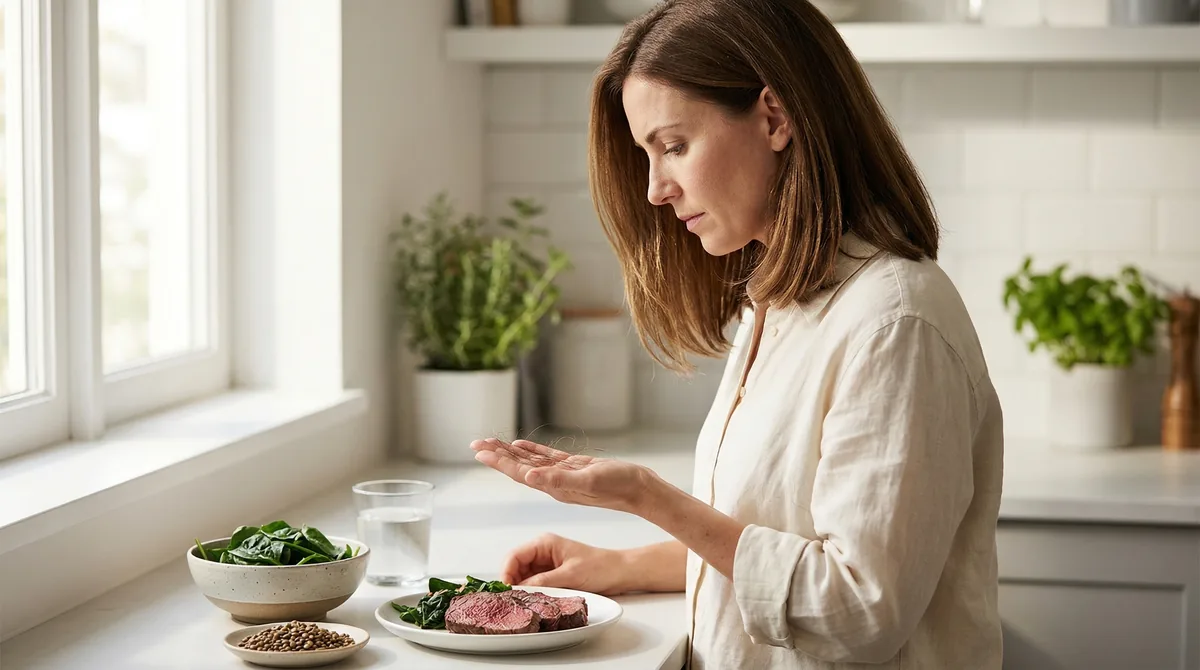
You’ve switched shampoos three times. You’re using a chelating treatment for the hard water. You’ve cut out heat styling entirely. And your hair is still shedding more than it should. Here’s what almost no one tells you: the problem might not be in your bathroom at all. It might be in your blood.
This article contains affiliate links. See our affiliate disclosure for details.
Iron deficiency is behind a staggering percentage of hair loss cases in women, yet it’s routinely overlooked because standard blood tests don’t flag the levels that matter for hair health. Your doctor says your iron is ‘normal.’ Your ferritin is technically within range. But your hair knows better. Medically reviewed by Dr. Layla Hassan, Trichologist.
If you’re living in a hard water environment like the Gulf region, low iron becomes an even more significant factor. The environmental stress on your hair follicles is already high. When your body doesn’t have enough iron to support the hair growth cycle, the combination can trigger shedding that feels sudden and relentless. What you need to understand is this: iron deficiency doesn’t just contribute to hair loss. In many cases, it’s the primary driver, and everything else is secondary.
Why Iron Deficiency Causes Hair Loss (And Why It’s So Common in Women)
Iron is essential for producing hemoglobin, the protein in red blood cells that carries oxygen throughout your body. Your hair follicles are among the most metabolically active cells you have. They’re constantly dividing, growing, and cycling through phases. When iron levels drop, your body triages. Essential organs get priority. Your hair follicles don’t.
The result is a changeion in the anagen phase, the active growth stage of the hair cycle. Research published in the Journal of Korean Medical Science found that women with hair loss had significantly lower ferritin levels than controls, even when their hemoglobin was normal. Ferritin is your body’s iron storage protein. It’s the marker that matters for hair, not just hemoglobin.
Women are particularly vulnerable because of menstruation, pregnancy, and dietary patterns. If you’re eating a plant-based diet or limiting red meat, your iron intake is likely lower than you realize. And if you’re in your reproductive years, you’re losing iron every month. The Gulf region adds another layer: many women here are expats adjusting to new food systems, and vitamin D deficiency (common in sun-heavy climates despite the irony) can interfere with iron absorption.
Here’s the threshold that matters: while standard medical ranges consider ferritin levels above 30 ng/mL ‘normal,’ dermatology research suggests that optimal ferritin for hair regrowth is closer to 70 ng/mL or higher. That’s a massive gap. You can be clinically ‘fine’ and still experiencing significant hair shedding due to suboptimal iron stores.
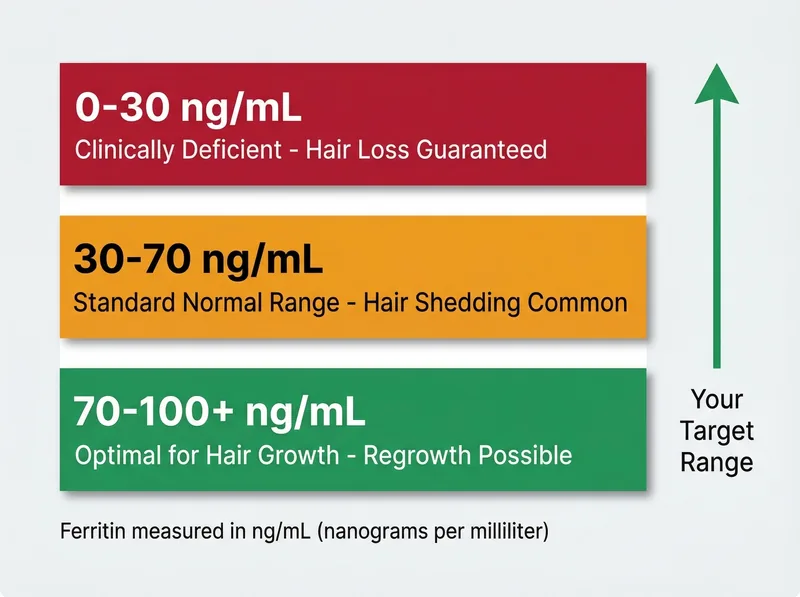 The gap between ‘normal’ ferritin and optimal ferritin for hair health is significant. Most doctors won’t flag levels below 70 ng/mL.
The Ferritin Test Your Doctor Probably Didn’t Order
Most routine blood panels include hemoglobin and hematocrit. They don’t include ferritin unless you specifically request it. And even when ferritin is tested, doctors rarely flag levels below 70 ng/mL because they’re focused on anemia, not hair health. This is the disconnect that leaves so many women confused and dismissed.
If you’re experiencing unexplained hair shedding, you need to ask for a full iron panel: serum iron, ferritin, total iron-binding capacity (TIBC), and transferrin saturation. Don’t accept ‘your iron is fine’ without seeing the actual ferritin number. If it’s below 70 ng/mL and you’re losing hair, that’s your answer.
There’s also a pattern that’s easy to miss: ferritin levels can fluctuate based on inflammation. If you’re dealing with chronic stress, gut issues, or autoimmune conditions, your ferritin might read falsely improved because it’s an acute-phase reactant. This is why context matters. A single test isn’t always conclusive. If your ferritin is borderline and you have other signs of iron deficiency (fatigue, pale skin, brittle nails, cold sensitivity), treat it as low regardless of the number.
Women in the Gulf often face an additional challenge: limited access to healthcare providers who specialize in nutritional deficiencies and hair loss. The standard approach is reactive, not preventive. By the time hair loss is visibly significant, ferritin has often been low for months or even years. The earlier you catch it, the faster you can reverse the shedding.
How Low Iron Interacts with Hard Water and Environmental Stress
Here’s where things get compounded. Hard water in the Gulf region is loaded with calcium and magnesium. These minerals bind to your hair shaft, creating buildup that makes strands brittle and prone to breakage. When your hair is already weakened from the inside due to low iron, the external assault from hard water accelerates damage. You’re fighting on two fronts.
Iron deficiency also affects your scalp health. Studies show that low ferritin is associated with increased scalp sensitivity, slower wound healing, and reduced sebum production. In a dry, hard water climate, your scalp is already struggling to maintain moisture and barrier function. Low iron makes it worse. The result is a scalp environment that can’t support healthy hair growth even if you’re using the right products.
This is why addressing iron deficiency is non-negotiable if you’re living in a challenging climate. You can use a chelating shampoo like Regrowth+ to remove mineral buildup and protect your hair from hard water damage, but if your follicles aren’t getting the oxygen and nutrients they need from adequate iron stores, regrowth will stall. Internal health drives external results.
The timeline matters too. Hair grows slowly. Even after you restore your ferritin levels, it can take three to six months to see a reduction in shedding and another six months to see visible regrowth. This isn’t a quick fix. It’s a sustained effort. But it works. Women who correct iron deficiency consistently report that their hair shedding stops and density improves, especially when combined with environmental protection strategies like removing mineral buildup.
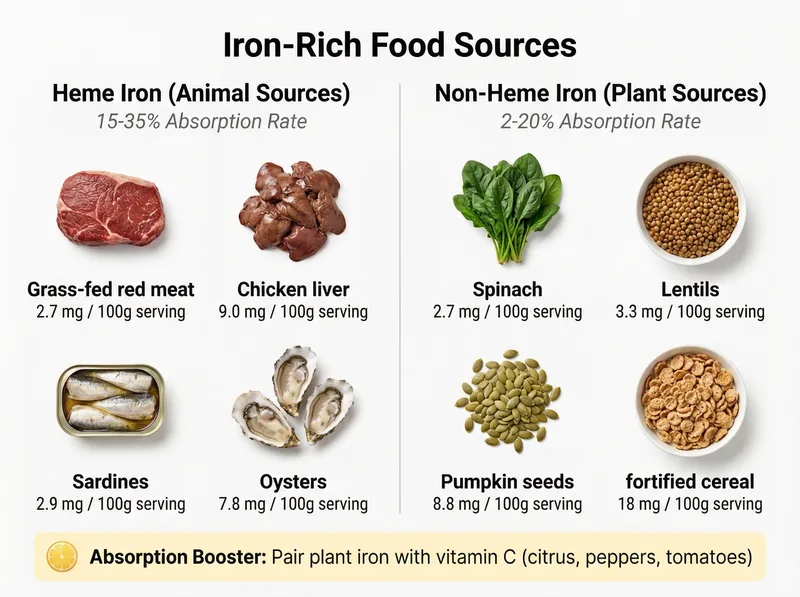 Heme iron from animal sources is absorbed 2-3 times more efficiently than plant-based non-heme iron. Pair plant sources with vitamin C for better uptake.
How to Restore Iron Levels (and What Actually Works)
Dietary iron comes in two forms: heme iron from animal sources and non-heme iron from plants. Heme iron is absorbed two to three times more efficiently. If you’re not eating red meat, liver, or shellfish regularly, you’re at a disadvantage. This doesn’t mean you can’t get enough iron from plants, but it requires more intentional planning and pairing strategies.
The best heme iron sources are grass-fed red meat, chicken liver, sardines, and oysters. For non-heme iron, focus on dark leafy greens (spinach, kale), lentils, chickpeas, pumpkin seeds, and fortified cereals. The key is pairing plant-based iron with vitamin C to enhance absorption. Add lemon juice to your lentils. Eat bell peppers with your spinach. Drink orange juice with your fortified cereal. These combinations can double or triple non-heme iron uptake.
Supplementation is often necessary if your ferritin is below 50 ng/mL. But not all iron supplements are created equal. Ferrous sulfate is the most commonly prescribed form, but it causes significant digestive upset for many women (constipation, nausea, stomach pain). Ferrous bisglycinate is a chelated form that’s much gentler on the gut and often better absorbed. Start with 25-30 mg of elemental iron daily, taken with vitamin C and away from calcium, tea, or coffee (which inhibit absorption).
Here’s what most women don’t know: it takes months to replenish iron stores. You might feel better within weeks, but your ferritin won’t normalize for three to six months of consistent supplementation. This is why retesting is critical. Check your ferritin every three months until it’s stable above 70 ng/mL. Once you’re there, you can often maintain levels with diet alone, but some women need ongoing low-dose supplementation, especially if they have heavy periods or are vegetarian.
When to Suspect Iron Deficiency Beyond Hair Loss
Hair shedding is rarely the only symptom of low iron, but it’s often the one that gets the most attention because it’s visible. If you’re also experiencing chronic fatigue that doesn’t improve with sleep, you need to consider iron deficiency. The same goes for feeling cold all the time, even in the Gulf heat. Brittle nails that break easily. Pale skin or a washed-out complexion. Difficulty concentrating or brain fog that feels persistent.
Another overlooked sign: craving ice or non-food items like dirt or clay. This is called pica, and it’s a documented symptom of severe iron deficiency. If you find yourself chewing ice compulsively or craving strange textures, that’s a red flag. Restless leg syndrome is also associated with low ferritin. These aren’t just quirks. They’re your body signaling that something is off.
Women who’ve recently given birth are at particularly high risk. Postpartum hair loss is common and often attributed to hormonal shifts, but iron depletion from pregnancy and blood loss during delivery is a major contributing factor. If your postpartum shedding hasn’t resolved by six months, or if it’s more severe than expected, check your ferritin. It’s likely low.
The emotional toll of unexplained hair loss can’t be understated. You feel like you’re doing everything right, and nothing is working. You’re told it’s stress or hormones or just genetics. But when the root cause is something as fixable as low iron, the frustration of not knowing is compounded by the realization that it could have been addressed months earlier. This is why advocating for yourself and requesting specific tests is so important. Don’t wait for your doctor to suggest it. Ask directly.
What Happens When You Correct Iron Deficiency
The first change you’ll notice isn’t your hair. It’s your energy. Within two to four weeks of starting iron supplementation, most women report feeling less fatigued. You’ll sleep better. You’ll feel warmer. The brain fog starts to lift. These improvements happen before your hair responds because your body is still prioritizing essential functions over hair growth.
Hair shedding typically begins to slow around the three-month mark, assuming your ferritin is climbing steadily. You might notice fewer hairs in the shower drain, less accumulation on your brush, and a reduction in the number of strands you find on your pillow. This is the sign that your hair follicles are transitioning back into a healthy growth cycle.
Visible regrowth takes longer. By six months, you should see baby hairs along your hairline and part. These are the new growth cycles that started after your iron levels normalized. By twelve months, those baby hairs will have grown several inches, and your overall density will improve noticeably. This timeline assumes consistent supplementation, adequate protein intake, and management of external stressors like hard water damage.
Some women see dramatic improvement. Others see moderate but meaningful change. The outcome depends on how long your ferritin was low, whether you have other contributing factors (thyroid issues, hormonal imbalances, genetic hair loss patterns), and how well you address environmental damage. Iron deficiency correction isn’t a miracle cure for all hair loss, but for the women whose primary issue is low ferritin, the results can feel life-changing. Your hair can recover. It just needs the right internal foundation to do so.
References
- Serum ferritin and vitamin D in female hair loss: role of screening - PubMed - Journal of Korean Medical Science
- Iron deficiency without anemia - a clinical challenge - PubMed Central
- Serum ferritin levels in women with chronic hair loss - PubMed
- Iron deficiency and hair loss in women - Cleveland Clinic - Dermatology