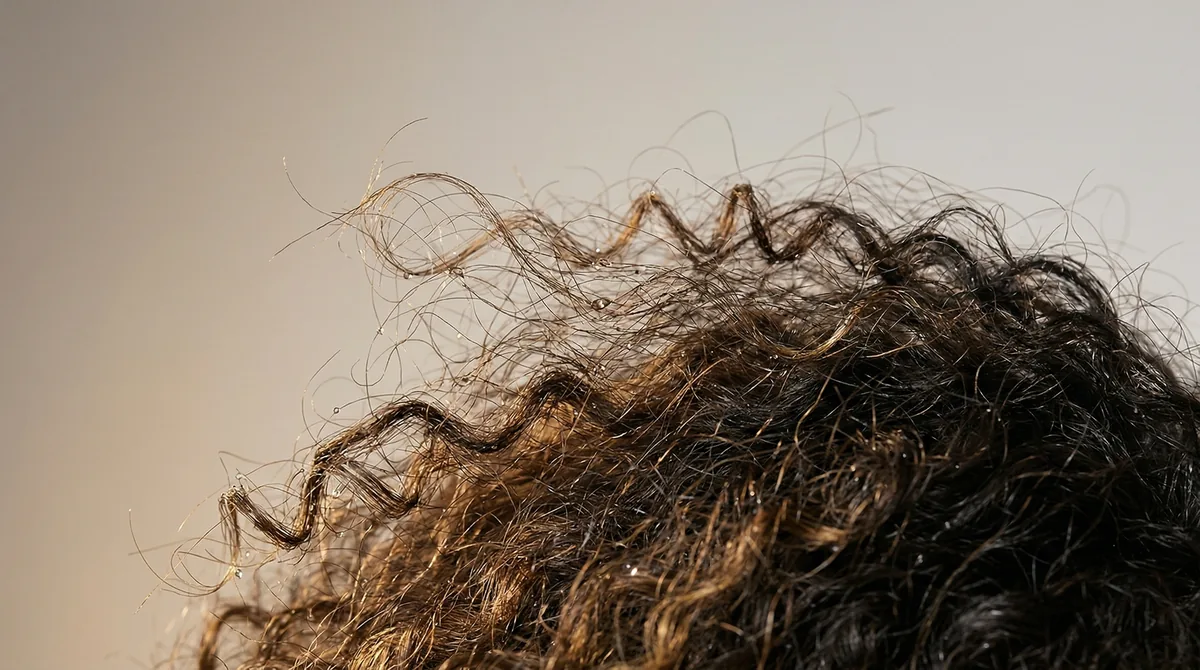
You moved to a dry climate expecting your frizz problems to disappear. The air is bone-dry, humidity hovers around 20%, and yet your hair still looks like you walked through a rainstorm. You’ve bought every anti-frizz serum on the shelf. You’ve watched tutorials from influencers who swear by their routines. Nothing works the way it should.
Here’s what’s actually happening. The frizz you’re experiencing isn’t just about humidity in the air. It’s about what’s already in your hair. When hard water deposits minerals on your strands, it creates a porous, rough surface that reacts to even minimal moisture. Your hair becomes a humidity magnet, regardless of the climate. This article contains affiliate links. See our affiliate disclosure for details.
The science behind frizz is more complex than most hair care advice acknowledges. Understanding why your hair behaves this way in a dry climate with hard water changes everything about how you treat it. Let’s break down what’s really going on and what actually helps.
Why Frizz Happens: The Actual Science
Frizz occurs when the hydrogen bonds inside your hair shaft break and reform irregularly. In normal conditions, these bonds maintain your hair’s structure and shape. When water molecules penetrate the hair shaft, they change these bonds, causing the cortex to swell unevenly. The cuticle scales lift. Individual strands expand at different rates. The result is frizz.
Your hair’s cuticle, the outer protective layer, acts like roof shingles when healthy. The scales lie flat and overlap smoothly. When humidity is present, water molecules slip between these scales, penetrating into the cortex (the hair’s inner structure). Research published in the Journal of Cosmetic Science shows that hair can absorb up to 30% of its weight in water, causing significant structural changes.
But here’s the thing. The cuticle only allows this penetration when it’s damaged or porous. Healthy, intact cuticles with tightly sealed scales resist moisture penetration far better. This is why some people’s hair handles humidity beautifully while others turn into a frizz halo at the first sign of moisture.
The paradox of frizz in dry climates comes down to one factor: your hair’s baseline porosity. If your cuticle is already compromised, even the 20-30% humidity typical of arid regions is enough to cause problems. And in the Gulf region, the most common cause of compromised cuticles isn’t heat styling or chemical treatments. It’s the water you wash with every day.
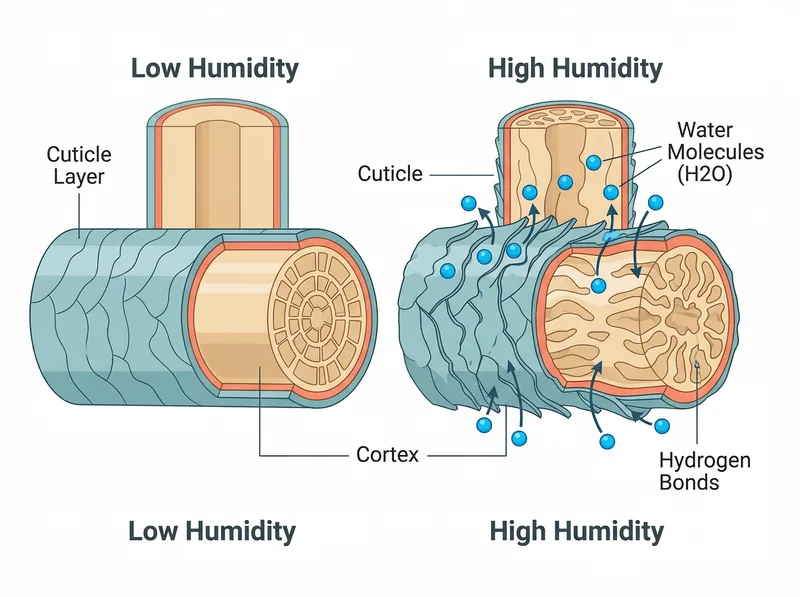 How humidity causes frizz: water molecules penetrate the hair shaft, causing cuticle scales to lift and strands to swell unevenly.
The Hard Water Connection Nobody Talks About
Hard water contains dissolved minerals, primarily calcium and magnesium carbonates. When you wash your hair, these minerals don’t rinse away cleanly. They bind to the hair shaft, creating a coating that changes everything about how your hair behaves. This buildup is cumulative. Every wash adds another layer.
The mineral coating does two things that directly cause frizz. First, it makes the cuticle surface rough and irregular. Instead of smooth, flat scales, you have a bumpy, porous surface. Second, it increases your hair’s hygroscopicity (its ability to absorb moisture from the air). Studies on mineral deposition show that calcium buildup can increase hair’s water absorption capacity by up to 40%.
This explains why your anti-frizz products stopped working after you moved. They’re formulated to seal healthy cuticles and repel humidity. But when there’s a layer of mineral buildup between the product and your actual hair, the product can’t do its job. You’re essentially trying to waterproof a surface that’s already compromised.
The solution isn’t more product. It’s removing the minerals first. A chelating shampoo like Regrowth+ uses ingredients that bind to mineral deposits and lift them away, restoring your hair’s natural surface. Once the buildup is gone, your cuticle can lie flat again. Your hair becomes less porous. And suddenly, your frizz products actually work.
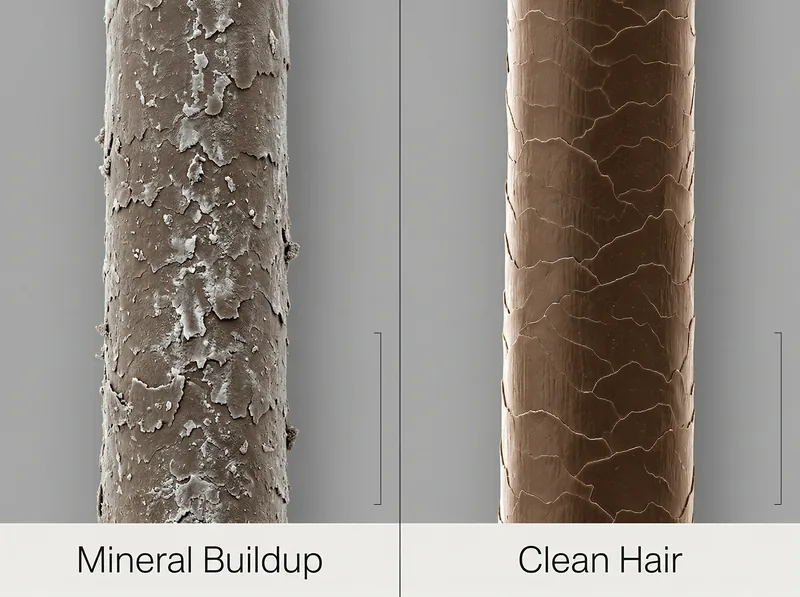 Mineral buildup creates a rough, porous surface that absorbs humidity faster than clean hair, amplifying frizz in any climate.
Why Standard Frizz Advice Fails in Hard Water
Most anti-frizz advice assumes you’re starting with relatively clean, healthy hair. Use a smoothing shampoo. Apply a leave-in conditioner. Seal with an oil. Avoid touching your hair. This works beautifully when your cuticle is intact and your main enemy is environmental humidity.
But when mineral buildup is present, this routine actually makes things worse. Smoothing shampoos and rich conditioners add more layers on top of the minerals. Oils sit on the surface without penetrating. Your hair feels coated and heavy but still frizzes because the underlying problem (the rough, porous cuticle created by minerals) hasn’t been addressed.
You’ll see advice to avoid sulfates, use co-washing methods, or apply heavy butters and creams. For someone dealing with hard water, these approaches trap minerals against the hair shaft. The Curly Girl Method, while effective in soft water areas, often fails spectacularly in hard water regions for exactly this reason.
The missing step in standard frizz advice is clarification. Not the gentle kind that removes product buildup. The serious kind that removes mineral deposits. Until you do this, you’re building a routine on a compromised foundation. Every product you add is fighting an uphill battle against the rough, porous surface created by hard water minerals.
What Actually Works: A System That Addresses the Root Cause
Effective frizz control in hard water climates requires a two-phase approach. Phase one is mineral removal. Phase two is moisture barrier protection. You can’t skip phase one and expect phase two to work. The order matters.
Start with chelation. Use a chelating shampoo once a week to remove accumulated minerals. These shampoos contain ingredients like EDTA (ethylenediaminetetraacetic acid) or citric acid that bind to calcium and magnesium, allowing them to be rinsed away. You’ll know it’s working when your hair feels squeaky clean, almost stripped. That’s the minerals coming off.
After chelation, your cuticle is clean but temporarily more porous because it’s been stripped of everything, including natural oils. This is when your regular frizz-control products finally work as intended. Apply a protein treatment or strengthening conditioner to temporarily fill in gaps in the cuticle. Follow with a leave-in product that contains humectants (to maintain optimal moisture) and occlusives (to seal the cuticle).
Between chelating washes, use a sulfate-free, moisturizing shampoo that won’t strip your hair but will maintain cleanliness. The goal is to prevent new mineral buildup while keeping your cuticle smooth and sealed. Understanding mineral buildup patterns helps you adjust your chelation frequency based on how quickly deposits accumulate on your specific hair type.
For daily styling, focus on products with film-forming ingredients (like polyquaterniums or PVP) that create a flexible barrier against humidity. These work by forming a thin, breathable layer over the cuticle that prevents water molecules from penetrating. But remember, they only work when applied to clean, mineral-free hair.
The Role of Hair Porosity in Frizz Management
Your hair’s natural porosity level determines how aggressively you need to manage frizz. Porosity refers to how easily moisture can enter and exit your hair shaft. It’s determined by the condition of your cuticle and is influenced by genetics, chemical treatments, heat damage, and yes, hard water exposure.
Low porosity hair has tightly sealed cuticles that resist moisture penetration. This hair type typically handles humidity well naturally because water molecules can’t easily get inside to change hydrogen bonds. However, low porosity hair also struggles to absorb beneficial moisture and products, which can lead to buildup. In hard water, minerals accumulate on the surface quickly because they can’t penetrate, creating a coating that paradoxically makes low porosity hair behave like high porosity hair.
High porosity hair has damaged or lifted cuticles with gaps and holes. Water rushes in and out easily. This hair type is naturally prone to frizz in any humidity because the cuticle can’t regulate moisture properly. Research on hair porosity shows that high porosity hair can lose moisture as quickly as it absorbs it, leading to the dry-yet-frizzy paradox many women experience.
Hard water affects both porosity types but in different ways. For low porosity hair, minerals create surface roughness that increases friction and frizz. For high porosity hair, minerals lodge in the gaps and holes of the cuticle, making an already porous structure even more damaged. Both need chelation, but high porosity hair requires more intensive protein and moisture balancing afterward to temporarily seal the cuticle.
Environmental Factors Beyond Humidity
Frizz in dry climates isn’t just about the occasional humidity spike. It’s about rapid environmental changes that your hair can’t adapt to quickly enough. In the Gulf region, you move from 45-degree outdoor heat into 18-degree air conditioning multiple times a day. Each transition causes your hair to contract and expand, stressing the cuticle and creating opportunities for frizz.
UV exposure in high-sun climates degrades the hair’s protein structure, particularly the outer cuticle layers. Studies on UV damage to hair show that prolonged sun exposure breaks down the lipid layer that holds cuticle scales together, making hair more porous and prone to frizz even in dry conditions. When you combine UV damage with hard water minerals, you get a compounding effect that standard frizz products can’t address.
Wind is another factor. Dry, hot winds create friction between hair strands and lift the cuticle mechanically. In desert climates, this constant mechanical stress keeps cuticles raised and rough. Add mineral deposits to this scenario, and you have a surface that catches and holds onto any available moisture, causing frizz even when the air is technically dry.
The solution is environmental protection, not just moisture management. Use leave-in products with UV filters. Cover your hair when moving between extreme temperature zones. Minimize friction by using silk or satin pillowcases and avoiding rough towels. Understanding how environment affects hair structure helps you build a protective routine that addresses all the factors contributing to frizz, not just humidity.
References
- Water Absorption and Desorption of Human Hair and Nails - Journal of Cosmetic Science
- Effect of Hard Water on Hair and Scalp - ScienceDirect
- Hair Porosity: Structural and Functional Aspects - PubMed Central
- Photodegradation of Human Hair - PubMed