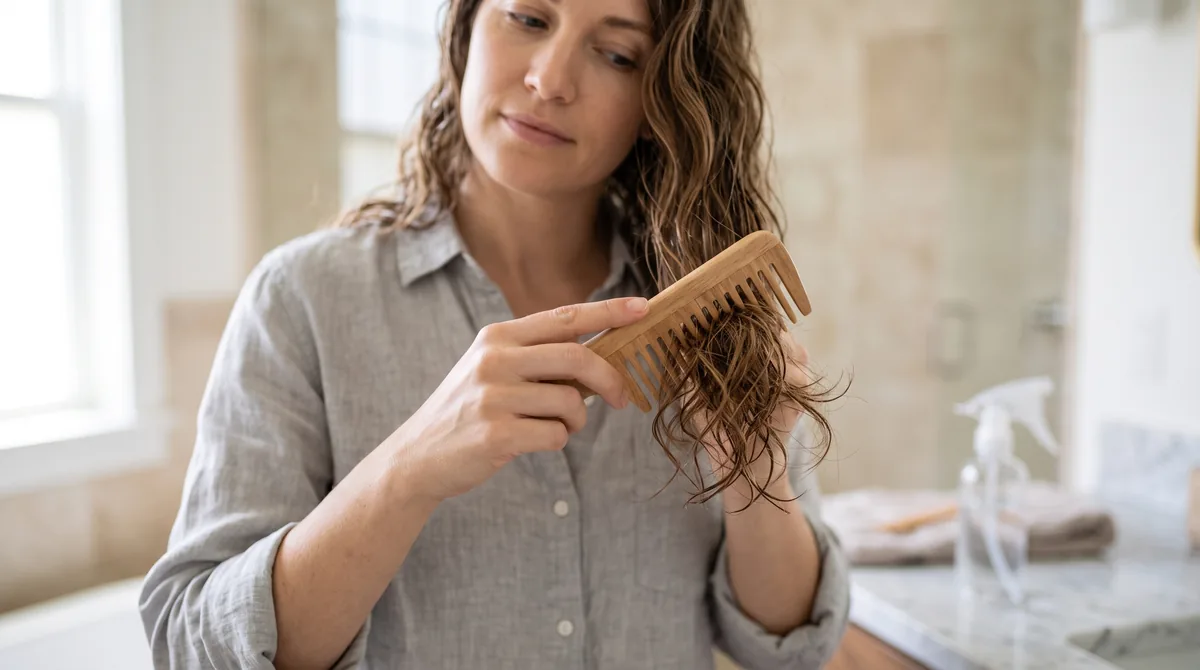
If your hair tangles worse here than it did back home, you’re not imagining it. And if detangling has become a daily battle that ends with a fistful of broken hair in your brush, you’re dealing with more than just damage. You’re dealing with mineral buildup. The hard water coating your hair is creating a rough, friction-heavy surface that makes every strand catch on the next one. That’s why the same detangling routine that worked before doesn’t work now.
This article contains affiliate links. See our affiliate disclosure for details.
Medically reviewed by Dr. Layla Hassan, Trichologist.
Here’s what most detangling advice misses: the substrate matters more than the tool. You can buy the gentlest brush on the market, but if your hair is coated in calcium and magnesium deposits, you’re still fighting physics. The minerals create microscopic rough patches that grab onto neighboring strands. Remove that coating with a chelating shampoo like Regrowth+, and suddenly detangling becomes easier. Not effortless, but manageable.
This guide covers the tools that actually help, the techniques that minimize breakage, and the mistakes that make tangling worse. We’ll also address why mineral buildup is the hidden factor most hair advice ignores.
Key Takeaways
• Hard water mineral deposits create a rough coating on hair that increases friction and tangling, making detangling significantly harder than it should be
• Detangle hair when damp (not soaking wet) with a leave-in conditioner or detangling spray to provide slip and reduce breakage
• Always start detangling from the ends and work upward in small sections, never pull from the roots downward
• Wide-tooth combs and wet brushes with flexible bristles cause less breakage than fine-tooth combs or paddle brushes on tangled hair
• Regular chelating treatments to remove mineral buildup make detangling dramatically easier by restoring smooth cuticle surfaces
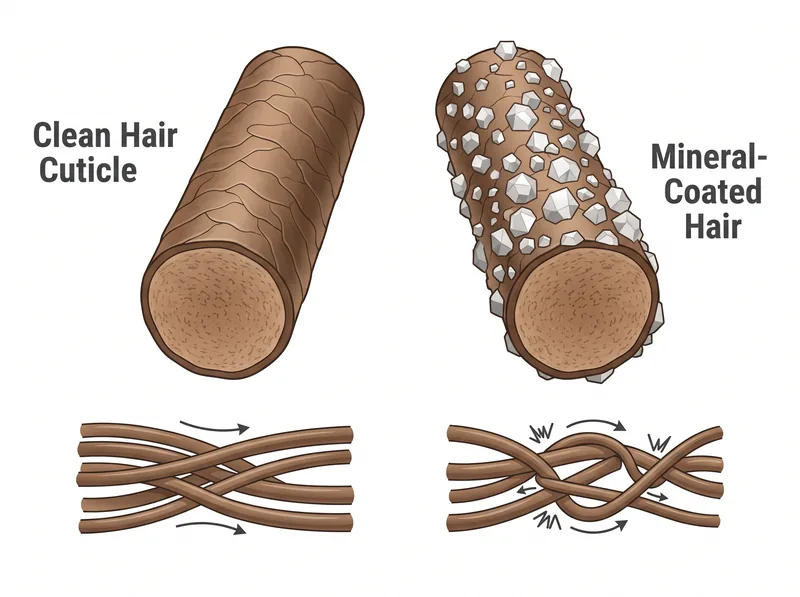 Mineral buildup creates a rough coating on the hair shaft, increasing friction and tangles
Why Hair Tangles More in Hard Water Climates
Let’s start with the science. Your hair cuticle is made of overlapping scales, like roof shingles. When those scales lie flat, hair is smooth and strands slide past each other easily. When they’re raised or damaged, hair catches and tangles. Hard water makes this worse in two ways.
First, the minerals in hard water (calcium, magnesium, iron) don’t rinse away. They bind to your hair shaft and build up over time, creating a rough, uneven coating. Research published in the International Journal of Trichology found that hard water exposure significantly increases hair surface roughness and reduces combability. That rough surface creates friction. More friction means more tangling.
Second, hard water raises the hair cuticle. The alkaline pH of mineral-heavy water causes the cuticle scales to lift and stay lifted, even after your hair dries. Raised cuticles catch on each other like velcro. This is why your hair feels rougher, looks duller, and tangles within hours of washing it.
In the Gulf region, where water hardness often exceeds 300 ppm (parts per million), this effect is extreme. For context, water above 180 ppm is considered very hard. You’re washing your hair in water that’s depositing minerals faster than most detangling products can compensate for. That’s the substrate problem. Until you address the mineral coating, you’re fighting an uphill battle.
The Right Tools for Detangling Damaged Hair
Not all detangling tools are equal, and the wrong choice can cause more breakage than the tangles themselves. Here’s what actually works.
Wide-tooth combs are your first line of defense. The wide spacing between teeth allows tangles to pass through without snagging, and the smooth, rounded teeth don’t catch on raised cuticles the way fine-toothed combs do. Look for smooth combs (no seams where the teeth meet the spine) to avoid catching and breaking hair. Wood or cellulose acetate combs are gentler than plastic.
Wet brushes with flexible bristles work well for damp hair because the bristles bend and give when they hit resistance, rather than pulling through and breaking the strand. The American Academy of Dermatology recommends brushes with soft, flexible bristles for wet hair specifically because they reduce breakage. Avoid brushes with ball-tipped bristles if your hair is heavily tangled; the balls can catch in knots.
Detangling brushes with varying bristle lengths are designed to work through layers of hair simultaneously. The longer bristles reach deeper tangles while shorter ones smooth the surface. These work best on damp, conditioned hair, not dry or soaking wet hair.
What to avoid: fine-tooth combs, paddle brushes with rigid bristles, and any brush marketed for blow-drying. These tools are designed for smooth, tangle-free hair. Using them on tangled hair is like trying to sand wood with a sledgehammer.
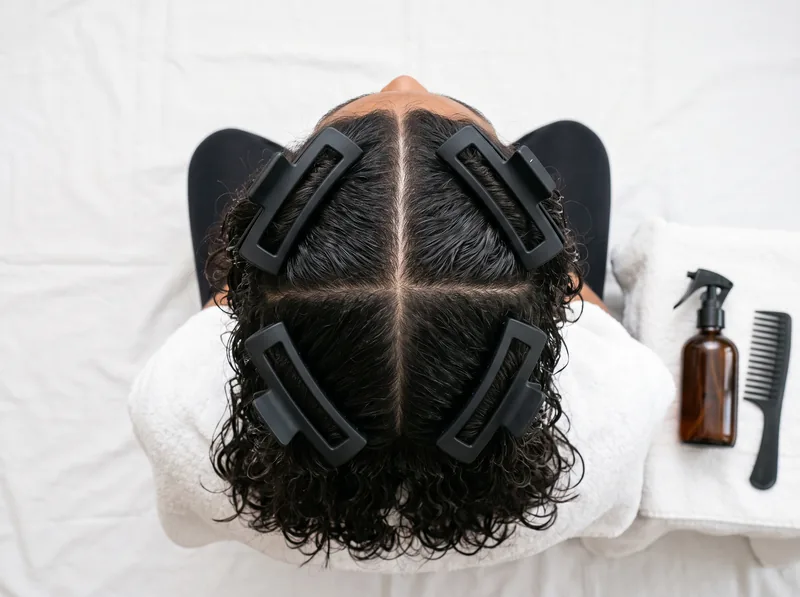 Sectioning hair before detangling prevents re-tangling and makes the process manageable
Detangling Techniques That Minimize Breakage
Technique matters more than the tool. You can use the gentlest brush in the world and still cause breakage if you’re using it wrong. Here’s the process that works.
Start with damp hair, not soaking wet. Hair is most fragile when it’s fully saturated because the water swells the hair shaft and weakens the hydrogen bonds that give hair its strength. Let your hair dry for 5-10 minutes after washing, or mist it lightly if it’s already dry. You want it damp enough to provide slip, but not waterlogged.
Apply a leave-in conditioner or detangling spray. This is non-negotiable. The product provides slip (reduces friction) and helps the comb glide through tangles instead of catching. In hard water climates, look for products with chelating ingredients like EDTA or citric acid that help break down mineral deposits while you detangle.
Section your hair. Divide it into four to six sections using clips. This prevents you from re-tangling hair you’ve already detangled, and it makes the process less overwhelming. Work on one section at a time, keeping the others clipped away.
Start from the ends. Hold the section of hair firmly above where you’re working (this takes tension off the roots and prevents pulling). Use your wide-tooth comb or wet brush to gently work through the last 2-3 inches of hair. Once the ends are smooth, move up another 2-3 inches and repeat. Work your way up to the roots gradually. Never start at the roots and pull down; this pushes tangles toward the ends and creates bigger knots that are harder to undo.
If you hit a stubborn knot, stop pulling. Hold the hair above the knot to protect the roots, then use your fingers to gently separate the strands. You can also apply more detangling spray directly to the knot and let it sit for a minute before trying again. Patience here prevents breakage.
What Makes Tangling Worse (and What to Stop Doing)
Some habits feel productive but actually create more tangles. Here’s what to eliminate.
Brushing dry hair aggressively. Dry brushing raises the cuticle and creates static, which makes hair more prone to tangling. If you must brush dry hair, use a boar bristle brush (which distributes oils and smooths the cuticle) and work gently. Better yet, save detangling for when your hair is damp and conditioned.
Using regular shampoo in hard water. Standard shampoos don’t remove mineral buildup; they can even add to it by leaving behind residues that bind with the minerals already on your hair. This creates a thicker coating and more friction. A study in the Journal of Cosmetic Science found that hard water reduces the cleansing efficiency of shampoos and increases residue deposition. You need a chelating shampoo to actually remove the substrate.
Skipping conditioner or using too little. In hard water, conditioner is your primary defense against friction. It coats the hair shaft, smooths the cuticle, and provides slip. If you’re only using a dime-sized amount, you’re not getting enough coverage. For shoulder-length hair in hard water, you need at least a quarter-sized amount, concentrated on the mid-lengths and ends.
Sleeping with loose, unprotected hair. Friction against your pillowcase creates tangles overnight, especially if your hair is mineral-coated. Braid your hair loosely or tie it in a low, loose bun before bed. Use a silk or satin pillowcase to reduce friction. This one change can cut morning tangles in half.
Waiting too long between washes. If you’re stretching washes to avoid stripping your hair, but your hair is mineral-coated, you’re allowing the buildup to accumulate. More buildup means more friction and more tangles. In hard water climates, washing every 2-3 days with a chelating shampoo is better than washing weekly with a regular shampoo.
Chelating Treatments: The Missing Step in Your Routine
Here’s the part most detangling advice skips: if you don’t remove the mineral buildup, you’re just managing symptoms. The tangles will keep coming back because the rough, friction-heavy coating is still there.
Chelating shampoos contain ingredients (EDTA, citric acid, phytic acid) that bind to mineral ions and allow them to be rinsed away. Unlike clarifying shampoos, which remove oils and product buildup, chelating shampoos specifically target the calcium and magnesium deposits that hard water leaves behind. This restores the smooth surface of your hair shaft and dramatically reduces friction.
How often you need to chelate depends on your water hardness and hair type. In the Gulf, where water hardness is extreme, most women benefit from chelating once a week. If your hair is fine or gets oily quickly, you might chelate every wash. If your hair is thick, coarse, or very dry, once a week is enough.
After chelating, your hair will feel different. Lighter. Softer. Detangling will be noticeably easier because you’ve removed the substrate causing the friction. This is the difference between fighting your hair and working with it.
When to Seek Professional Help
If you’ve addressed mineral buildup, changed your detangling technique, and your hair is still tangling excessively, something else is happening. Severe tangling can be a sign of underlying hair damage, scalp conditions, or even nutritional deficiencies that affect hair structure.
Matted hair that won’t respond to gentle detangling may need professional intervention. A trichologist or experienced hairstylist can assess the condition of your hair and scalp, identify whether the tangling is due to damage, buildup, or a medical issue, and recommend targeted treatments.
Persistent scalp issues like flaking, itching, or inflammation can also contribute to tangling by changeing the hair growth cycle and weakening new hair as it emerges. If your scalp is uncomfortable, address that first. Healthy hair starts with a healthy scalp.
References
- Effect of hard water on hair - International Journal of Trichology
- Tips for healthy hair - American Academy of Dermatology
- Hard water effects on surfactant systems - Journal of Cosmetic Science
- Hair care and styling practices - Cleveland Clinic